Where to Stay in Japan: Accommodation Guide and Budget Tips
This guide is part of our Japan Travel Guide. Prices, rules and opening details can change, so confirm important details with the official provider before you book.
Quick answer: For a first trip to Japan, stay in a clean, well-reviewed hotel close to a train or subway station, and add one night in a traditional ryokan with a hot spring bath for the experience. In Tokyo, Shinjuku is the easiest base for first-time visitors. In Kyoto, stay near Kyoto Station or in Gion. In Osaka, Namba is the most convenient. Business hotels give the best value, capsule hotels and hostels are cheapest, and apartments suit families and long stays. Last updated 11 October 2026.
Key takeaways
- Location matters more than hotel size. A room within a short walk of a station saves time and money every day.
- Japanese hotel rooms are small but very clean. Check bed size and room size before you book.
- A ryokan is worth one night, but book it well ahead and send food requests early.
- Book months ahead for cherry blossom season (late March to early April), autumn leaves (November) and Golden Week (late April to early May).
- Use only legally registered apartments and check cancellation rules, since plans often change.
- Foreign guests must show their passport at check-in, so keep it handy.
Types of accommodation in Japan
Japan has a wider range of places to stay than most countries, and each type suits a different traveller.

| Type | Best for | Watch out for |
|---|---|---|
| Hotel | Families, couples, first-timers | Smaller rooms than you may expect |
| Business hotel | Solo travellers, short stays, value | Compact rooms, little luggage space |
| Ryokan | One cultural night, hot springs | Fixed meal times, advance booking |
| Capsule hotel | Solo budget travellers, one night | Shared bathrooms, limited privacy |
| Hostel | Backpackers, meeting people | Dorm noise, shared spaces |
| Apartment | Families, groups, long stays | Registration, house rules, key pickup |
Hotels
International chains, boutique hotels and luxury hotels are the easiest choice for a first visit. They usually have private bathrooms, air conditioning, Wi-Fi, daily housekeeping and staff who speak some English in tourist areas. The main trade-off is room size, which is smaller than in many countries, especially in Tokyo and Osaka.
Business hotels
Business hotels are a Japanese speciality. Rooms are compact but include a bed, private bathroom, desk, television, small fridge and Wi-Fi. They are often right next to a train station and offer excellent value, so they suit solo travellers, couples and short stays. If you travel with big suitcases, check the room size first, because there may not be space to open two cases at once.
Ryokan (traditional inns)
A ryokan is a traditional Japanese inn. You usually sleep on a futon on tatami mats, wear a yukata (a light cotton robe), eat a multi-course dinner called kaiseki and a Japanese breakfast, and relax in an onsen, which is a hot spring bath. Ryokans are best in Hakone, Kyoto, Kinosaki Onsen and other hot spring towns. One night is enough for most visitors, and it is worth choosing a place with a private or small shared bath if you are not comfortable with public bathing.
Capsule hotels
Capsule hotels have small sleeping pods with a bed, light and curtain. Lockers, bathrooms and lounges are shared, and many are separated by gender. They are cheap, clean and an interesting experience for one night, but they are not ideal if you want privacy, carry a lot of luggage or have a late-night schedule that might disturb others.
Hostels
Hostels suit backpackers and solo travellers who want to meet people. Many have dorm beds and private rooms, shared kitchens, lounges and tours. Modern hostels in Japan are clean and well run, and some are designed more like boutique stays.
Apartments and vacation rentals
Apartments give you space, a kitchen and sometimes a washing machine, so they work well for families, groups and longer stays. Japan requires short-term rentals to be registered, so book only listings that show a valid registration number, read the house rules about noise and rubbish, and check how you will get the key.
Best areas to stay in Tokyo
Tokyo is huge, and the best base depends on what you want. All of the areas below are on major train lines.
| Area | Best for | Good to know |
|---|---|---|
| Shinjuku | First-time visitors, transport, nightlife | Busy station, very well connected |
| Shibuya | Young travellers, fashion, restaurants | Lively and crowded at night |
| Asakusa | Temples, traditional feel, budget stays | Further from the west side of the city |
| Ginza | Luxury shopping, fine dining | Higher prices |
| Ueno | Museums, parks, families, affordable hotels | Good for airport trains |
For a first visit, Shinjuku is hard to beat for transport links, food and shopping. If you want a quieter and more traditional feel, Asakusa and Ueno are good budget-friendly options, though they are further from the busy areas on the west side.
Best areas to stay in Kyoto
- Kyoto Station area: the most convenient for trains, day trips to Nara and Osaka, and families. It is not the most atmospheric, but it saves time.
- Gion: the best choice if you want historic streets, tea houses and evening atmosphere. Rooms are often small and prices are higher.
- Kawaramachi and Shijo: central, with shops and restaurants, and a good all-round base.
- Arashiyama: best for nature, quiet mornings and luxury ryokans, but further from the city centre and quieter at night.
Best areas to stay in Osaka
- Namba: the most popular for first-time visitors, with food, shopping and nightlife close by.
- Umeda: good for business travellers, luxury hotels and transport connections.
- Shin-Osaka: best if you are arriving or leaving by shinkansen, but it is less lively in the evening.
How many nights should you stay?
The numbers below are a good starting point for a first trip. You can compress them if your time is short.
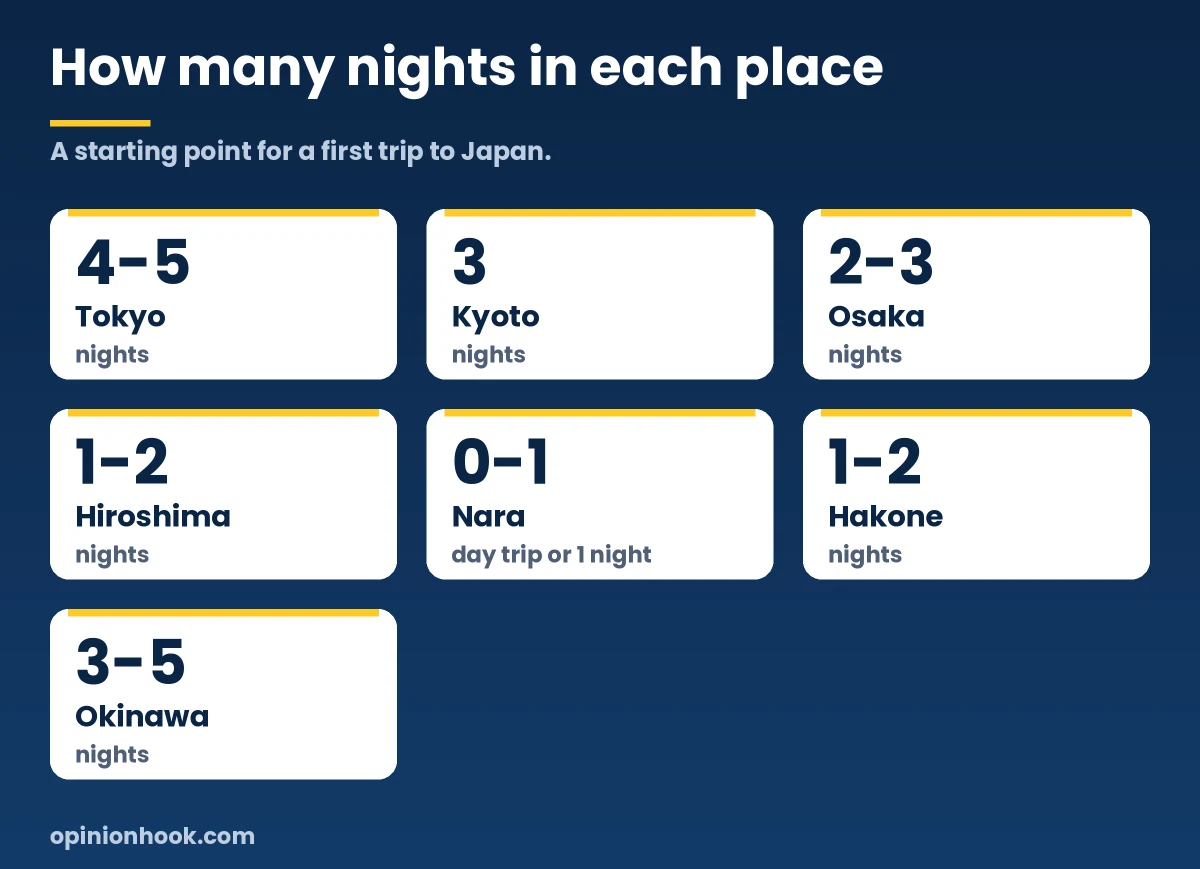
| City | Recommended stay |
|---|---|
| Tokyo | 4 to 5 nights |
| Kyoto | 3 nights |
| Osaka | 2 to 3 nights |
| Hiroshima | 1 to 2 nights |
| Nara | Day trip or 1 night |
| Hakone | 1 to 2 nights |
| Okinawa | 3 to 5 nights |
If you have limited time, base yourself in Kyoto or Osaka for day trips to Nara, rather than moving hotels every night. Each move costs half a day. For detailed routes, read our Japan itineraries for 3 to 14 days and the guide to getting around Japan.
Ryokan and onsen etiquette for first-timers
A few simple rules make a ryokan stay easier.
- Remove your shoes at the entrance and use the slippers provided. Take slippers off before stepping on tatami.
- Wear the yukata with the left side over the right. The reverse is used for the dead.
- Wash and rinse your body fully before getting into the onsen. Swimsuits are not worn, and small towels stay out of the water.
- Some onsen do not allow visible tattoos. Check the policy before you book if this affects you.
- Dinner and breakfast are usually served at fixed times, so tell the ryokan if you will be late.
- If you are vegetarian or have allergies, send the request at booking, because kaiseki menus are set in advance. See our Japanese food guide for more.
Our guide to Japanese culture and etiquette covers the wider rules.
Booking tips that save money and stress
- Book early for busy seasons. Cherry blossom, autumn colours, Golden Week and Obon in mid-August fill up fast and prices rise.
- Stay near a station. A cheaper hotel 25 minutes from the line often costs more in time and fares.
- Check what is included. Look at breakfast, laundry, luggage storage and late check-in.
- Check bed and room size. A semi-double bed is smaller than a standard double.
- Read recent reviews. Look for comments on noise, cleanliness and distance to the station.
- Know the cancellation terms. Choose a free-cancellation rate if your plans may change.
- Allow for local taxes. Some cities charge a small lodging tax per night, often paid at check-in.
- Use luggage forwarding. Japan has a reliable service that sends bags ahead to your next hotel, so you can travel light on trains.
Our comparison of hotel booking platforms can help you choose where to book.
Accommodation budget guide
Prices change by city, season and the exchange rate, so use this as a comparison of levels, not as a price list. Always check the current rate on the booking site.
| Level | Typical options | Best for |
|---|---|---|
| Budget | Hostels, capsule hotels, business hotels | Solo travellers and short stays |
| Mid-range | Standard hotels, vacation rentals | Couples and families |
| Luxury | Five-star hotels, premium ryokans, resorts | Special trips and honeymoons |
For trip costs as a whole, see our Japan trip budget guide.
Our suggestion for a first trip
Spend most nights in a convenient hotel near a station, and treat yourself to one night in a ryokan with an onsen. This gives you both modern comfort and a traditional experience. If you travel with family, mix in one apartment night where you can do laundry. Check the best time to visit Japan before you fix your dates.
Frequently asked questions
Where should I stay in Japan for the first time?
Stay in a hotel near a train station. In Tokyo, Shinjuku is the easiest base. In Kyoto, stay near Kyoto Station or in Gion. In Osaka, Namba is the most convenient.
Is a ryokan worth it?
Yes, for at least one night. You get tatami rooms, a kaiseki dinner and an onsen bath, which are hard to find in a normal hotel. Book early and send food requests when you book.
What are business hotels in Japan?
Business hotels have compact, clean rooms with a private bathroom and a desk, and they are usually close to train stations. They offer good value for solo travellers and short stays.
Are capsule hotels safe for tourists?
Yes. They are clean and well run, and many are separated by gender. They are best for a single night and for travellers with light luggage.
How many nights should I spend in Tokyo?
Four to five nights is a good number for a first visit, and three to four if your time is short.
When should I book hotels for cherry blossom season?
Book several months ahead, since rooms in Tokyo and Kyoto fill quickly from late March to early April, and prices rise.
Are Airbnb-style apartments allowed in Japan?
Short-term rentals are allowed only if they are properly registered. Book listings that show a valid registration number and read the house rules.
Do I need my passport at a Japanese hotel?
Yes. Foreign guests are asked to show their passport at check-in, and the hotel records the details.
Sources and how we checked
This guide is general information. Prices, taxes and rules change, so confirm details with the booking provider before you travel. Last updated 11 October 2026.
Related Guides
- Vietnam vs. Thailand for Budget Travel: Where Your Money Goes Further
- Japan SIM Cards, Internet, Currency and Payments: A Traveller Guide
- Best Places to Visit in Japan for First-Time Travelers (2026 Guide)
Browse all of our Japan Travel guides.

Varinder Kaur is from Amritsar, India. She has traveled to well-known places across India, including Darjeeling, and to a few countries abroad, and shares travel experiences and practical tips for travelers through OpinionHook.




5 Comments
Comments are closed.