Japan SIM Cards, Internet, Currency and Payments: A Traveller Guide
SIM cards, eSIM, cash and cards are the four things most visitors worry about before landing in Japan. The good news is that all four are easier than they look. Japan has fast mobile data, plenty of ATMs that accept foreign cards, and a payment culture that still leans on cash more than you might expect. This guide explains each option in plain language, so you can decide what to set up at home and what to leave until you arrive.
This is general travel information based on how things commonly work for visitors. Prices, plans and card rules change, so always confirm the latest details with your provider, your bank and the official sources listed at the end.
Quick Answer: What Should You Set Up Before You Fly?
For most first-time visitors, the simplest setup is an eSIM for data, one Visa or Mastercard card that works abroad, and some yen in cash. Add a pocket Wi-Fi only if you are travelling in a group and want to share one connection. If your phone is not eSIM-compatible, a physical SIM or pocket Wi-Fi is the fallback.
Key Takeaways
- An eSIM is usually the easiest way to get data in Japan, because you can install it before you leave home.
- Cash is still useful. Small restaurants, shrines, local buses and some shops may not take cards.
- Visa and Mastercard are the most widely accepted international cards. Check whether your card network is accepted before you rely on it.
- Tipping is not expected in Japan.
- Japan uses 100 V power and flat two-pin plugs, so check your chargers.
Staying Connected in Japan
Good mobile data matters more in Japan than in many countries. You will use it for maps, train routes, translation, restaurant searches and booking changes. Street names are often hard to read for visitors, and a working map can save you a lot of stress. There are four main ways to get online.
eSIM
An eSIM is a digital SIM that you install on your phone by scanning a QR code or tapping a link. There is no tiny card to swap and no shop to visit. You can buy a plan online, install it at home, and switch it on when you land.
- **Best for:** solo travellers, couples and anyone with a newer phone.
- **Good:** quick setup, no pickup, and your normal SIM can stay in the phone.
- **Watch out:** your phone must support eSIM and be unlocked. Check this before you buy. Many plans are data-only, so you will not get a Japanese phone number.
A useful habit is to install the eSIM while you still have home Wi-Fi, then turn it on only after you land. That way you are not stuck trying to download a QR code at the airport.
Physical SIM Card
A physical SIM is a small card you put into your phone. Visitors can usually buy one online for pickup or delivery, or sometimes at airport counters and electronics stores. It works well for phones that do not support eSIM.
- **Best for:** older phones, or travellers who like a physical backup.
- **Good:** simple to use once it is in the phone.
- **Watch out:** you must remove your home SIM, so keep it safe. If you need your home SIM for banking codes, think about this before you swap it out.
Pocket Wi-Fi
A pocket Wi-Fi is a small portable router. You rent it, carry it, and connect your phone and other devices to it. Several people can share one device.
- **Best for:** families and groups who want one shared connection.
- **Good:** one device can cover a few phones, a tablet and a laptop.
- **Watch out:** you need to charge it, carry it and return it before you leave. If it runs out of battery, everyone loses their connection.
Free Public Wi-Fi
Japan has free Wi-Fi at many airports, stations, hotels, convenience stores and tourist spots. It is handy as a top-up, but it should not be your only plan. Connections can be slow, may need registration, and drop out when you move around. Avoid logging in to banking apps on public networks you do not trust.
Will Your Indian SIM Work in Japan?
It can, through international roaming, but only if you have activated a roaming pack with your operator. Roaming is often more expensive than a local eSIM, so compare before you decide. The real reason many travellers keep their Indian number active is OTPs. Banks and apps often send one-time passwords by SMS, and you may need them while you are away. Check with your bank and operator before you leave, so you know how you will receive those codes.
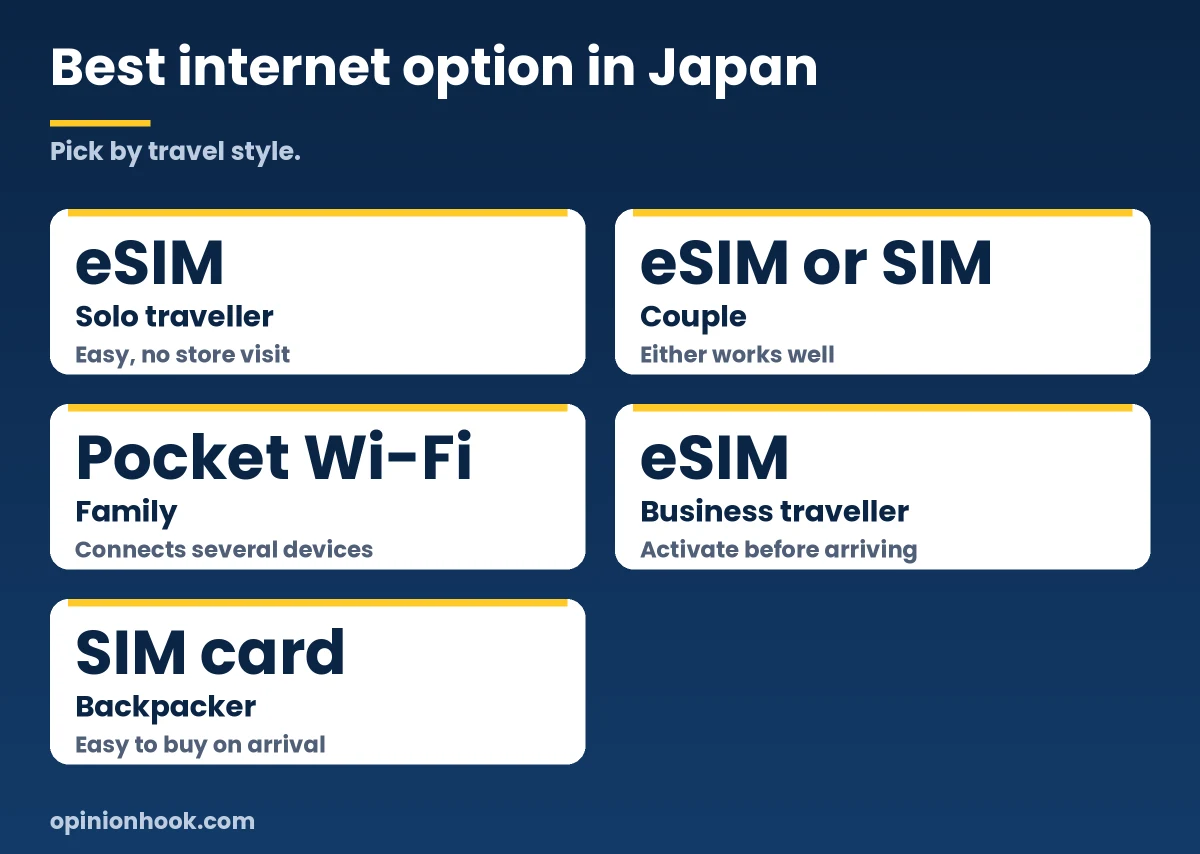
Which Internet Option Is Best?
| Option | Best for | Main advantage | Main drawback |
|---|---|---|---|
| eSIM | Solo travellers, couples | Install before you fly | Phone must support eSIM |
| Physical SIM | Older phones | Works on most unlocked phones | Home SIM must be swapped out |
| Pocket Wi-Fi | Groups and families | One shared connection | Must charge and return it |
| Free Wi-Fi | Backup only | No cost | Slow and unreliable on the move |
| Indian roaming | Keeping your number active | Keeps OTPs working | Can cost more |
If you are unsure, choose an eSIM and keep roaming switched off. Then ask your bank how you will get OTPs.
Currency in Japan
Japan uses the yen, written as JPY or with the symbol ¥. Banknotes come in 1,000, 5,000 and 10,000 yen. Japan began issuing redesigned banknotes in July 2024, so you may see both the new and older designs. Both are valid. Coins come in 1, 5, 10, 50, 100 and 500 yen. The 500 yen coin is the largest, and the 5 and 50 yen coins have a hole in the middle.
There are no big coins you cannot spend, but you will collect a lot of small ones. Many travellers use them for vending machines, lockers and small shops, so keep them handy rather than burying them in a bag.
Cash vs. Card: What Do You Really Need?
Japan is much more card-friendly than it used to be, especially in cities, department stores, hotels and chain restaurants. Even so, cash is still common in small places. Expect to need it at:
- small family-run restaurants and ramen counters
- some temples, shrines and entry gates
- local buses and some rural trains
- market stalls and small shops
- vending machines and coin lockers
A sensible approach is to carry a card as your main payment method and keep a modest amount of cash for these situations. You do not need to carry a huge amount, because ATMs are easy to find.
Which Cards Work Best?
Visa and Mastercard are the most widely accepted. Some places also take American Express, JCB or other networks. If you hold a RuPay card, check with your bank whether it works in Japan before you travel, rather than assuming it will. It is a good idea to carry at least one Visa or Mastercard as a backup.
Before you leave, tell your bank you are travelling, confirm that international transactions are switched on, and note the number to call if your card is lost.
Pay in Yen
Some card machines and ATMs offer to charge you in your home currency instead of yen. This is often called dynamic currency conversion. The exchange rate it uses is usually less favourable than the one your own card provider applies. In most cases, choosing to pay in yen is the better option. Check your card’s foreign transaction fee before you go, as fees vary a lot between banks.
Using ATMs
Many ATMs in Japan only work with Japanese bank cards, so do not try the first one you see. The most reliable places for visitors are:
- **7-Eleven ATMs:** found across the country, open long hours, and set up for many foreign cards, with English instructions.
- **Post office ATMs:** commonly work with international cards, but follow post office opening hours.
- **Major bank ATMs and airports:** often help, particularly in big cities.
Withdraw what you expect to need for a few days instead of large amounts. Your bank may charge a fee, and the ATM operator may add its own. Check both before you go.
Currency Exchange
You can exchange money at airports, banks and some exchange counters in big cities. Airports are convenient for a small starter amount, but rates can be less favourable than elsewhere. Compare the rate and any fee before you hand over money. Bring your passport, because exchange counters often ask to see it.
If you want a stress-free start, many travellers carry a small amount of yen from home and withdraw more at a 7-Eleven ATM after they arrive.
Mobile Payments and IC Cards
IC cards such as Suica and Pasmo are rechargeable cards used for trains, buses and many shops and vending machines. They save you from working out fares at each ticket machine. Many visitors use them on phones through a digital wallet, although what is available for foreign visitors can change, so check the latest options before you travel. For train routes and passes, see our [getting around Japan transportation guide](/getting-around-japan-transportation-guide/).
QR-code and wallet payments are also widespread, but many of the popular ones need a Japanese account or number. Do not plan around them as a visitor. Cards, cash and an IC card are the safer trio.
Is Tipping Expected?
No. Tipping is not part of Japanese culture, and leaving money on the table can cause confusion. Service is included. A polite thank-you, such as saying “arigato gozaimasu”, is plenty. For more on local habits, read our [guide to Japanese culture and etiquette for tourists](/japanese-culture-etiquette-for-tourists/).
Power and Chargers
Japan uses 100 V electricity and flat two-pin plugs (Type A). Most modern phone and laptop chargers handle 100 V, but check the label on each charger. If it says something like 100-240 V, you only need a plug adapter. Plugs from India with round pins will not fit without an adapter. A small power bank is also useful, as maps and translation apps drain batteries quickly.
Budgeting Tips
- Decide your daily cash amount, and top it up from an ATM instead of carrying everything at once.
- Keep a card for hotels, trains and bigger purchases.
- Keep coins for lockers, vending machines and small shops.
- Track what you spend each evening, so small costs do not add up unnoticed.
For a full picture of what a trip can cost, see our [Japan trip budget guide](/japan-trip-budget-guide-how-much-does-a-trip-to-japan-really-cost/) and our [guide on where to stay in Japan](/where-to-stay-in-japan-accommodation-guide/).
Safety Tips for Money
Japan is generally a low-crime country, but basic care still applies. Our guide on [whether Japan is safe for tourists](/is-japan-safe-for-tourists/) covers this in more detail.
- Keep your cards and cash in different places, so one loss does not leave you stranded.
- Save your bank’s international helpline number offline.
- Do not leave your wallet or phone unattended at restaurants or on trains.
- Use your phone’s lock screen and keep a screenshot of key booking details.
Quick Checklist
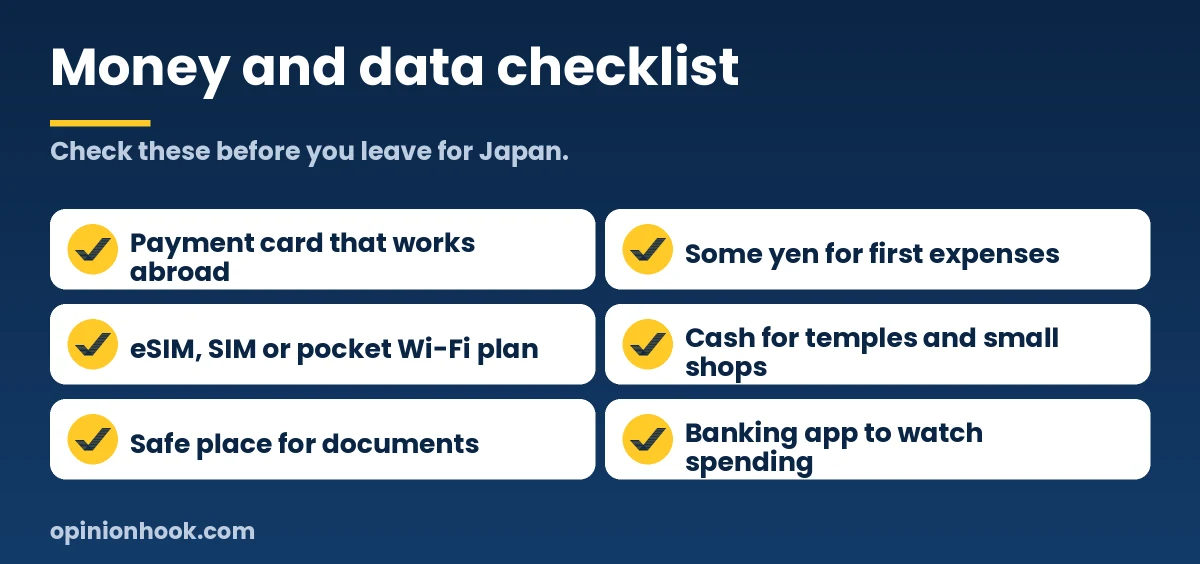
Before you leave home, make sure you have done the following.
- Check that your phone is unlocked and supports eSIM.
- Buy and install your data plan, or arrange a pocket Wi-Fi.
- Ask your bank about OTPs, international use and fees.
- Pack a Visa or Mastercard and a backup card.
- Carry some yen for the first day.
- Check your chargers for 100 V and bring a plug adapter.
Frequently Asked Questions
Is an eSIM the best option for Japan?
For most visitors with a compatible phone, yes. It is quick to set up and works as soon as you land. If your phone does not support eSIM, a physical SIM or pocket Wi-Fi is a good alternative.
Do I need cash in Japan?
Yes, some. Cards are common in cities, but small restaurants, shrines, local buses and vending machines often still prefer cash. Carry a modest amount alongside your card.
Will my Indian card work in Japan?
Visa and Mastercard cards are usually accepted if international use is switched on. For RuPay and other networks, confirm with your bank first, and carry a backup card.
Where can I withdraw cash in Japan?
7-Eleven and post office ATMs are the most dependable for foreign cards. Check any fees with your bank before you go.
Should I pay in yen or my home currency?
Usually yen. Paying in your home currency at the terminal often gives a less favourable rate than your card provider’s own conversion.
Do I need to tip in Japan?
No. Tipping is not expected, and service is included in the price.
Will my Indian chargers work in Japan?
Most modern chargers handle 100 V, but check the label. You will probably need a plug adapter for the flat two-pin sockets.
How will I receive OTPs while I am in Japan?
Talk to your bank and mobile operator before you leave. Options include international roaming on your Indian number or other methods your bank supports. Plan this in advance, so you are not locked out of payments.
Keep Planning Your Japan Trip
Pair this guide with our [transport guide](/getting-around-japan-transportation-guide/), [culture and etiquette guide](/japanese-culture-etiquette-for-tourists/) and [budget guide](/japan-trip-budget-guide-how-much-does-a-trip-to-japan-really-cost/).
Sources
- [https://www.japan.travel/en/](https://www.japan.travel/en/)
- [https://www.japan.travel/en/plan/](https://www.japan.travel/en/plan/)
- [https://www.jnto.go.jp/](https://www.jnto.go.jp/)
Related Guides
- Best Places to Visit in Japan for First-Time Travelers (2026 Guide)
- Japan Itineraries: 3, 5, 7, 10 and 14 Days, Plus a Packing List
- Where to Stay in Japan: Accommodation Guide and Budget Tips
- Japan Tourist Visa Guide (2026): Requirements, Documents and Fees
Browse all of our Japan Travel guides.

Varinder Kaur is from Amritsar, India. She has traveled to well-known places across India, including Darjeeling, and to a few countries abroad, and shares travel experiences and practical tips for travelers through OpinionHook.