
Best Places to Visit in Japan for First-Time Travelers (2026 Guide)
For a first trip to Japan, the best places to visit are Tokyo, Kyoto and Osaka, with Nara, Hiroshima and Miyajima as easy add-ons, and Hakone or the Mount Fuji area if you want mountain views and hot springs. Together they give you a balanced first look at the country: big-city energy, old temples, great food and some nature, all connected by fast, reliable trains.
This guide is written for Indian travellers planning a first trip. It explains what each place is best for, how many days to give it, a simple 10-day route, and the practical things that matter before you go, such as the visa, money, a new departure tax and a change to tax-free shopping coming in November 2026.
You do not need to see everything. A slower trip with fewer cities is usually more enjoyable, and cheaper, than a rushed one.
Key takeaways
- A classic first route is Tokyo, then Kyoto and Osaka, with day trips to Nara and Hiroshima or Miyajima. Add Hakone or the Fuji Five Lakes area if you want Mount Fuji views.
- Ten to fourteen days is comfortable for this route. If you have only a week, pick Tokyo and Kyoto with Osaka or Nara as a day trip.
- Indian passport holders need a visa for Japan. A tourist e-visa route for Indian applicants was reported from 2024; confirm the current process on the official Japanese government site.
- Japan raised its international tourist (departure) tax to 3,000 yen in July 2026. It is built into airline and cruise ticket prices, not paid at the airport.
- From 1 November 2026, tax-free shopping in Japan changes to a refund-based system. You pay the full price at the shop and claim the tax back when you leave.
- A nationwide rail pass is no longer an automatic saving. Add up your actual train trips before you buy.
- Cherry blossom and autumn leaf seasons are beautiful and crowded, so book stays early.
Where to go in Japan on a first trip
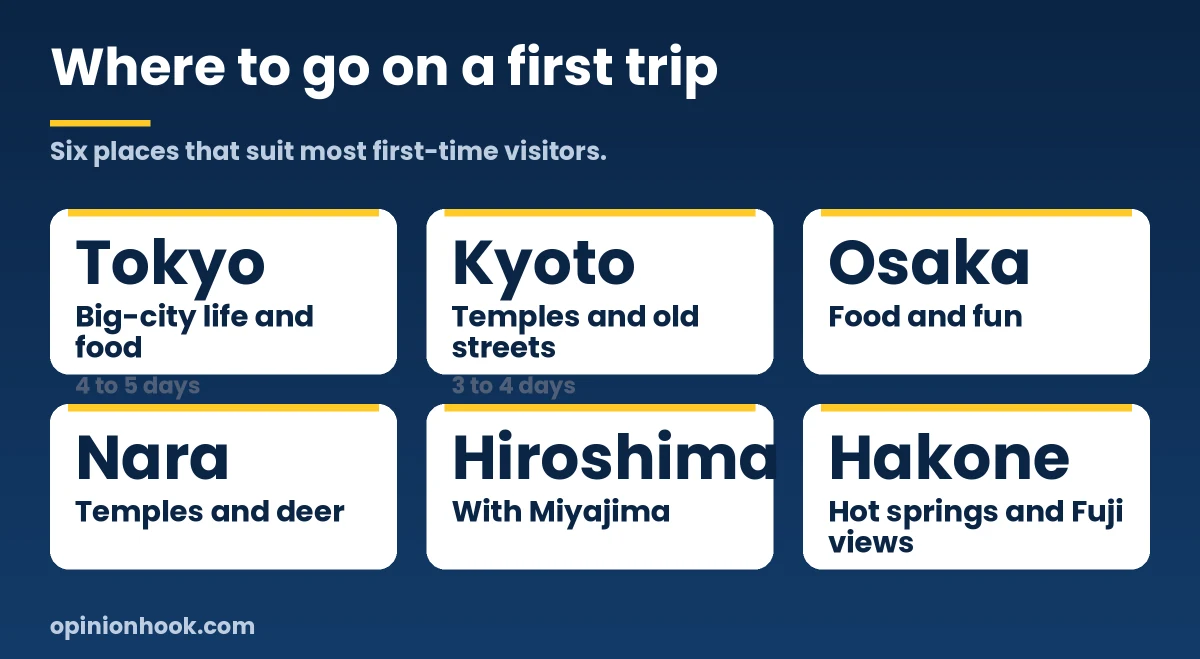
| Place | Best for | Suggested stay |
|---|---|---|
| Tokyo | Big-city life, food, shopping, modern Japan | 4 to 5 days |
| Kyoto | Temples, gardens, traditional streets | 3 to 4 days |
| Osaka | Street food, nightlife, a lively feel | 2 to 3 days |
| Nara | Deer, Todai-ji temple, a calm day trip | Half to 1 day |
| Hiroshima and Miyajima | History, peace memorials, the floating torii | 2 days |
| Hakone | Hot springs, lake views, Fuji views on clear days | 1 to 2 days |
| Fuji Five Lakes | Mount Fuji scenery and photography | 1 to 2 days |
The suggested stays are practical guidelines for a relaxed pace, not rules. Our guide to Japan itineraries for 3, 5, 7, 10 and 14 days shows how to adjust them.
Tokyo: modern Japan
Tokyo is the usual starting point because most international flights arrive here. It is huge, and each area feels like a different city. Plan by neighbourhood to avoid spending your day on trains.
Popular first-timer stops include:
- Senso-ji (Asakusa): Tokyo’s oldest well-known temple area, with a busy shopping street leading to it.
- Shibuya Crossing: The famous crossing is best seen from a nearby viewpoint.
- Meiji Jingu: A quiet forest shrine in the middle of the city.
- Ueno Park: Museums, a pond and open space.
- Akihabara: Electronics, anime and game shops.
- Tsukiji Outer Market: A food market for snacks and breakfast.
- Tokyo Skytree and teamLab Planets: City views and immersive digital art. Check booking rules in advance.
Tip: get a rechargeable IC card such as Suica or PASMO for trains, buses and many shops. Many travellers also find it easier to base themselves near a major station on a main line.
Kyoto: traditional Japan
Kyoto was Japan’s imperial capital for more than a thousand years and still has a large number of temples, shrines, gardens and old wooden streets.
Key places:
- Fushimi Inari Taisha: Thousands of red gates on a hillside path. Go early to avoid crowds.
- Kinkaku-ji (Golden Pavilion): A gold-covered temple beside a pond.
- Kiyomizu-dera: A hillside temple with city views.
- Arashiyama Bamboo Grove: A short walk through tall bamboo; best early in the morning.
- Nishiki Market: A narrow market street with food stalls.
- Gion: A historic district known for traditional wooden buildings and tea houses. Be respectful and do not chase or block people who live and work there.
Be aware that Kyoto raised its accommodation tax from March 2026, with the rate depending on the room price per night. It is charged per person per night, so check it when you compare stays.
Osaka: food and fun
Osaka is known for street food, a lively evening scene and a friendly, relaxed feel compared with Tokyo. Dotonbori is the main food-and-lights area, Osaka Castle is a good half-day, and Kuromon Market and Shinsekai are good for snacks. Local favourites include takoyaki, okonomiyaki and kushikatsu. If you travel with children or enjoy theme parks, Universal Studios Japan is a big draw, and popular areas may need timed entry, so check the official site.
Osaka is a good base for day trips to Kyoto, Nara and Himeji because trains run often.
Nara: temples and deer
Nara is an easy half-day or full-day trip from Kyoto or Osaka. It was Japan’s first permanent capital and has several UNESCO World Heritage sites. Todai-ji houses a giant bronze Buddha inside one of the world’s largest wooden buildings. The deer in Nara Park are wild animals. Do not tease them, and follow the park’s signs on feeding, because deer can bite or butt when they are excited.
Hiroshima and Miyajima
Hiroshima is a modern city that carries an important history. The Peace Memorial Park, the Atomic Bomb Dome and the Peace Memorial Museum are the main sights, and many visitors find the visit moving. Allow time and keep a respectful tone. A short ferry ride away is Miyajima, known for the Itsukushima Shrine and its famous torii gate, plus walking trails and local snacks.
Hakone and Mount Fuji
Hakone is a hot-spring and mountain area that is easy to reach from Tokyo. It is popular for lake cruises, ropeways, art museums and stays at ryokan, which are traditional inns. Mount Fuji views depend on weather, and clear mornings and cooler months are generally better. Do not plan your whole trip around one view; treat it as a bonus.
The Fuji Five Lakes area, with Lake Kawaguchiko as the best-known base, is another way to see the mountain.
If you want to climb Mount Fuji
Climbing is only possible in a short summer season, and rules have become stricter. For 2026, the official Yamanashi (Yoshida trail) page listed a season from 1 July to 10 September, a hiking fee of 4,000 yen per person, a daily limit of 4,000 climbers, and a gate that closes in the afternoon. Reservations are needed, and mountain huts are booked separately. These details can change each year, so check the official Mount Fuji climbing website before you plan for 2027.
When to go
Japan has four distinct seasons, and each has its charm. Our month-by-month guide to the best time to visit Japan has more detail. In short:
- Spring (March to May): Cherry blossoms and mild weather. Very popular, so book early. Bloom dates change every year.
- Summer (June to August): Festivals and fireworks, but hot and humid. A rainy period usually comes in early summer.
- Autumn (September to November): Cooler weather and autumn leaves. Popular, and a good time for walking.
- Winter (December to February): Clear skies in many areas, hot springs, and snow in the north and mountains.
For Indian travellers, school holidays and festival periods may also affect flight prices, so compare dates.
A simple 10-day first-timer route
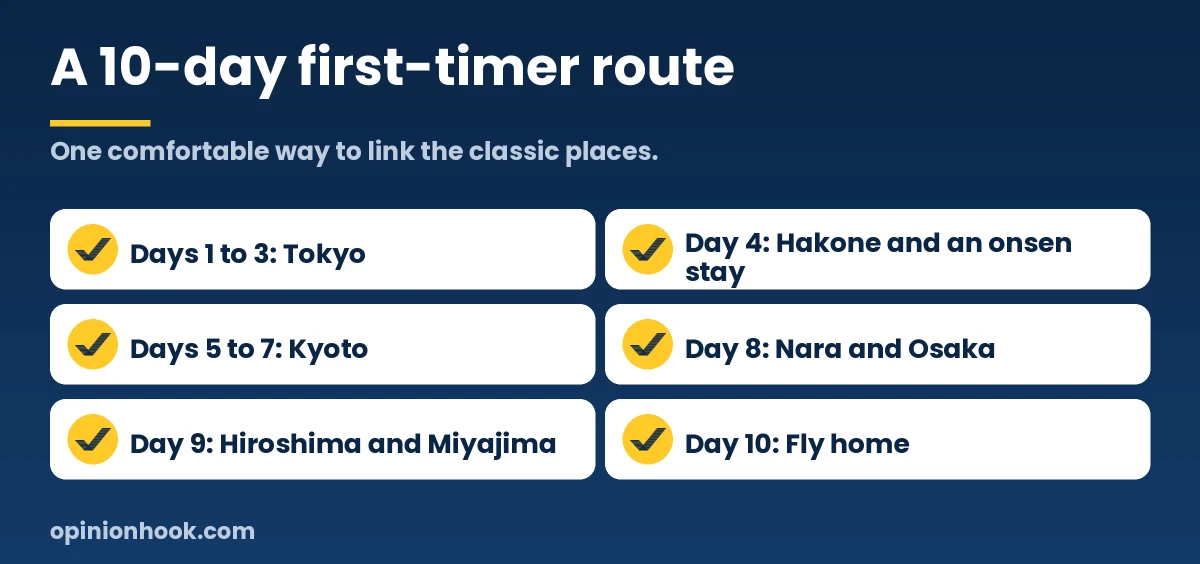
| Day | Where | Ideas |
|---|---|---|
| 1 | Tokyo | Arrive, settle in, short local walk |
| 2 | Tokyo | Asakusa, Ueno, Skytree |
| 3 | Tokyo | Shibuya, Meiji Jingu, Akihabara or teamLab |
| 4 | Hakone | Lake, ropeway, onsen stay |
| 5 | Kyoto | Travel in the morning, Gion in the evening |
| 6 | Kyoto | Fushimi Inari, Kiyomizu-dera, Nishiki Market |
| 7 | Kyoto | Arashiyama and Kinkaku-ji |
| 8 | Nara and Osaka | Nara in the morning, Osaka in the evening |
| 9 | Hiroshima and Miyajima | Day trip by bullet train from Osaka if you are short of time |
| 10 | Osaka or Tokyo | Fly home or return to your departure airport |
If this feels too fast, drop Hakone or the Hiroshima day trip.
Shorter and longer versions of the route
Not everyone has ten days. Here is how to adjust the same plan so it still feels comfortable.
| Trip length | Suggested route | What to skip |
|---|---|---|
| 5 to 6 days | Tokyo (3 nights) and Kyoto (2 nights) | Osaka, Hiroshima, Hakone |
| 7 to 8 days | Tokyo (3 nights), Kyoto (3 nights), Osaka or Nara as day trips | Hiroshima, Fuji area |
| 10 days | The route above | Fuji Five Lakes |
| 14 days | The 10-day route plus a slower pace, Fuji Five Lakes, and one extra region such as Kanazawa, Hokkaido or Kyushu | Nothing, but keep rest days |
If your flights allow, consider flying into one city and out of another, for example into Tokyo and out of Osaka. This is called an open-jaw ticket. It saves you a full day of backtracking by train, but compare the total fare with a return ticket first.
How to choose your base cities
- Stay in or near a major train station, so luggage and day trips are easier.
- Use Kyoto or Osaka as a base for Nara. Use Osaka or Hiroshima as a base for Miyajima.
- Send large bags between cities with a luggage-forwarding service, if your hotel offers it, so you can travel light on trains.
- Book at least the first and last nights before you fly, and keep the middle part flexible if you can.
A first-day plan after a long flight
Flights from India usually reach Japan after a long journey and a time difference of 3.5 hours (Japan is on UTC+9, India on UTC+5:30). Keep your first afternoon light: check in, take a short walk, eat something simple, and get to bed on local time. Starting with a busy day often leaves you tired for the next two. For more on planning your stay, see our guide to where to stay in Japan.
Practical tips for Indian travellers
Visa
Indian passport holders need a visa for tourism. Reports from 2025 say Japan offers a tourist e-visa for Indian applicants through the official process, with documents such as a passport with enough validity, financial proof, an itinerary and travel insurance. Fees and documents change, so use our Japan tourist visa guide for 2026 and confirm on the official Japanese government website or the visa application centre.
Costs
Japan can be affordable if you plan well: business hotels, convenience-store meals, set-lunch restaurants and regional passes all help. We have not printed daily cost tables because prices vary by season and exchange rate. See our Japan trip budget guide for a full breakdown of the main costs.
Departure tax
Japan tripled its international tourist tax to 3,000 yen, which applies to bookings from 1 July 2026. It is included in airline and cruise ticket prices, so you do not pay it at the airport.
Shopping
Tax-free shopping changes on 1 November 2026. You will pay the full tax-inclusive price at the shop and claim the 10 percent consumption tax back at the airport before leaving. Keep your passport, receipts and the items together, because customs may ask to see them. A minimum purchase of 5,000 yen applies per the reported rules, and there is a time limit for leaving Japan after you buy.
Food
If you are vegetarian, note that many soups and sauces use fish-based stock, which is not always obvious from the menu. Our Japanese food guide explains how to ask and what to look for. Carry some snacks for travel days.
Money and connectivity
Cards are accepted widely in cities, but some small shops, temples and rural places prefer cash. Keep some yen. For internet, compare an eSIM, a local SIM and pocket Wi-Fi in our guide to SIM cards, internet and payments in Japan.
Getting around
Trains are punctual and easy, but stations can be large and signage can be confusing at first. Read our Japan transportation guide before you book rail passes.
Is a Japan Rail Pass worth it?
Not always. The nationwide pass became much more expensive after a price rise in 2023, so it only pays off if you take many long-distance trips in a short period. For a route like Tokyo, Kyoto, Osaka and Hiroshima, price the individual bullet-train tickets, compare regional passes, and then decide. The official site lists current pass prices.
Common first-timer mistakes
- Trying to cover too much. Spend at least two nights in each base.
- Underestimating walking. Big stations and temple sites involve a lot of walking. Wear comfortable shoes.
- Ignoring etiquette. Keep your voice low on trains, queue properly, and carry your rubbish until you find a bin. See our post on Japanese culture and etiquette for tourists.
- Not booking popular sights. Some attractions need timed tickets, especially in peak seasons.
- Skipping safety basics. Japan is generally considered safe, but earthquakes and typhoons can occur. Our guide Is Japan safe for tourists? covers what to do.
What to pack
- Comfortable walking shoes
- A small bag or backpack
- Universal plug adapter (Japan uses two-flat-pin plugs, type A)
- Portable charger
- Weather-appropriate clothing and a compact umbrella
- Prescription medicines with a doctor’s note where needed
- Passport, visa documents and travel insurance
- Some yen
Frequently asked questions
What are the best places to visit in Japan for a first trip?
Tokyo, Kyoto and Osaka are the usual core, with Nara, Hiroshima and Miyajima as easy additions. Add Hakone or the Fuji area if you want mountain scenery and hot springs.
How many days do I need for Japan?
Ten to fourteen days is comfortable for the classic route. A week works if you focus on Tokyo and Kyoto, with Osaka or Nara as day trips.
Do Indians need a visa for Japan?
Yes. Indian passport holders need a visa for tourism. A tourist e-visa route for Indian applicants was reported from 2024. Confirm the current rules and fees on the official site.
What is the best month to visit Japan?
March to May and October to November are popular for mild weather and scenery, but they are also crowded. Shoulder weeks just before or after the peaks can be easier on budgets.
Can I visit Japan without speaking Japanese?
Yes. Major cities and tourist areas have signs in English and good transport information. A translation app and a few polite phrases help.
Final thoughts
For a first trip, choose a few places and give them time. Tokyo, Kyoto and Osaka cover the main contrasts, and one or two day trips add variety. Check visa and money rules early, book popular stays in advance, and leave space for unplanned walks and meals.
How we checked these facts
We checked the Mount Fuji climbing rules against the official Yamanashi climbing site, the departure tax and Japan’s tax-free shopping change against recent news and travel reports, Kyoto’s accommodation tax against a news report, and the Japan e-visa details against a 2025 news article. Descriptions of the places are general travel knowledge. We have not published price tables or itineraries as guaranteed costs. Visa rules, fees and attraction rules change, so confirm them on official sites.
Sources
- Japan National Tourism Organization (official travel guide)
- Official Mt. Fuji climbing website: Yamanashi notice for 2026
- Business Today: Japan departure tax raised to 3,000 yen
- Japan Travel: tax-free shopping changes in 2026
- Time Out: Kyoto accommodation tax increase
- Business Today: Japan tourist e-visas for Indians (April 2025)
- Japan Rail Pass official site
Related Guides
- Japan Itineraries: 3, 5, 7, 10 and 14 Days, Plus a Packing List
- Is Japan Safe for Tourists? A Practical Safety Guide
- Japan SIM Cards, Internet, Currency and Payments: A Traveller Guide
- Where to Stay in Japan: Accommodation Guide and Budget Tips
Browse all of our Japan Travel guides.

Varinder Kaur is from Amritsar, India. She has traveled to well-known places across India, including Darjeeling, and to a few countries abroad, and shares travel experiences and practical tips for travelers through OpinionHook.





2 Comments
Comments are closed.