Is Japan Safe for Tourists? A Practical Safety Guide
This guide is part of our Japan Travel Guide. Prices, rules and opening details can change, so confirm important details with the official provider before you book.
Quick answer: Yes, Japan is one of the safest countries for tourists. Violent crime against visitors is rare, public transport is reliable, streets in cities are busy and well lit late into the evening, and lost items are often handed in to the police. The real risks are small ones: pickpocketing in very crowded places, overpriced bars in a few nightlife areas, and natural events such as earthquakes, typhoons and summer heat. A little planning covers almost all of them. Last updated 11 October 2026.
Key takeaways
- Japan has a very low rate of violent crime, and it is safe for solo travellers, women, families and first-time visitors.
- Save the emergency numbers before you fly: 110 for police, 119 for fire and ambulance.
- The most common problems for tourists are bar overcharging and drink-related scams in nightlife districts, not street violence.
- Earthquakes and typhoons are real, but Japan has strong building rules and a good warning system. Know what to do and follow staff instructions.
- Buy travel insurance. Medical care is excellent, but visitors usually pay at the clinic and claim later.
- Carry your passport. Foreign visitors are expected to carry it in Japan.
How safe is Japan, really?
Japan is widely seen as one of the safest destinations in the world. You will notice it in daily life: people queue calmly at stations, shops are relaxed about bags left on the floor, and families travel on trains with young children without fuss. There are small police boxes called koban in many neighbourhoods, and officers there help with directions and lost property as well as crime.
Safe does not mean zero risk. Pickpockets and bag thieves do exist around busy stations, tourist sights and festivals. Bicycles get stolen. Phones get left on trains. The pattern is that most problems are the ordinary kind that happen in any big city, and most are avoidable if you keep your bag closed, your phone in a front pocket and your passport and spare card in the hotel safe.
The second point is that some things which are safe in Japan feel odd to visitors. Lost wallets and phones are often returned, so if you lose something, do not give up. Go to the nearest koban or station office, describe the item and give your hotel name.
Emergency numbers to save before you land
Put these in your phone contacts under clear names. The numbers are free to call, and they work from any phone.
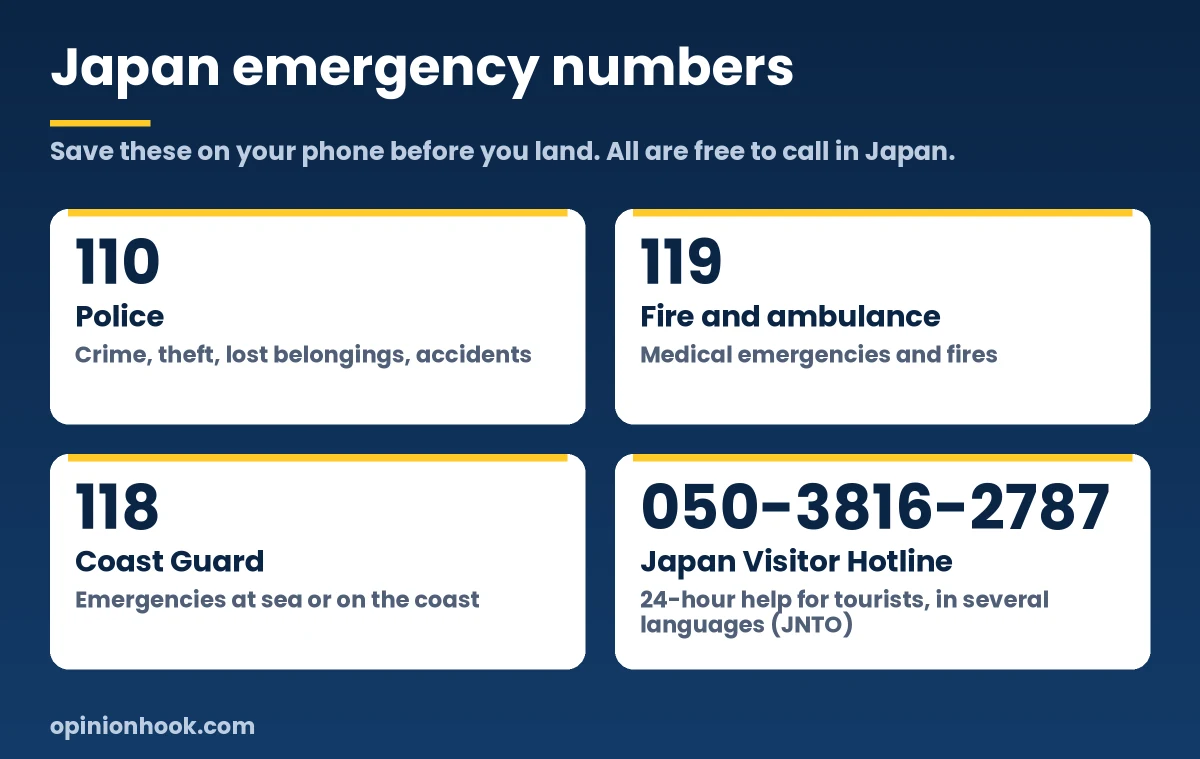
When you call, speak slowly and keep it simple. Say what happened, where you are and, if possible, the name of the nearest station or landmark. If your Japanese is limited, ask a hotel staff member or a nearby shopkeeper to help you with the call. The Japan Visitor Hotline run by the Japan National Tourism Organization (JNTO) can help with travel questions and emergencies in English and other languages.
It is also smart to keep contact details for your own embassy. Indian travellers can note the details of the Embassy of India in Tokyo and the Consulate General of India in Osaka-Kobe on the official websites before the trip. Keep photos of your passport and visa pages in your phone and in cloud storage, in case the original is lost.
Safety tips for different types of traveller
Solo travellers
Japan is a good place to travel alone. Restaurants have counter seating for one, public transport is simple, and people are polite to strangers. A few habits still help:
- Share your itinerary with family or a friend and message them each evening.
- Keep your phone charged and carry a small power bank.
- Save your hotel address offline, in Japanese if you can, so you can show it to a taxi driver.
- Carry some cash. Many small shops, temples and local restaurants still prefer it.
- Be extra careful in nightlife areas and never accept drinks from people you have just met.
Women travellers
Many women travelling in Japan say they feel comfortable moving around on their own, including on trains and in the evening. Sensible precautions are the same as anywhere:
- Choose well-reviewed accommodation in a busy area, and check the way back from the station before you book.
- Use the women-only carriages that many city train lines offer at certain hours, usually marked on the platform and on the train.
- Be aware of crowded trains, where unwanted touching can happen. If it does, speak up, move away and tell station staff.
- Use official taxis late at night and do not walk alone through quiet, unlit areas.
Families with children
Japan is easy for families. Public toilets are usually clean, many stations and malls have baby-changing rooms, and parks and attractions are built with children in mind. Two things to watch: crowds in big stations at rush hour, where children can get separated, and train doors that close quickly. Agree on a meeting point, keep young children by the hand and put your hotel card in their pocket.
Common tourist scams and how to avoid them
Scams are uncommon, and they cluster in a few places. The best-known are bars in adult nightlife districts, such as parts of Kabukicho in Shinjuku and Roppongi in Tokyo.
- Touts on the street: a person outside offers cheap drinks or a seat at a bar. Politely say no and keep walking. Never follow a stranger who approaches you.
- Menu and cover charges: the bill at the end is far higher than you expected. Ask for the price list, seat charge and any table fee before you order.
- Drink-related scams: some visitors have been drugged or charged very large amounts after accepting drinks. Keep your drink in sight and leave if something feels wrong.
- Card use: use your card only at places you trust, and check your statement after the trip.
If you are overcharged or feel unsafe, leave and go to the nearest koban. Do not argue alone in a back-street bar.
Earthquakes, typhoons and other natural risks
Japan sits in an area with frequent earthquakes, so visitors should know the basics. Modern buildings are designed to resist shaking, and phones receive loud emergency alerts. Trains stop automatically when a strong earthquake is detected.
What to do in an earthquake
- Stay calm and protect your head. Drop under a sturdy table if you are indoors.
- Move away from windows, shelves and anything that can fall.
- Do not run outside while the shaking continues.
- If you are on the coast and the shaking is strong or long, move to higher ground at once and do not wait for an official warning.
- Follow instructions from hotel and station staff, and check official alerts.
It helps to install an alert app before the trip. JNTO offers a free app called Safety tips for visitors, which gives earthquake and weather warnings in English and other languages. The Japan Meteorological Agency is the official source for forecasts and warnings.
Typhoons and heavy rain
Typhoon season runs roughly from late summer to autumn, and storms can disrupt flights, shinkansen and ferries. Check forecasts a few days before travel, keep a flexible day or two in your plan, and buy insurance that covers weather delays. If a typhoon is close, stay indoors and do not go to the coast or rivers.
Heat and cold
Summers are hot and humid, and heatstroke is a real risk for visitors who walk all day. Drink water often, carry a small towel and use shade and air-conditioned breaks. In winter, the north and mountain areas can have snow and icy paths, so wear layers and shoes with good grip.
Health, medicine and insurance
Japan has a high-quality healthcare system, and pharmacies are common in cities. As a visitor, you generally pay for treatment yourself at the time and claim from your insurer later, so travel insurance with medical cover is worth buying.
- Carry enough of your regular prescription medicine for the whole trip, in the original packaging, and a doctor’s letter that lists the medicine.
- Some common medicines, such as certain cold and allergy tablets and strong painkillers, are restricted in Japan. Check the rules on the official website of Japan’s Ministry of Health, Labour and Welfare before you pack.
- Tap water is safe to drink in most places.
- Tell your hotel if you have a food allergy, and carry a card in Japanese that lists it. Our Japanese food guide has more on dining and allergies.
Getting around safely
Trains and subways are safe and clear. Stand on the correct side of the escalator, keep your voice low and put your bag in front of you on very crowded trains. Most city trains stop running around midnight, so plan your last train home or budget for a taxi. Official taxis are safe and use a meter. If you cycle, follow the traffic rules, park only in marked areas and lock your bicycle. Our guide to getting around Japan covers passes and routes.
Money, documents and online safety
- Keep your passport with you, since foreign visitors are expected to carry it. Keep spare cards and extra cash in the hotel safe.
- Use ATMs inside convenience stores or banks, and cover the keypad.
- Do not leave bags on chairs in cafes or restaurants while you order.
- Use a VPN or your mobile data on public Wi-Fi, and avoid banking on open networks.
- Respect local rules, such as no smoking in non-smoking zones and no photos where signs forbid them. Our guide to Japanese etiquette explains what to expect.
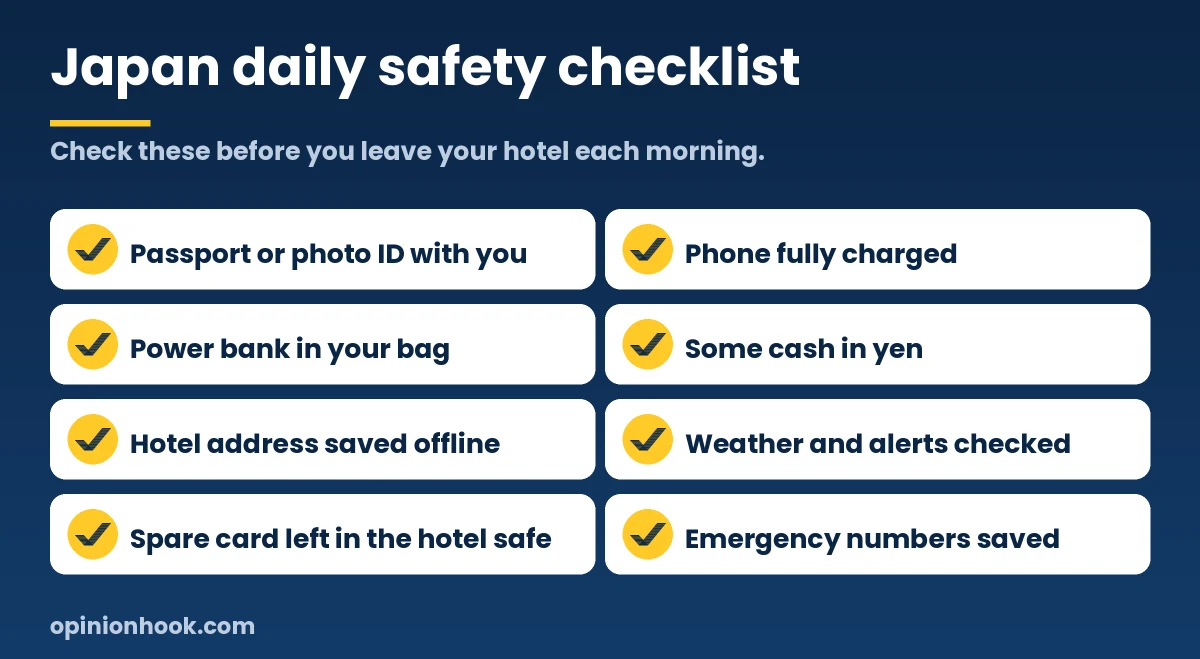
Daily safety checklist
Go through this list before you leave your hotel each morning.
Final thoughts
Japan’s biggest safety advantage is its culture of consideration for others. If you stay aware of your surroundings, avoid pushy nightlife touts, know what to do in an earthquake and carry insurance and the emergency numbers, you are very likely to have a calm, easy trip. For your next steps, read the Japan tourist visa guide, the Japan trip budget guide and the best time to visit Japan.
Frequently asked questions
Is Japan safe for tourists?
Yes. Japan has very low violent crime, reliable public transport and helpful locals. The main risks are pickpocketing in crowds, overpriced bars in some nightlife areas and natural events such as earthquakes and typhoons.
Is Japan safe for solo female travellers?
Many women travel alone in Japan and report feeling comfortable. Use common-sense precautions: pick accommodation in busy areas, use women-only train carriages where offered, avoid quiet unlit streets late at night and use official taxis.
Is Japan safe for Indian tourists?
Yes. Visitors from India follow the same advice as everyone else. Carry your passport, keep copies of your documents, save the emergency numbers and know where your embassy or consulate is.
What is the emergency number in Japan?
Call 110 for the police and 119 for fire and ambulance. For tourist help in several languages, the Japan Visitor Hotline is 050-3816-2787.
What should I do in an earthquake in Japan?
Protect your head, move away from windows and falling objects, do not run outside during the shaking and follow staff instructions. If you are on the coast and the shaking is strong, move to higher ground right away.
Are tourist scams common in Japan?
No, but some happen in nightlife districts such as Kabukicho and Roppongi. Avoid street touts, check prices before you order and never accept drinks from strangers.
Is tap water safe to drink in Japan?
Tap water is safe to drink in most places in Japan.
Do I need travel insurance for Japan?
Yes, it is strongly recommended. Visitors usually pay for medical care first and claim later, and insurance also helps with weather delays and lost belongings.
Sources and how we checked
- Japan National Tourism Organization (JNTO)
- Japan Meteorological Agency
- Ministry of Health, Labour and Welfare, Japan
This guide is general information, not legal or medical advice. Rules, numbers and warnings can change, so check the official sources before you travel. Last updated 11 October 2026.
Related Guides
- Getting Around Japan: A Transportation Guide for Tourists
- Japanese Food Guide: What to Eat, Dining Etiquette and Food Safety
- Japan Itineraries: 3, 5, 7, 10 and 14 Days, Plus a Packing List
- Japanese Culture and Etiquette for Tourists
Browse all of our Japan Travel guides.

Varinder Kaur is from Amritsar, India. She has traveled to well-known places across India, including Darjeeling, and to a few countries abroad, and shares travel experiences and practical tips for travelers through OpinionHook.


3 Comments
Comments are closed.