
What Makes a Trip Memorable? Why Some Places Stay With You
A place stays with you when it makes you feel something, when you meet people there, and when you have enough time to notice it. Fame, price and photo-worthy views matter far less than most people expect.
Have you ever looked back on your travels and wondered why one destination stayed vivid for years while another, just as beautiful, faded within months? This guide looks at the reasons: emotion, people, novelty, timing and pace. It also gives you practical ways to plan trips that are easier to remember, with Indian travellers in mind who often have limited leave and want every trip to count.
Key takeaways
- Emotion is the strongest ingredient. Moments that excite, move or challenge you are remembered more clearly than routine ones.
- People often leave a deeper mark than landmarks: a host, a guide, a stranger who helped.
- New and unfamiliar things make your brain pay closer attention.
- Slower trips with fewer stops usually leave clearer memories than rushed ones.
- Timing and life circumstances change how a place feels to you.
- The most memorable places are not always the most famous ones.
- You cannot guarantee a perfect memory, but you can make it more likely by leaving room for the unplanned.
Why do some destinations feel unforgettable?
Some destinations feel unforgettable because they were tied to a strong feeling: excitement, wonder, gratitude, pride, even nervousness. You do not store a place simply because you visited it. You store the moment when something happened there.
There is science behind this. Research on the brain shows that stress hormones released during emotional experiences strengthen memory formation, acting through the amygdala and linked brain regions. In simple terms, emotional moments get stored more firmly than routine ones.
This helps explain why a small village visit can stay clearer than a famous monument. The monument gave you a view. The village gave you a feeling.
What makes some places more memorable?
The most memorable places usually combine several things:
- Strong emotions
- Meaningful interactions with people
- Cultural differences that make you curious
- Unexpected moments
- A sense of personal growth or challenge
A beautiful landscape on its own may impress you. The same landscape, seen at the end of a hard multi-day trek or after a long-awaited reunion, is far more likely to stay with you. The effort and the anticipation become part of the memory.
Why do some trips stay with you longer than others?
Trips tend to last in memory when they change your perspective. They teach you something about yourself, about other cultures, about different ways of living or about what you actually care about. A holiday may entertain you. A trip that shifts how you see things is the one you keep thinking about.
How do travel experiences create lasting memories?
Daily life runs mostly on autopilot. Travel interrupts that. Language, transport, food, customs and surroundings are all new, so you pay more attention. More attention generally means better encoding in memory.
There is also the peak-end rule from psychology, based on research by Daniel Kahneman and colleagues. It says we judge and remember an experience mostly by its most intense moment and by how it ended, rather than by an average of every minute. For travel, that suggests two simple habits: plan at least one strong highlight, and finish the trip on a good note rather than a rushed airport dash.
What helps travel memories stick
The table below is a practical summary based on the ideas above, not a scientific ranking.
| Ingredient | Why it helps | Example |
|---|---|---|
| Emotional connection | Emotional moments are stored more strongly | A first sight of the mountains after a long climb |
| People and conversations | Shared moments carry feeling | A homestay host explaining a family recipe |
| Cultural contrast | Unfamiliar things hold attention | A local festival or market |
| Personal challenge | Effort adds meaning | Navigating a new city by public transport |
| Slow pace | Time to notice details | Three days in one neighbourhood |
| Fast-paced sightseeing | Often blurs into a list of places | Five cities in six days |
The strongest memories usually mix several of these, rather than relying on just one.
Why do human connections matter more than attractions?
People often remember conversations more than monuments. Many travellers can easily recall a helpful stranger, a guide, a host family, a fellow traveller or a cafe owner, yet struggle to list every museum they entered.
Connection brings emotional depth, and emotional depth brings stronger memory. If you want a trip that stays with you, plan time to talk to people: eat at a local place, join a walking tour, stay somewhere with a friendly host, or ask for a recommendation and actually follow it. Our guide on experiencing a country like a local has practical ideas.
Why do unexpected moments become the strongest memories?
Many unforgettable memories are unplanned. They feel special because they arrive without expectations. Think of:
- A hidden viewpoint you found by accident
- A local celebration you joined
- An invitation to a family meal
- A wrong turn that led to a lovely street
- A sunset from a bus stop you did not plan to stop at
You cannot schedule these, but you can leave space for them. Our post on how much to plan a trip explains how to balance fixed bookings with free time.
Why do cultural differences leave stronger impressions?
Destinations that feel very different from everyday life tend to hold your attention. When you meet new customs, foods, traditions and ways of thinking, you notice more. Places like Kyoto, Marrakech, Istanbul and Hanoi are often described as memorable for this reason, because they expose visitors to cultures that can feel very different from their own.
Contrast is personal. For someone from a busy Indian city, a quiet Scandinavian town may feel like the biggest change. For someone else, it might be the street food of Southeast Asia. Pick contrast that excites you, not what a list tells you to like.
How does timing change a destination?
The same place can affect two people in very different ways. A destination you visit during a big life moment, such as a graduation, a new job, a wedding anniversary, a retirement trip or a family reunion, becomes tied to that chapter of life. Years later you remember both the place and the stage of life you were in.
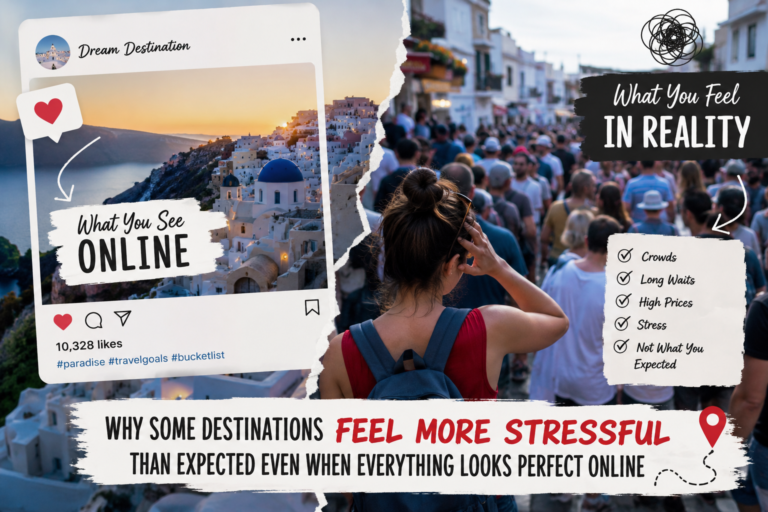
This is also why a place can disappoint on one trip and delight on another. Our article on why some destinations disappoint in person looks at the role of expectations.
Why does slower travel create better memories?
Fast travel focuses on quantity. Slow travel focuses on connection. Spending several days in one neighbourhood usually leaves clearer memories than rushing through five cities in a week, because you have time to repeat routes, recognise faces and notice small details.
| Fast travel | Slow travel |
|---|---|
| More destinations | Fewer destinations |
| More attractions | More experiences |
| Frequent transfers | Longer stays |
| Surface-level exploration | Deeper understanding |
| More rushing | More observation |
If you want to try this, start with our guide to slow travel and how to plan a slower trip, or compare the two styles in slow travel vs fast travel.
How can travel change the way you see the world?
Travel shows you different ways of working, living, communicating, celebrating and solving problems. Some visitors notice how well public transport works in one country. Others notice strong community life or street food culture in another. These observations can shape your thinking long after you return home.
Stop chasing only famous places
A common mistake is assuming the most famous destination will give you the strongest memory. That is not always true. Smaller towns and lesser-known neighbourhoods often feel more personal, because fewer people are there and you meet more everyday life. The goal is not to tick off a list. It is to have meaningful experiences. See our comparison of smaller towns vs major tourist cities for more on this.
Why do personal challenges make destinations more meaningful?
Places become more memorable when you overcome something there. That could be:
- Finding your way through a foreign transport system
- Learning a few phrases in another language
- Finishing a difficult hike
- Travelling solo for the first time
- Adapting to an unfamiliar environment
These moments build confidence, and confidence ties the place to a sense of growth. If you are thinking about a first solo trip, our solo travel tips for beginners is a helpful starting point.
Why do small sensory details last for years?
Travel memories often attach to the senses: the smell of fresh bread from a local bakery, music in a city square, street food cooking nearby, the sound of the sea at sunrise, conversations in a language you do not speak. These details act like anchors. A smell years later can sometimes bring back a whole trip.
You can help this along. Take a moment to stop, look, listen and breathe in on purpose. It takes ten seconds and costs nothing.
Why can too much comfort weaken memories?
Comfort has real value, and nobody needs to suffer for a good trip. But when everything feels exactly like home, your brain has less to pay attention to. A balance between comfort and novelty usually works best. Try a new food, walk through an unfamiliar neighbourhood, or learn a few local customs.
How to choose destinations and plans that create lasting memories
No one can guarantee an unforgettable trip, but you can improve the odds:
- Prioritise experiences over attractions.
- Spend more time in fewer places.
- Engage with local culture and people.
- Stay open to unexpected opportunities.
- Challenge yourself a little.
- Avoid planning every hour.
- Plan one clear highlight and a good last day.
These habits often matter more than the landmark list.
Small habits that help you remember
- Write three lines each night: what you saw, who you met, how you felt.
- Record a short voice note when something strikes you.
- Add captions to photos while the details are fresh.
- Collect one small thing per place, such as a ticket or a postcard.
How this guide was checked
The emotion-and-memory point was checked against a peer-reviewed review of brain systems involved in memory consolidation, and the peak-end rule against a behavioural economics reference that cites Kahneman’s research. The rest of the article is general travel advice drawn from common patterns, not statistics. Memory research describes tendencies, and individuals differ.
Frequently asked questions
Why do some travel destinations feel unforgettable?
They usually combine emotion, human connection, novelty and personal meaning. These factors make memories stronger than simple sightseeing does.
Can a small destination be more memorable than a famous one?
Yes. Smaller towns and local neighbourhoods often feel more personal, and you tend to interact with more everyday life. Fame does not decide how well you remember a place.
Why do some trips stay with you longer than others?
Trips with emotional moments, cultural learning, personal challenges or important life events tend to stay vivid longer because they create stronger memory links.
How can I make my trips more memorable?
Slow down, spend longer in fewer places, talk to local people, leave free time and note down small moments each day. Planning one clear highlight and a good final day also helps.
Does a luxury trip create better memories?
Not necessarily. Comfort can make a trip easier, but memory is shaped more by emotion, people and new experiences than by the price of the room.
Final thoughts
The reason some destinations leave stronger memories than others has less to do with popularity and more to do with connection. The places that stay with us tend to challenge us, teach us something or introduce us to people we would not meet at home.
As you plan your next trip, focus less on what looks impressive online and more on what might feel meaningful. Choose places that make you curious, spend more time in fewer spots and leave room for surprises.
Sources
- McIntyre, McGaugh and Williams (2012), Interacting brain systems modulate memory consolidation, Neuroscience and Biobehavioral Reviews (PMC)
- Peak-end rule, Behavioral Economics mini-encyclopedia
- Fredrickson and Kahneman (1993), Duration neglect in retrospective evaluations of affective episodes (PDF)
Related Guides
- Why Some Destinations Disappoint in Person: Expectations vs Reality
- Where to Stay in Japan: Accommodation Guide and Budget Tips
- Why Digital Nomads Stay Longer in Portugal (Lisbon and Madeira)
- What Are the Best Overseas Holiday Packages for Families in 2026?
Browse all of our Trip Planning guides.

Varinder Kaur is from Amritsar, India. She has traveled to well-known places across India, including Darjeeling, and to a few countries abroad, and shares travel experiences and practical tips for travelers through OpinionHook.




2 Comments
Comments are closed.