Japan Time to India Time: JST to IST Hour Table
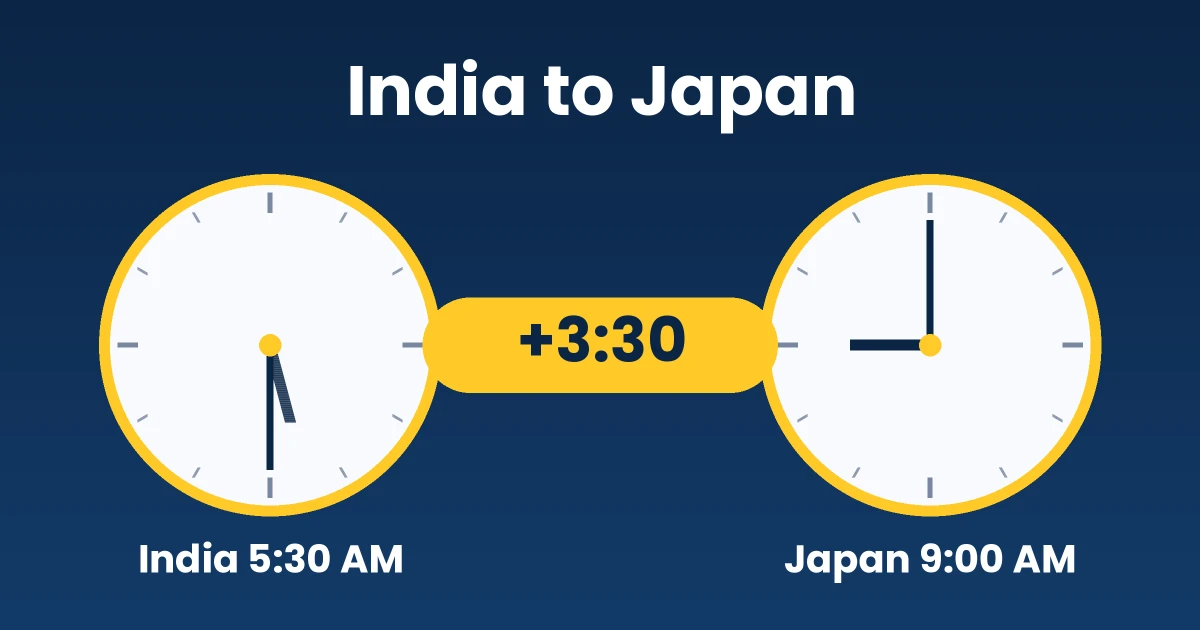
Quick answer: Japan is 3 hours 30 minutes ahead of India, all year round. Japan Standard Time (JST) is UTC+9 and Indian Standard Time (IST) is UTC+5:30. To change Japan time to India time, subtract 3 hours 30 minutes. To change India time to Japan time, add 3 hours 30 minutes. For example, 9:00 AM in Tokyo is 5:30 AM in India, and 9:00 AM in India is 12:30 PM in Japan.
If you are searching for the India to Japan time difference or the Japan to India time difference, the answer is the same number in both directions. Only the direction of the maths changes. The good news is that Japan does not use daylight saving time and neither does India, so the gap never moves. This guide gives you full hour-by-hour tables in both directions, the other countries on Japan time, the best hours to call or meet, simple examples, and tips for travellers planning a trip. Last updated 11 October 2026.
Key takeaways
- Japan is ahead of India by 3 hours 30 minutes.
- Japan uses JST (UTC+9). India uses IST (UTC+5:30). Neither uses daylight saving time.
- The gap is the same every day of the year, so there is no summer or winter change to track.
- Japan to India: subtract 3:30. India to Japan: add 3:30.
- The whole of Japan, from Hokkaido to Okinawa, uses one time zone. South Korea uses the same time.
- After 8:30 PM in India it is already the next calendar day in Japan.
Japan time zone difference to India
Japan sits at UTC+9. India sits at UTC+5:30. The difference between the two offsets is 3 hours 30 minutes, and Japan is the one that is ahead. When the sun is rising in Tokyo, it is still the middle of the night in India.
The half hour comes from India, which is one of the few large countries on a half-hour offset. A simple way to remember the gap is to add three hours and then thirty minutes. If it is 2:00 PM in India, add three hours to get 5:00 PM, then thirty minutes to get 5:30 PM in Japan.
Japan uses one time zone for the whole country. Tokyo, Osaka, Kyoto, Sapporo, Fukuoka and Okinawa all show the same time, so you never need to adjust for the city. Japan tried daylight saving for a few years after the Second World War, from 1948 to 1951, and then stopped. It has not used it since, and the gap with India has been stable for decades.
Japan time to IST: hour-by-hour table
Use this table when you know the time in Japan and want the time in India. The last column shows when the date changes.
| Japan time (JST) | India time (IST) | Day |
|---|---|---|
| 12:00 AM | 8:30 PM | Previous day in India |
| 1:00 AM | 9:30 PM | Previous day in India |
| 2:00 AM | 10:30 PM | Previous day in India |
| 3:00 AM | 11:30 PM | Previous day in India |
| 4:00 AM | 12:30 AM | Same day |
| 5:00 AM | 1:30 AM | Same day |
| 6:00 AM | 2:30 AM | Same day |
| 7:00 AM | 3:30 AM | Same day |
| 8:00 AM | 4:30 AM | Same day |
| 9:00 AM | 5:30 AM | Same day |
| 10:00 AM | 6:30 AM | Same day |
| 11:00 AM | 7:30 AM | Same day |
| 12:00 PM | 8:30 AM | Same day |
| 1:00 PM | 9:30 AM | Same day |
| 2:00 PM | 10:30 AM | Same day |
| 3:00 PM | 11:30 AM | Same day |
| 4:00 PM | 12:30 PM | Same day |
| 5:00 PM | 1:30 PM | Same day |
| 6:00 PM | 2:30 PM | Same day |
| 7:00 PM | 3:30 PM | Same day |
| 8:00 PM | 4:30 PM | Same day |
| 9:00 PM | 5:30 PM | Same day |
| 10:00 PM | 6:30 PM | Same day |
| 11:00 PM | 7:30 PM | Same day |
A quick check: if the Japan time is before 3:30 AM, the India time is on the previous day. For example, 2:00 AM on Wednesday in Tokyo is 10:30 PM on Tuesday in India.
India time to Japan time: common times
This table covers the times people ask about most often, such as office hours, interview slots, webinars and evening calls.
| India time (IST) | Japan time (JST) | Day |
|---|---|---|
| 5:00 AM | 8:30 AM | Same day |
| 6:00 AM | 9:30 AM | Same day |
| 8:00 AM | 11:30 AM | Same day |
| 9:30 AM | 1:00 PM | Same day |
| 10:00 AM | 1:30 PM | Same day |
| 12:00 PM | 3:30 PM | Same day |
| 2:00 PM | 5:30 PM | Same day |
| 5:30 PM | 9:00 PM | Same day |
| 8:00 PM | 11:30 PM | Same day |
| 10:00 PM | 1:30 AM | Next day in Japan |
| 11:30 PM | 3:00 AM | Next day in Japan |
| 12:00 AM | 3:30 AM | Same day |
If the India time is 8:30 PM or later, the Japan time is already past midnight, so it is the next calendar day. This matters for flight bookings, hotel check-in dates and online sign-up deadlines.
Which countries share Japan time?
Japan time (UTC+9) is also used in South Korea and North Korea, and in parts of Indonesia and a few other places. Here is how Japan and its neighbours compare with India.
| Place | Zone | Gap from India |
|---|---|---|
| Tokyo, Osaka, Kyoto (Japan) | JST, UTC+9 | 3h 30m ahead |
| Seoul, South Korea | KST, UTC+9 | 3h 30m ahead |
| Jayapura, Indonesia (east) | WIT, UTC+9 | 3h 30m ahead |
| Singapore, Hong Kong, Beijing | UTC+8 | 2h 30m ahead |
| Bangkok, Jakarta | UTC+7 | 1h 30m ahead |
| Dubai, UAE | GST, UTC+4 | 1h 30m behind |
If you are planning a longer trip through East and Southeast Asia, note that Japan and Korea are one hour ahead of Singapore, Hong Kong and China, and two hours ahead of Bangkok and Jakarta. Our guide to Singapore time to India time covers the UTC+8 side.
Best time to call or meet between India and Japan
The 3 hours 30 minutes gap leaves a smaller overlap than Singapore, but it is still workable. Japan finishes its working day while India is just getting into its afternoon. These are the windows that work for most schedules.
| Purpose | Japan time | India time |
|---|---|---|
| Business overlap (best) | 1:00 PM to 6:00 PM | 9:30 AM to 2:30 PM |
| Japan office hours | 9:00 AM to 6:00 PM | 5:30 AM to 2:30 PM |
| Indian office hours | 1:00 PM to 10:00 PM | 9:30 AM to 6:30 PM |
| Family calls | 7:00 PM to 10:00 PM | 3:30 PM to 6:30 PM |
| Late-night family calls | 10:00 PM to 11:00 PM | 6:30 PM to 7:30 PM |
Some practical points:
- Business meetings: the best overlap is from 1:00 PM to 6:00 PM in Japan, which is 9:30 AM to 2:30 PM in India. Both sides are inside normal office hours.
- Early Japan meetings: a 9:00 AM start in Japan is 5:30 AM in India. It is too early for most people, so try to avoid it.
- Late India meetings: a 5:00 PM start in India is 8:30 PM in Japan. It is possible for a short call, but not comfortable for a Japan-based team.
- Family calls: evenings are best. 7:00 PM to 10:00 PM in Japan is 3:30 PM to 6:30 PM in India.
- Holidays: Japan has several long holiday weeks, such as Golden Week in late April and early May. Check both calendars before you fix a date.
Examples that show how to convert
These are the questions people usually have.
Example 1: A job interview in Japan
Your interview is at 11:00 AM Japan time. Subtract 3 hours 30 minutes: it is 7:30 AM in India. Plan to be ready early and test your video link the evening before.
Example 2: A webinar at an Indian time
A Japanese company hosts a webinar at 4:00 PM IST. Add 3 hours 30 minutes: it starts at 7:30 PM in Japan. A Japan-based speaker should plan for a late-evening session.
Example 3: A flight from Delhi
You leave Delhi at 11:00 PM IST and the flight takes about 8 hours. You land at 7:00 AM IST, which is 10:30 AM in Japan. Your body clock thinks it is early morning, but the local time is mid-morning. Always check the arrival time on your ticket, because it is shown in local Japan time.
Example 4: Late night in India
It is 9:15 PM on Saturday in India. In Japan it is 12:45 AM on Sunday. A form that closes at midnight Japan time closes at 8:30 PM India time the day before.
Does the gap ever change?
No. Japan does not use daylight saving time and India does not use it either. This is different from the UK, the USA, Canada and Australia, where clocks change twice a year and the gap with India moves by an hour. A call that you set for 6:00 PM Japan time in January is still at 2:30 PM India time in July.
The only gaps that move are those between Japan and countries that do use daylight saving. For example, the Japan to UK gap is 9 hours in winter and 8 hours in summer. The India to Japan gap stays at 3 hours 30 minutes. If you work with the UK as well, see our guide on UK time to India time.
What the time difference means for a trip to Japan
If you are travelling from India to Japan, a few practical things follow from the time difference.
- Jet lag is mild. A shift of 3 hours 30 minutes is smaller than most long trips. Because you fly east, you lose time, so the first night can feel short. Get daylight after landing, avoid a long afternoon nap, and go to bed at local time.
- Arrival dates. Long flights often land the next calendar day in Japan. Write down your hotel check-in date in Japan time, not India time.
- Booking windows. If a ticket, restaurant or attraction opens bookings at a set time, check whether the time is shown in JST. A 10:00 AM JST release is 6:30 AM in India.
- Calls home. The easiest family call time is Japan evening, which is India afternoon. Morning in Japan is the middle of the night in India.
For more trip planning, read our Japan travel guide, the Japan tourist visa guide and the Japan itineraries for 3 to 14 days.
Common mistakes to avoid
- Subtracting when you should add. Japan is ahead of India, so you subtract when you go from Japan to India.
- Forgetting the half hour. The gap is 3:30, not 3 hours or 4 hours.
- Missing the date change at night. After 8:30 PM in India, it is the next day in Japan.
- Assuming the gap changes in summer. It does not, for Japan or India.
- Mixing Japan with China or Singapore. They are one hour behind Japan.
- Trusting an invite that shows only JST or IST. Add the city name to the invite as well.
Check the live gap
Want a quick answer for any hour? Use our free India–Japan time difference tool, which uses the same time zone data as this guide. All our calculators are on the tools page. If you speak with family in several countries, our guide to the best time to call family abroad from India lists call hours for the most common ones.
Frequently asked questions
What is the time difference between India and Japan?
Japan is 3 hours 30 minutes ahead of India all year. Japan uses UTC+9 and India uses UTC+5:30. When it is 9:00 AM in India, it is 12:30 PM in Japan.
How do I convert Japan time to India time?
Subtract 3 hours 30 minutes from the Japan time. For example, 3:00 PM in Japan is 11:30 AM in India. If the result goes below midnight, the India time is on the previous day.
How do I convert India time to Japan time?
Add 3 hours 30 minutes to the India time. For example, 10:00 AM IST is 1:30 PM in Japan. If the result goes past midnight, it is the next day in Japan.
Is Japan ahead of or behind India?
Japan is ahead of India. When it is morning in India, it is already afternoon in Japan.
Does the Japan to India time difference change in summer?
No. Japan and India both keep the same time all year and do not change their clocks, so the gap stays 3 hours 30 minutes.
What time is it in India when it is 9:00 AM in Japan?
It is 5:30 AM in India when it is 9:00 AM in Japan.
Does Japan have more than one time zone?
No. Japan uses one time zone, JST (UTC+9), for the whole country, including Tokyo, Osaka, Kyoto, Sapporo and Okinawa.
What is the best time to call India from Japan?
The easiest window for business is 1:00 PM to 6:00 PM in Japan, which is 9:30 AM to 2:30 PM in India. For family calls, 7:00 PM to 10:00 PM in Japan is 3:30 PM to 6:30 PM in India.
Is South Korea in the same time zone as Japan?
Yes. South Korea uses KST, which is UTC+9, so it has the same time as Japan and the same 3 hours 30 minutes gap from India.
Sources and how we checked
The gaps in this guide are calculated from the IANA time zone database. Neither Japan nor India uses daylight saving time. This guide is general information. For visa, flight or legal deadlines, always use the official source. Last updated 11 October 2026.

Varinder Kaur is from Amritsar, India. She has traveled to well-known places across India, including Darjeeling, and to a few countries abroad, and shares travel experiences and practical tips for travelers through OpinionHook.