Best AI Travel Planning Tools in 2026 and How to Use Them
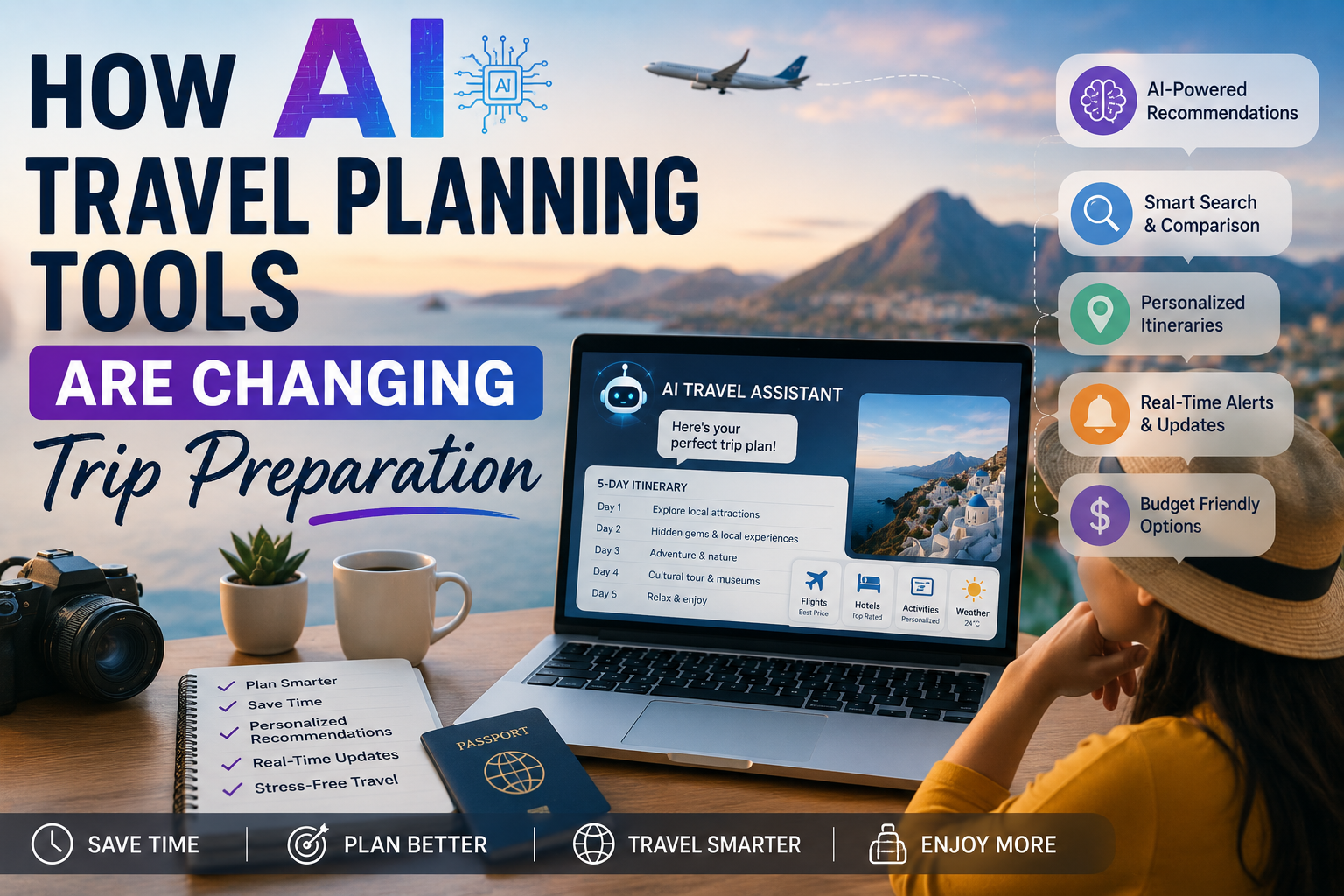
AI tools can cut hours off trip planning. They are very good at first drafts: itinerary ideas, destination comparisons, packing lists and rough budgets. They are not good at being your final source for visas, prices, timings or safety. The best way to use them is simple: let AI draft, then check the facts on official sites before you book anything.
This guide covers the main AI tools travellers use in 2026, what each is good for, where they fall short, and how Indian travellers can write better prompts and stay safe while using them.
Key takeaways
- AI is best for brainstorming, itinerary drafts, comparisons and checklists.
- It can be wrong or out of date. Always verify visas, fares, opening hours and entry rules on official sources.
- Specific prompts give far better answers than vague ones. Include budget (in INR), dates, travel style and constraints.
- Google Flights, Google Maps and Kayak now have AI-style search built in, so you may already have these tools on your phone.
- Human travel agents still make sense for complex, multi-country or visa-heavy trips.
- Never paste passport numbers, card details or OTPs into any AI chat.
Why is AI popular for travel planning?
Travel planning means juggling flights, hotels, attractions, local transport, visas, weather, customs and insurance. The internet has more information on all of this than anyone can read. AI helps by organising it and answering specific questions in plain language, so you spend less time opening tabs.
For Indian travellers, there is an extra layer: visas, forex, long-haul fares and limited leave. AI can help you sort options quickly, which is useful when you have only a short window of leave. Our guide to planning a Europe trip on a budget shows how many moving parts even a basic trip has.
What can AI actually do for your trip?
Most travellers use AI as an assistant, not a replacement for research. Common uses:
Destination research
You can ask AI to compare places by budget, weather, safety, activities, family-friendliness or suitability for solo travel. This works well for narrowing a shortlist. It does not replace checking current conditions.
Itinerary building
AI can group attractions by location so you do not zigzag across a city. Treat the result as a draft. Always check the map and opening days yourself.
Budget planning
You can ask for a rough daily budget split into accommodation, food, local transport and activities. Use the result as a starting point only, then compare against real prices. Travel costs change often.
Checklists
Packing lists, pre-departure checklists and document lists are an easy win. They are low risk and easy to check. For a good example of a packing list you can adapt, see our two-week Europe packing list.
Which AI tools can you use to plan a trip?
The tools below are widely used. Features and availability change quickly, so treat this as a snapshot and check what is live in your region and app version.
| Tool | Good for | Watch out for |
|---|---|---|
| ChatGPT | Itinerary drafts, comparisons, packing lists, trip questions in plain language | Can state outdated or wrong facts confidently. Verify anything time-sensitive |
| Google Gemini | Destination research and questions, linked with Google’s other services | Same accuracy limits as other chatbots. Check official sources |
| Google Maps (Ask Maps) | Questions about a specific place, such as parking or what to see there | Answers are based on reviews and web data, so check recent details |
| Google Flights (Flight Deals) | Finding cheap destinations and dates from a plain-language description | Fares change quickly. Confirm on the airline or booking page |
| Kayak (AI Mode) | Conversational flight and travel search | Check which features are available in India at the time you use it |
| Tripadvisor | Reviews and AI-assisted trip building | Availability of AI features varies by market |
ChatGPT and Google Gemini
Both are general-purpose AI assistants, and both can build itineraries, compare destinations and answer travel questions. They are strong at structure and ideas. Their weakness is real-time accuracy: neither is a guaranteed source for current prices, visa rules or opening hours. Check the plans and limits on each service’s own website, since free and paid options change.
Google Maps with Gemini
Google announced in November 2025 that Indian users could start asking Gemini-powered questions about places inside Google Maps on Android and iOS. Google’s own example was asking whether a place such as Dilli Haat has parking, or which stalls are worth visiting. This is handy once you are on the ground and want quick answers about a specific place.
Google Flights: Flight Deals
Google launched Flight Deals in beta in August 2025 for users in the US, Canada and India. You describe the trip you want, such as a week-long trip to a city with great food, and the tool finds matching destinations using Google Flights data. In November 2025, Google said it was expanding Flight Deals to more than 200 countries and territories. It is a good way to find inspiration when your dates are flexible. For more fare-hunting methods, read our guide on finding cheap flights.
Kayak AI Mode
Kayak introduced an AI Mode in October 2025 that lets you ask travel questions in natural language and see real-time results compared across providers. Kayak’s article did not state which countries get it, so check on the Kayak site or app.
Tripadvisor
Tripadvisor launched an AI itinerary generator in 2023, first as a US beta. It has changed since then, so check its current trip planning features in the app. The real value of Tripadvisor is still its large pool of traveller reviews, which you can use to sense-check AI suggestions.
How do you use AI for stress-free travel planning?
- Decide your budget, dates and goals first.
- Ask AI for destination ideas and shortlists.
- Generate a draft itinerary.
- Check transport times and accommodation locations on a map.
- Verify visa and entry rules on official government sites.
- Adjust the plan to suit you and leave free time.
- Save the final plan in one place, with bookings and confirmation numbers.
Step 6 matters. AI itineraries tend to be packed. Our post on how much you should plan a trip explains why a lighter schedule often works better.
How to write better prompts
Vague questions get vague answers. A good prompt includes who is travelling, dates, budget, interests and limits. Compare these:
- Weak: “Plan a vacation.”
- Better: “Plan a 10-day trip to Portugal for two adults in May. Budget is about 1.5 lakh rupees per person excluding flights. We like food, local culture and public transport, and we do not want to rent a car.”
A few more ideas:
- Ask the tool to list assumptions and anything it is unsure about.
- Ask it to flag items that need to be booked in advance.
- Ask for a day with low activity after long-haul arrival.
- Ask it to say “check official source” for any rules or prices.
Remember, the budget figure in your prompt is yours. The tool’s price estimates are guesses unless it shows a live source.
AI planning or a travel agent?
They solve different problems. The table below is a general comparison, not a ranking.
| Feature | AI planning tools | Travel agent |
|---|---|---|
| Speed | Very fast | Slower |
| Cost | Often free or low cost | May charge service fees |
| Human judgement | Limited | Strong |
| Complex multi-country trips | Needs careful checking | Often a good fit |
| Visa paperwork support | Not a source of truth | Can help, but check what they offer |
| Help during emergencies | Not available | Sometimes available |
Agents can add real value for multi-country trips, large groups, luxury travel and complicated visa situations. For simple trips, AI plus your own checking is often enough.
What are the limitations of AI travel planning?
Information gets outdated
Airlines change schedules, hotels close and visa rules shift. An AI model may repeat old information with confidence. For visas, use official embassy or government pages. For example, our Japan tourist visa guide and visa-free countries for Indians are a good starting point, but you should still confirm the current rules with the embassy or official visa portal before applying.
It can invent details
AI sometimes makes up places, opening hours or transport links that sound real. If something looks unusually perfect, search for it on a map.
Local context is missing
Strikes, festivals, local holidays and closures might not appear in AI answers. Locals, hosts and recent reviews are better for this.
Privacy and safety
Do not share passport numbers, card numbers, bank details or OTPs in a chat. Share only what you need for the planning question.
What does AI do beyond planning?
The travel industry also uses AI for pricing analysis, customer support, hotel recommendations, translation tools and navigation. Translation apps in particular can be helpful when you are abroad, though they can make mistakes with nuance and local phrases. For booking, you still need to compare platforms yourself, and our guide on hotel booking platforms can help.
What might change next?
Google has said it is working with partners such as Booking.com, Expedia and Marriott on flight and hotel booking inside AI Mode, but it gave no date in its November 2025 announcement. Whether this becomes available in India is something to check on Google’s pages. Until then, treat AI as a planner, not as a booking engine you can fully trust.
How this guide was checked
Tool descriptions were checked against the companies’ own announcements: Google’s August 2025 Flight Deals post, Google’s November 2025 travel and AI Mode post, Google India’s November 2025 Maps post, Kayak’s launch coverage and Tripadvisor’s 2023 press release. We did not run price or accuracy tests, and we do not give any rankings of which tool is best. Features are rolling out in stages, so what you see in your app today may differ from what was announced.
Frequently asked questions
What are the best AI tools for planning a vacation?
ChatGPT and Google Gemini are common choices for itinerary drafts and questions, while Google Flights, Google Maps and Kayak offer AI-based search for flights and places. Which is best depends on whether you want ideas, fares or place details.
Can AI replace a travel agent?
Not fully. AI is useful for research and drafts, but agents can offer human judgement and support on complex trips. For simple trips, many people manage with AI plus their own checking.
Are AI travel recommendations always accurate?
No. They can be outdated or wrong. Check visas, flights, hotels and opening hours on official or booking sites before you pay.
Is it safe to share personal details with AI chatbots?
Keep sensitive information out of chats. Do not share passport numbers, card details or OTPs. Give only the information needed to plan.
Can AI help me find cheap flights from India?
It can help you explore dates and destinations. Google’s Flight Deals tool was launched in India in 2025 for flexible trip ideas. Always confirm the final fare on the airline or booking site, since prices change quickly.
Final thoughts
AI travel tools make planning faster and more personal, but they work best as a starting point. Use AI to generate ideas and organise information, use trusted sources to confirm details, and use your own judgement for the final call. Try asking an AI tool for a first draft of your next trip, then compare it with your usual process and see how much time it saves.
Sources
- Google: Flight Deals, an AI-powered flight search tool (Aug 2025)
- Google: New ways to plan and book travel with AI in Search (Nov 2025)
- Google India: Google Maps in India supercharged with Gemini (Nov 2025)
- TravelPulse: Kayak launches AI trip planner
- Tripadvisor press release: AI-powered travel planning product (2023)
Related Guides
- Multi-Country Trip Planning: How to Handle City-to-City Travel
- Planning a Trip From Instagram and TikTok: Why It Often Backfires
- Solo Travel Planning Mistakes: How First-Timers Can Avoid Them
- Staying Longer in One Destination: What Changes After the First Week
Browse all of our Trip Planning guides.

Varinder Kaur is from Amritsar, India. She has traveled to well-known places across India, including Darjeeling, and to a few countries abroad, and shares travel experiences and practical tips for travelers through OpinionHook.






3 Comments
Comments are closed.