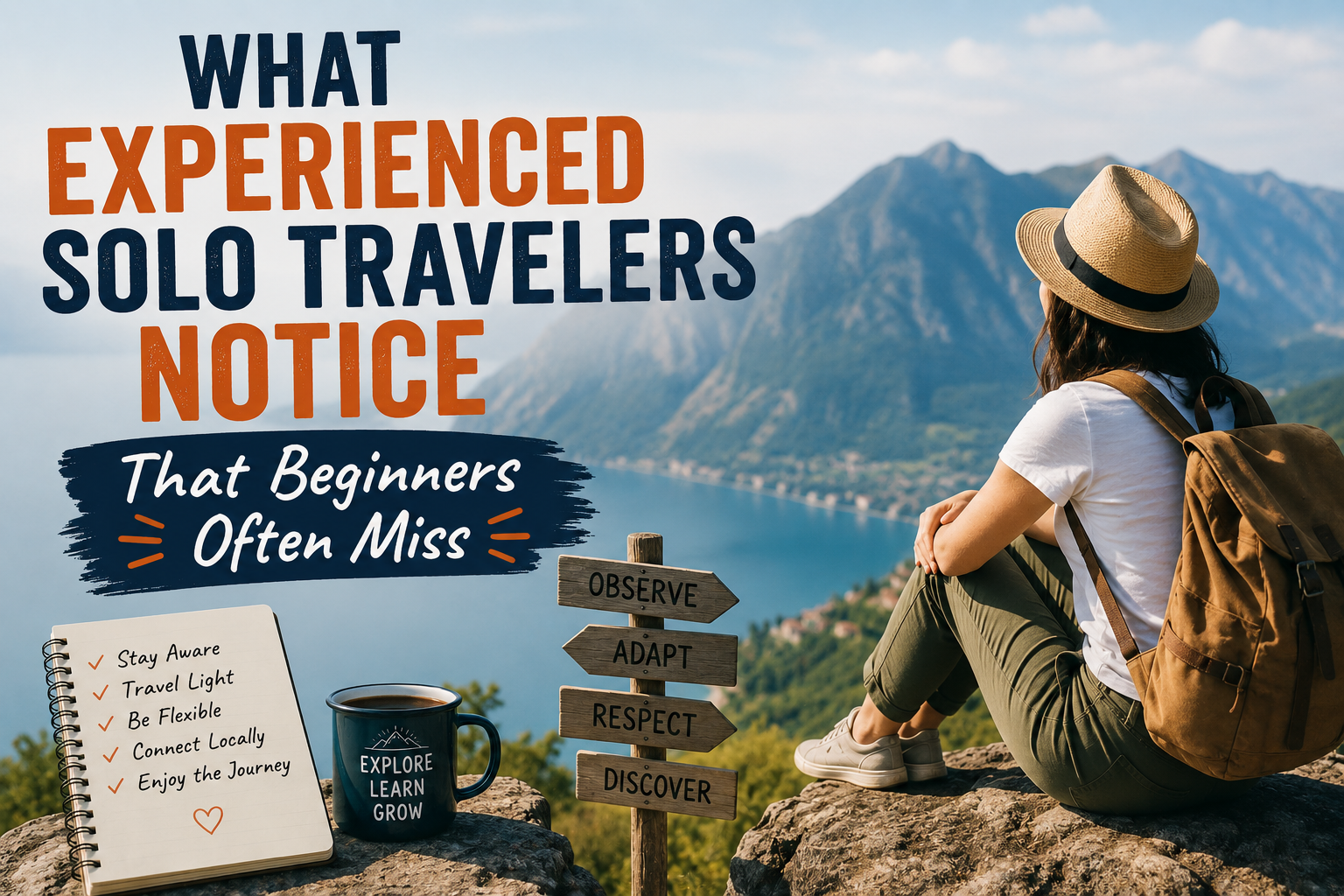
Solo Travel Tips: What Experienced Travelers Notice First
Most people think solo travel is about courage. After a few trips, you find out it is mostly about paying attention. The travellers who look calm and relaxed are usually not fearless. They are just noticing small things early: how the local train works, when a street empties out, how tired they are, and when to change the plan.
This guide covers those small things in plain language. It is written for first-timers, with Indian travellers in mind, so you will also find notes on money, insurance, phone connectivity and who to contact if something goes wrong abroad.
If this is your first trip alone, read it alongside our guides on easy destinations for first-time solo travellers and common solo travel planning mistakes.
Key takeaways
- Awareness beats confidence. Notice how a place works before you try to see everything in it.
- Plan your energy, not just your hours. A packed day on paper often falls apart by mid-afternoon.
- Pack lighter than feels comfortable at home. You will carry the bag up stairs, across stations and through crowds on your own.
- Choose where you stay for location and transport first, and price second.
- Loneliness shows up on almost every solo trip. It passes, and it is easier to handle if you expect it.
- Before you leave, sort the boring basics: travel insurance, digital copies of your documents, a working phone plan and two emergency contacts.
Why do experienced solo travellers see travel differently?
The biggest difference is perspective. Beginners often travel with a checklist: landmarks, photos, famous restaurants. That is natural, and nothing is wrong with it. But a checklist makes you look at the list instead of the place.
Seasoned solo travellers tend to ask a different question. Instead of “What should I see?”, they ask “How does this place work?” That one change makes travel smoother, because you start noticing:
- How locals commute and which tickets or cards they use
- When neighbourhoods get crowded and when they go quiet
- Which areas feel comfortable after dark
- Where people actually eat, not just where the reviews are
- How transport changes between rush hour and late evening
None of this needs special skill. It only needs you to look up from your phone for a few minutes after you arrive.
How should you plan your time on a solo trip?
Rushing creates stress, and when you are alone there is nobody to share the load. If a train is late or you feel unwell, every decision is yours.
Beginners schedule attractions
A first itinerary often looks like this: museum at 9 am, walking tour at 11, lunch booking at 1, landmark at 3, evening activity at 6. It looks efficient. Then a delayed bus, a long queue, bad weather or plain tiredness breaks the chain, and the rest of the day becomes a scramble.
Experienced travellers schedule energy
A better habit is to pick one main thing per half-day and leave gaps around it. Gaps are where you recover, find a good chai or coffee place, talk to someone, or deal with a transport hiccup without panic.
If you want a fuller look at this balance, our post on how much you should plan a trip goes deeper into planned versus flexible days.
Why do experienced solo travellers pack less?
Carrying less is one of the most useful lessons in solo travel. Beginners pack for every possible situation: extra shoes, several jackets, backup outfits, a full bathroom shelf of toiletries. Then they drag that bag through airports, train stations, staircases and cobbled streets.
Many older city stations and metro systems have long staircases and few lifts, and you will often be alone with your bag. A suitcase that felt fine in your hallway can become a daily irritation. A smaller bag also means you can keep it with you on buses and trains instead of trusting a luggage rack, and you avoid checked-baggage waits and fees on many airlines.
A simple test: if you cannot lift your packed bag over your head once, comfortably, it is too heavy. For more help choosing a bag, see our guide to choosing the right travel backpack.
What do experienced solo travellers notice about safety?
Good solo travel safety advice is rarely about fear. It is about awareness. Most problems can be reduced by paying attention to your surroundings and making small, sensible choices.
They notice patterns
They watch how locals behave, which streets stay lively at night, when the last metro or bus runs, and which areas suddenly empty out. If locals avoid a street after dark, they take that as information. If everyone uses a particular ride app or transport option, they use it too.
They avoid looking lost
This does not mean pretending to know everything. It means stepping into a cafe or shop to check directions, instead of standing in the middle of a busy street with your phone and bag in your hands. Small habits like this lower your risk of being targeted by pickpockets or touts.
They set up safety basics before the trip
These are the unglamorous steps that matter most if something goes wrong:
- Travel insurance. Buy it before you fly. Some countries, including the Schengen area, require it for a visa. Check the exact rules for your destination.
- Digital copies of documents. Keep photos of your passport, visa, tickets and insurance in your email and on your phone.
- Two emergency contacts. Share your itinerary and your hotel address with family or a friend back home.
- Know your embassy. Save the address and phone number of the Indian embassy or consulate for your destination. The Ministry of External Affairs runs the MADAD portal for Indians abroad who need consular help.
- Read the official advisory. Government travel advice pages list local scams, health notes and areas to avoid.
For trip-specific safety, our guide on first-time international travel tips covers the pre-departure checklist in more detail.
Why do experienced solo travellers spend time near locals?
Tourist areas give you convenience. Local areas give you understanding. Cities like Lisbon, Bangkok and Mexico City are known for famous sights, but daily life often leaves the stronger memory: a neighbourhood bakery, a morning market, a public park where people gather in the evening.
This does not mean avoiding the big sights. It means balancing them. Spend a morning at the landmark, then an afternoon walking through a residential area, sitting in a local cafe, or eating where the menu is not translated into five languages. Our guide on experiencing a country like a local has practical ideas for this.
How do you choose accommodation when travelling alone?
Experienced solo travellers choose a place to stay for convenience, not only price. A very cheap room far from transport can cost you extra every day in fares and time, and it can feel uncomfortable to return to late at night.
| Factor | Beginner focus | Experienced traveller focus |
|---|---|---|
| Price | Lowest cost | Best value for the location |
| Location | Sometimes ignored | High priority |
| Reviews | Overall star rating only | Recent, detailed reviews |
| Transport | Often overlooked | Checked on the map before booking |
| Neighbourhood | Little research | Checked for night-time comfort and noise |
A slightly pricier room near a metro or train station often saves money and energy over a full trip. Read the most recent reviews, and look for comments from other solo travellers about the walk back at night.
Why do experienced solo travellers build daily routines?
Many beginners imagine travel as non-stop excitement. In practice, even great destinations involve laundry, navigation, planning, waiting and problem solving. Experienced travellers add small routines to cope with this:
- A morning coffee or chai at the same cafe
- An evening walk
- A quick daily budget check in INR so spending does not drift
- Planning tomorrow before bed
These habits reduce decision fatigue. When everything around you is unfamiliar, a small routine feels like solid ground.
Keep a simple travel journal
You do not need to write pages. A few lines a day is enough: places visited, interesting conversations, surprises and lessons learned. Months later, these notes often mean more than photos. For more on managing the nerves before you go, read our guide on first-time solo travel anxiety.
What should you expect about loneliness?
Loneliness is normal, even for experienced travellers. Social media makes solo travel look like a daily string of new friendships, and that is rarely the reality. Some evenings are lively. Some are quiet.
Being alone and feeling lonely are not the same thing. Sometimes solitude feels peaceful. Sometimes it feels uncomfortable. Both are part of the trip. The difference with experienced travellers is that they do not panic when it happens. They have a plan for it: a call home, a walking tour, a hostel common room, or simply an early night.
Why do they talk to more people?
They know conversations create some of the best memories. That does not mean talking to everyone. It means staying approachable. A short chat can lead to a restaurant tip, a local insight, a travel buddy for a day or a better sense of the city. Walking tours, hostels, cafes and train journeys are easy places to start.
What do experienced solo travellers know about itineraries?
The best itineraries leave room for change. Weather shifts, transport gets delayed and new opportunities appear. A flexible plan with a few fixed anchors, such as your flights, first night and one or two must-see bookings, usually works better than a perfect schedule.
What experienced solo travellers do differently
- Pack lighter.
- Choose location over price.
- Leave room for flexibility.
- Observe local habits.
- Build small daily routines.
- Focus on awareness rather than fear.
- Manage energy instead of maximising activities.
- Stay open to unexpected experiences.
What should you expect on your first solo trip?
The first solo trip feels exciting and uncomfortable at the same time. That is completely normal. You can expect more decisions, more freedom, occasional loneliness, growing confidence and a few unexpected problems. Most people go through a learning curve in the first few days, and things get easier once routines settle.
If you are choosing where to go, our list of solo travel destinations for beginners is a good place to start.
Common mistakes first-time solo travellers make
Trying to see everything
No trip covers everything. Accepting this makes the trip more enjoyable.
Overplanning
Rigid schedules increase stress and leave no room for the good surprises.
Overpacking
Heavy luggage reduces flexibility at every step.
Ignoring recovery time
Travel is physically tiring, especially after a long flight. Build in at least one slower day each week.
Comparing your trip to social media
Online travel content shows the best moments. Real travel includes delays, mistakes and quiet days.
Why do small travel skills matter more than big travel dreams?
Practical skills create better trips. Reading a transport map, managing a budget, handling a delay, adapting a plan and speaking politely to strangers matter more than ambitious goals. A traveller who can adapt usually enjoys more of a destination than someone who needs perfect conditions.
How this guide was checked
This article covers general travel habits rather than prices or rules that change often. The points about travel insurance, the MADAD portal and government travel advice were checked against the official pages listed below. Insurance rules, visa rules and advisories change, so always confirm the current position for your destination before you book.
Frequently asked questions
What should beginners know before travelling solo?
Solo travel needs flexibility, awareness and patience. Things will not always go to plan, and that is fine. Learning to adapt is more useful than building a perfect itinerary. Sort the basics before you leave: documents, insurance, phone connectivity and emergency contacts.
Is solo travel safe for first-time travellers?
It can be, when you research the destination, read official travel advice, stay aware of your surroundings, use trusted transport and follow common-sense habits. Safety varies by country and city, so check the current advisory for your destination.
How long should a first solo trip be?
There is no fixed rule. Many people find a short first trip, around three to seven days, gives enough time to build confidence without feeling overwhelming. A familiar-feeling destination with easy transport helps too.
How do solo travellers deal with loneliness?
They expect it, stay active, join walking tours, spend time in social spaces and stay open to conversation. They also keep in touch with people at home. Occasional loneliness is a normal part of travelling alone.
Does solo travel get easier over time?
Yes, for most people. Navigation, planning, communication and decision-making feel more natural after a few trips, and uncertainty drops as experience grows.
Final thoughts
The biggest thing experienced solo travellers notice is that travel is rarely about the famous landmark or the perfect itinerary. It is about awareness: how places work, how people move through them and how small decisions shape your day.
So do not aim to be fearless. Aim to be observant. Pack lighter than you think you need, leave room in your schedule, learn the local habits and accept that some moments will feel uncomfortable. Your first solo trip is not a test to pass. It is the start of learning how to travel on your own terms.
Sources
- GOV.UK Foreign travel advice (UK FCDO)
- Ministry of External Affairs, India: MADAD consular grievance system
- National Portal of India: Indian missions and posts abroad
Related Guides
- Solo Travel vs Group Travel: Which Is Better in 2026?
- Best Solo Travel Destinations for Beginners 2026 Guide
- Solo Travel Planning Mistakes: How First-Timers Can Avoid Them
- Ultimate Solo Travel Guide 2026: Safe, Smart & Budget-Friendly Tips
Browse all of our Solo Travel guides.

Varinder Kaur is from Amritsar, India. She has traveled to well-known places across India, including Darjeeling, and to a few countries abroad, and shares travel experiences and practical tips for travelers through OpinionHook.


3 Comments
Comments are closed.