How to Calculate Time Difference Between India and USA
Quick answer: India is 9 hours 30 minutes to 15 hours 30 minutes ahead of the USA, depending on the state and the time of year. To get Indian time from US time, add the gap. To get US time from Indian time, subtract it. For New York the gap is 9 hours 30 minutes until 31 October 2026 and 10 hours 30 minutes from 1 November 2026 to 13 March 2027. For California it is 12 hours 30 minutes, then 13 hours 30 minutes.
If you search for the time difference from India to USA, you usually get one number. But the right number depends on two things: which US state you mean, and whether the USA is on daylight saving time right now. This guide gives you a simple three-step method, a table for every US time zone, worked examples (including cases where the date changes), and a cheat-sheet you can save. The gaps are calculated from the international time zone database (the IANA tz database) that phones and computers use. India’s 2026 Legal Metrology (Indian Standard Time) rules describe Indian Standard Time (IST) as UTC+5:30, based on the 82.5° E meridian. Last updated 11 October 2026.
Key takeaways
- India uses IST (UTC+5:30) all year and never changes its clocks, so only the US side moves the gap.
- The gap ranges from 9 hours 30 minutes (New York in US summer) to 15 hours 30 minutes (Hawaii).
- US clocks go back on 1 November 2026 and forward on 14 March 2027, so for most states the gap is one hour bigger in winter.
- To go from US time to Indian time, add the gap. To go from Indian time to US time, subtract it. Then check the date.
- Hawaii and most of Arizona do not change clocks, so their gap stays the same all year.
- The USA is never exactly 12 hours behind India. Every gap ends in 30 minutes.
How to calculate the time difference between India and USA
You only need three steps.
- Pick the US time zone. Eastern covers New York, Washington DC, Miami and Atlanta. Central covers Chicago, Dallas and Houston. Mountain covers Denver and Salt Lake City. Pacific covers Los Angeles, San Francisco, Seattle and Las Vegas. Alaska and Hawaii have their own zones, and Arizona (except the Navajo Nation) stays on Mountain standard time all year.
- Check whether US daylight saving time is on. The USA is on daylight time from the second Sunday of March to the first Sunday of November. In 2026 that ends on Sunday 1 November. After that the USA is on standard time until Sunday 14 March 2027.
- Add or subtract the gap, then check the date. Indian time equals US time plus the gap. US time equals Indian time minus the gap. If the answer passes midnight, move the date forward (when adding) or back (when subtracting) by one day.
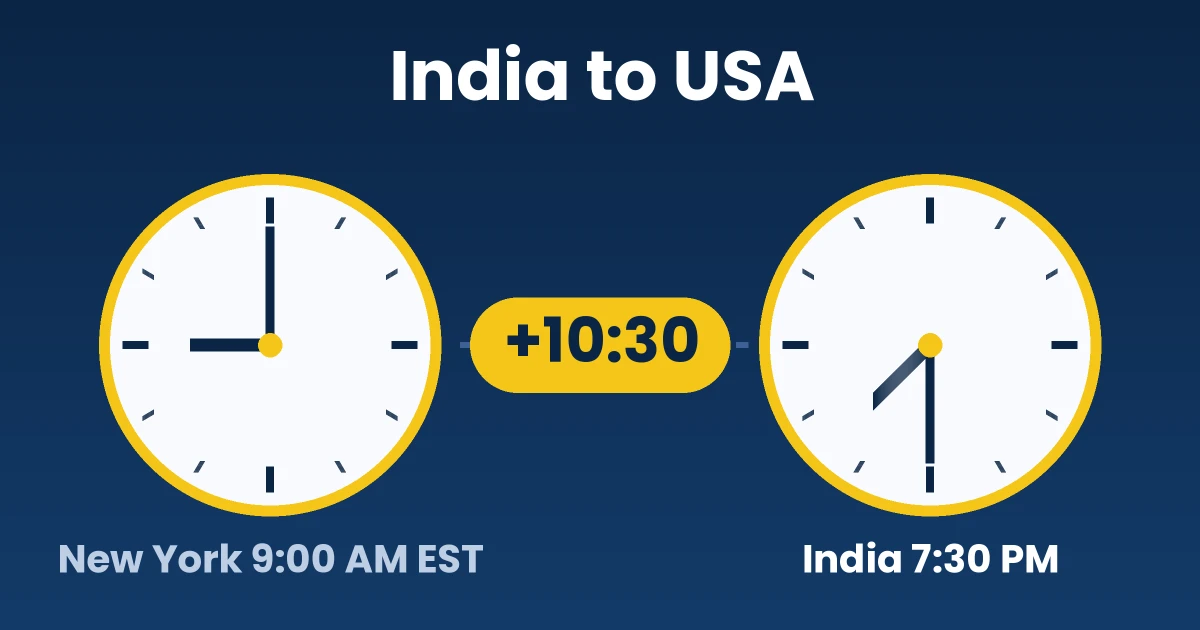
There is a second way that works for any country. Convert the US time to UTC, then add 5 hours 30 minutes for India. For example, New York in winter is UTC−5, so you add 5 hours to reach UTC and 5 hours 30 minutes more to reach IST. That is 10 hours 30 minutes in total.
Time difference from India to USA by zone
The table shows how far India is ahead of each US zone. It covers the two periods that matter right now.
| US zone and cities | Gap until 31 Oct 2026 (US daylight time) | Gap 1 Nov 2026 to 13 Mar 2027 (US standard time) |
|---|---|---|
| Eastern: New York, Washington DC, Miami | 9 h 30 min | 10 h 30 min |
| Central: Chicago, Dallas, Houston | 10 h 30 min | 11 h 30 min |
| Mountain: Denver, Salt Lake City | 11 h 30 min | 12 h 30 min |
| Arizona: Phoenix (no clock change) | 12 h 30 min | 12 h 30 min |
| Pacific: Los Angeles, San Francisco, Seattle | 12 h 30 min | 13 h 30 min |
| Alaska: Anchorage | 13 h 30 min | 14 h 30 min |
| Hawaii: Honolulu (no clock change) | 15 h 30 min | 15 h 30 min |
The zones that do not change clocks are Hawaii, and Arizona apart from the Navajo Nation. Every other zone in the table moves by one hour on 1 November 2026 and again on 14 March 2027.
USA to India time difference: converting the other way
When you start from Indian time, subtract the gap from the table. A call that is at 9:00 PM in India is 10:30 AM in New York in winter (9:00 PM minus 10 hours 30 minutes) and 11:30 AM in New York in summer. The date stays the same here. The date changes when the Indian time is earlier than the gap, for example 8:00 AM in India minus 10 hours 30 minutes lands on 9:30 PM the previous day in New York.
A simple rule helps: if India is in the morning, the USA is in the evening of the previous day. If India is in the evening, the USA is in the morning of the same day.
Worked examples
Here are examples using New York and Los Angeles. EST and PST are the winter times. EDT and PDT are the summer times.
- 7:00 AM EST to India: 7:00 AM plus 10 hours 30 minutes is 5:30 PM in India, same day. In summer (7:00 AM EDT) it is 4:30 PM.
- 7:00 PM in India to New York: 7:00 PM minus 10 hours 30 minutes is 8:30 AM EST, same day. In summer it is 9:30 AM EDT.
- 9:00 AM PST to India: 9:00 AM plus 13 hours 30 minutes is 10:30 PM in India, same day. In summer (9:00 AM PDT) it is 9:30 PM.
- 7:00 PM in India to Los Angeles: 7:00 PM minus 13 hours 30 minutes is 5:30 AM PST, same day. In summer it is 6:30 AM PDT.
- Date change, US to India: 10:00 PM Friday in New York (EST) plus 10 hours 30 minutes is 8:30 AM Saturday in India.
- Date change, India to US: 8:00 AM Monday in India minus 10 hours 30 minutes is 9:30 PM Sunday in New York (EST).
Daylight saving: why the gap changes twice a year
India has no daylight saving time, so the clocks in India stay the same all year. The USA moves its clocks forward one hour in March and back one hour in November. That is the only reason the gap changes.
| Date | What happens in the USA | Effect on the gap from India |
|---|---|---|
| Until 31 Oct 2026 | Daylight time (EDT, CDT, MDT, PDT) | New York 9 h 30 min, Chicago 10 h 30 min, Denver 11 h 30 min, Los Angeles 12 h 30 min |
| 1 Nov 2026, 2:00 AM | Clocks go back one hour to standard time | Every gap grows by 1 hour: New York 10 h 30 min, Los Angeles 13 h 30 min |
| 14 Mar 2027, 2:00 AM | Clocks go forward one hour | Every gap shrinks by 1 hour again |
Two details trip people up. First, Hawaii and most of Arizona do not change, so their gap stays fixed. Second, the USA and Europe change clocks on different dates. The UK, for example, moves its clocks back on 25 October 2026, a week before the USA. For one week the gap between the USA and the UK is different, which can confuse a three-way call that includes India.
Is the USA 12 hours behind India?
No. People often say 12 hours as a rough guide, but the real gap is never exactly 12 hours. Because India is half an hour away from a whole-hour time zone, every gap to a US zone ends in 30 minutes. The closest gap to 12 hours is 12 hours 30 minutes, which is Los Angeles in summer and Denver in winter. For New York it is 9 hours 30 minutes or 10 hours 30 minutes, so using 12 hours would put your call hours off by an hour and a half to two and a half hours.
Cheat-sheets you can save
The two tables use US winter time (standard time), which is the period from 1 November 2026 to 13 March 2027. In US summer time the gap is one hour smaller, so subtract one hour from every Indian time in the first table, and add one hour to every US time in the second table.
US Eastern time (EST) to Indian time
| US Eastern time (EST) | Indian time |
|---|---|
| 6:00 AM | 4:30 PM |
| 8:00 AM | 6:30 PM |
| 9:00 AM | 7:30 PM |
| 12:00 PM | 10:30 PM |
| 3:00 PM | 1:30 AM (next day) |
| 6:00 PM | 4:30 AM (next day) |
| 9:00 PM | 7:30 AM (next day) |
Indian time to US Eastern (EST) and Pacific (PST)
| Indian time | US Eastern (EST) | US Pacific (PST) |
|---|---|---|
| 7:00 AM | 8:30 PM (previous day) | 5:30 PM (previous day) |
| 9:00 AM | 10:30 PM (previous day) | 7:30 PM (previous day) |
| 12:00 PM | 1:30 AM | 10:30 PM (previous day) |
| 3:00 PM | 4:30 AM | 1:30 AM |
| 6:00 PM | 7:30 AM | 4:30 AM |
| 9:00 PM | 10:30 AM | 7:30 AM |
| 11:00 PM | 12:30 PM | 9:30 AM |
Best times to call or meet
The table shows the hours when it is between 8:00 AM and 9:30 PM on both sides. These are polite hours for most people, and you can stretch them a little for close family.
| Place | US time | India time |
|---|---|---|
| New York (until 31 Oct 2026) | 8:00 AM to 12:00 PM | 5:30 PM to 9:30 PM |
| New York (1 Nov 2026 to 13 Mar 2027) | 8:00 AM to 11:00 AM | 6:30 PM to 9:30 PM |
| Los Angeles (until 31 Oct 2026) | 8:00 AM to 9:00 AM 7:30 PM to 9:30 PM | 8:30 PM to 9:30 PM 8:00 AM to 10:00 AM (next day) |
| Los Angeles (1 Nov 2026 to 13 Mar 2027) | 6:30 PM to 9:30 PM | 8:00 AM to 11:00 AM (next day) |
For New York the overlap is large, and it sits in the Indian evening. For California the overlap is short, so plan early or use the Indian morning to reach the US evening. For a full plan for relatives and a way to share a schedule with them, see our guide to the best time to call family abroad from India. If you are flying, our jet lag guide for India to the USA explains how the same gap affects your body clock.
Real-life situations where the calculation matters
Job interviews and work meetings
Write the time in both zones, for example 9:00 AM ET / 7:30 PM IST. ET means Eastern time, and it covers both winter and summer, so it avoids the EST or EDT mix-up. In your calendar app, pick the city (such as New York) instead of a short code, so the invite converts correctly on both sides.
University and visa deadlines
US deadlines are in US local time. A deadline of 11:59 PM Eastern is 10:29 AM the next day in India in winter, and 9:29 AM the next day in summer. For 11:59 PM Pacific it is 1:29 PM the next day in India in winter, and 12:29 PM in summer. Always confirm the deadline on the official website and set your reminder in the US city’s time zone.
Live events and sports
US events are listed in ET or PT. An 8:00 PM ET start is 6:30 AM the next day in India in winter, and 5:30 AM in summer. A game or launch listed in the US evening will always fall in the Indian early morning.
Flights
A flight ticket shows local time at each airport, not Indian time. If your flight lands at 6:00 AM in New York in winter, it is 4:30 PM in India, and your body will feel the 10 hours 30 minutes difference. Use the zone table above to convert the arrival time before you plan pick-ups or calls.
Common mistakes to avoid
- Using one fixed number for the whole year. For most states the gap is one hour bigger from 1 November to 13 March.
- Using 12 hours as the gap. It is never exactly 12 hours.
- Forgetting the date change. If you add or subtract past midnight, the day changes too.
- Treating the whole USA as one zone. A call to Los Angeles has a different gap from a call to New York.
- Assuming Arizona and Hawaii change clocks like other states. They do not, so their gap stays the same.
Check any date instantly
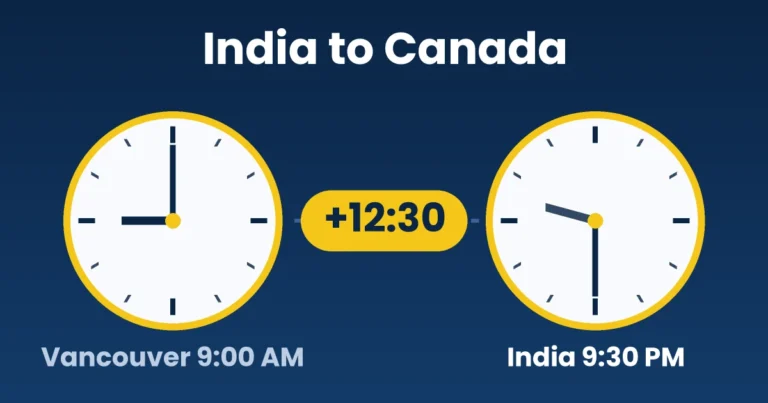
If you want the answer for a specific day and city without calculating, use our free India–USA time difference tool. It uses the same time zone data as this guide. If you are also planning Canada, read our guide to the India–Canada time gap in 2026, because three Canadian provinces changed their clock rules this year. All our calculators are on the tools page. Planning a first long trip? See our first-time international travel tips.
Frequently asked questions
How do I calculate the time difference between India and USA?
Find the US zone, check whether US daylight saving is on, then add the gap to US time to get Indian time, or subtract it to go the other way. Check the date if you pass midnight. For example, New York in winter is 10 hours 30 minutes behind India, so 7:00 AM in New York is 5:30 PM in India.
What is the time difference between India and New York?
India is 9 hours 30 minutes ahead of New York until 31 October 2026. From 1 November 2026 to 13 March 2027 the gap is 10 hours 30 minutes.
What is the time difference between India and California?
India is 12 hours 30 minutes ahead of California until 31 October 2026. From 1 November 2026 to 13 March 2027 the gap is 13 hours 30 minutes.
What time is 7 AM EST in India?
7:00 AM EST is 5:30 PM in India on the same day. If the US is on daylight time, 7:00 AM EDT is 4:30 PM in India.
What time is 7 PM IST in the USA?
7:00 PM in India is 8:30 AM EST in New York on the same day, or 9:30 AM EDT in summer. In Los Angeles it is 5:30 AM PST, or 6:30 AM PDT in summer.
Does India have daylight saving time?
No. India uses Indian Standard Time, UTC+5:30, all year, so only the US clocks change the gap.
Which US state is closest to Indian time?
The states in the Eastern time zone, such as New York, Florida and Georgia, have the smallest gap: 9 hours 30 minutes in US summer and 10 hours 30 minutes in US winter.
Why does the time difference between the USA and India change twice a year?
The USA moves its clocks forward in March and back in November, but India does not change its clocks. Each US change moves the gap by one hour.
Sources and how we checked
- Wikipedia: Daylight saving time in the United States
- Wikipedia: Indian Standard Time
- Drishti IAS: Legal Metrology (Indian Standard Time) Rules, 2026
The gaps and examples in this guide are calculated from the 2026 release of the IANA time zone database. US daylight saving dates follow the second Sunday of March and the first Sunday of November, which gives 1 November 2026 and 14 March 2027. This guide is general information. For visa, flight or legal deadlines, always use the official source. Last updated 11 October 2026.

Varinder Kaur is from Amritsar, India. She has traveled to well-known places across India, including Darjeeling, and to a few countries abroad, and shares travel experiences and practical tips for travelers through OpinionHook.




2 Comments
Comments are closed.