India–Canada Time Gap 2026: BC, Alberta, Manitoba Rules
Quick answer: India is 8 hours to 12 hours 30 minutes ahead of Canada, depending on the province (9 hours 30 minutes to 12 hours 30 minutes from Toronto to Vancouver). Vancouver is always 12 hours 30 minutes behind India, Calgary is 11 hours 30 minutes behind and Winnipeg is 10 hours 30 minutes behind. Toronto is 9 hours 30 minutes behind India now, and 10 hours 30 minutes behind from 1 November 2026 until 14 March 2027. In 2026, British Columbia, Alberta and Manitoba stopped changing their clocks, so for those three provinces the gap no longer moves during the year.
Canada used to be easy to explain: clocks changed twice a year everywhere except Saskatchewan and a few small areas. In 2026 that stopped being true. Three large provinces left the clock-change cycle, while Ontario, Quebec and the Atlantic provinces did not. This guide gives the exact gap from India for each place, explains what changed and when, shows how to work out any time yourself, and lists the best hours to call or meet. The gaps are calculated from the international time zone database (the IANA tz database) that phones and computers use, and the rule changes were checked against provincial announcements. Last updated 11 October 2026.
Key takeaways
- India (IST, UTC+5:30) never changes its clocks, so only the Canadian side moves the gap.
- British Columbia and Yukon are 12 hours 30 minutes behind India all year.
- Alberta and Saskatchewan are 11 hours 30 minutes behind India all year.
- Manitoba is 10 hours 30 minutes behind India all year, because it will skip the fall clock change in 2026.
- Ontario, Quebec and most of Atlantic Canada still change clocks on 1 November 2026 and 14 March 2027, so their gap changes by one hour each time.
- If you saved a winter gap for Vancouver, Calgary or Winnipeg last year, it is now one hour smaller.
India–Canada time difference at a glance
The table shows how many hours India is ahead of each Canadian time zone. A bigger number means more hours between the two clocks.
| Place | Clock rule | Gap until 31 Oct 2026 | Gap 1 Nov 2026 to 13 Mar 2027 | Gap from 14 Mar 2027 |
|---|---|---|---|---|
| Vancouver, Victoria (BC) | Permanent UTC−7 since 8 Mar 2026 | 12 h 30 min | 12 h 30 min | 12 h 30 min |
| Whitehorse (Yukon) | UTC−7 all year | 12 h 30 min | 12 h 30 min | 12 h 30 min |
| Calgary, Edmonton (Alberta) | Alberta Time, UTC−6 all year | 11 h 30 min | 11 h 30 min | 11 h 30 min |
| Regina, Saskatoon (Saskatchewan) | UTC−6 all year | 11 h 30 min | 11 h 30 min | 11 h 30 min |
| Winnipeg (Manitoba) | UTC−5 all year from 1 Nov 2026 | 10 h 30 min | 10 h 30 min | 10 h 30 min |
| Toronto, Ottawa, Montreal | Changes clocks | 9 h 30 min | 10 h 30 min | 9 h 30 min |
| Halifax (Nova Scotia) | Changes clocks | 8 h 30 min | 9 h 30 min | 8 h 30 min |
| St. John’s (Newfoundland) | Changes clocks | 8 h | 9 h | 8 h |
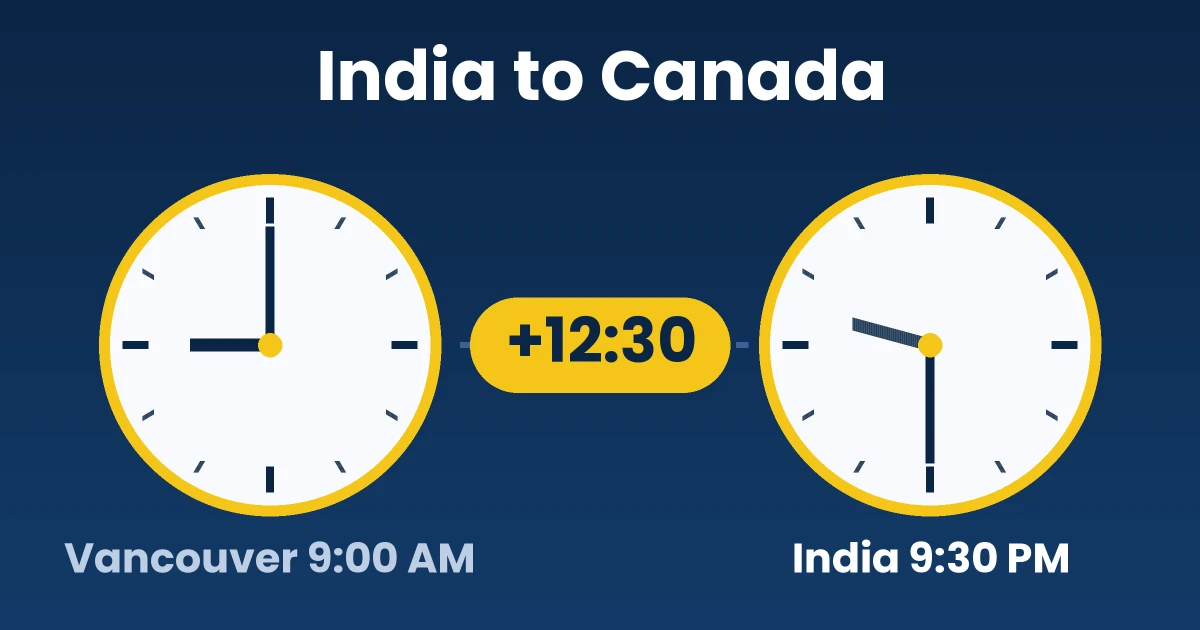
If you remember only one rule, remember this: add the gap to the Canadian time to get Indian time. For example, 9:00 AM in Vancouver plus 12 hours 30 minutes is 9:30 PM in India on the same day.
How many hours difference between India and Canada?
If you search how many hours difference between India and Canada, or how much time difference between India and Canada, the short answer is between 8 hours (St. John’s) and 12 hours 30 minutes (Vancouver). Most people mean Toronto, which is 9 hours 30 minutes now and 10 hours 30 minutes from 1 November 2026.
The time gap between India and Canada is not one number, because Canada has six main time zones. Canada time compared to India depends on the province, and Indian time is always ahead, so to convert Canada time to Indian time you add the gap. The same is true for Ontario: Toronto, Ottawa and Montreal share one gap, and it changes on 1 November 2026 and 14 March 2027.
The table shows the Indian time for popular Canadian hours, such as 12:00 AM or 8:00 AM Canada time in India. Each cell is the time in India at that moment.
| Canada local time | Vancouver | Calgary | Winnipeg | Toronto until 31 Oct 2026 | Toronto 1 Nov 2026 to 13 Mar 2027 |
|---|---|---|---|---|---|
| 12:00 AM | 12:30 PM | 11:30 AM | 10:30 AM | 9:30 AM | 10:30 AM |
| 8:00 AM | 8:30 PM | 7:30 PM | 6:30 PM | 5:30 PM | 6:30 PM |
| 9:00 AM | 9:30 PM | 8:30 PM | 7:30 PM | 6:30 PM | 7:30 PM |
| 12:00 PM | 12:30 AM (next day) | 11:30 PM | 10:30 PM | 9:30 PM | 10:30 PM |
| 5:00 PM | 5:30 AM (next day) | 4:30 AM (next day) | 3:30 AM (next day) | 2:30 AM (next day) | 3:30 AM (next day) |
| 8:00 PM | 8:30 AM (next day) | 7:30 AM (next day) | 6:30 AM (next day) | 5:30 AM (next day) | 6:30 AM (next day) |
What changed in Canada in 2026
In Canada, each province and territory decides its own time, not the federal government. That is why the country now looks like a patchwork. Three provinces made changes this year.
British Columbia: permanent Pacific time (UTC−7)
BC made its last clock change on 8 March 2026 and now stays on what used to be its summer time all year. Vancouver is therefore UTC−7 in winter as well as summer. Before the change, Vancouver was UTC−8 in winter, which made the gap from India 13 hours 30 minutes. Now it is 12 hours 30 minutes all year. Some areas in the east and south-east of BC, such as the Peace River region (Dawson Creek, Fort St. John) and Creston, were already on UTC−7 all year, so in winter they now share Vancouver’s clock.
Alberta: Alberta Time (ABT), UTC−6
The Alberta government calls its new clock Alberta Time (ABT), fixed at UTC−6. Alberta stops switching back to standard time in the fall, so on 1 November 2026 Calgary and Edmonton do not move their clocks back. The international time zone database recorded the change as official on 18 June 2026. For India, Calgary’s gap stays at 11 hours 30 minutes all year. In winter it used to be 12 hours 30 minutes.
Manitoba: permanent daylight time (UTC−5)
Manitoba will also skip the fall change on 1 November 2026 and stay on UTC−5. Winnipeg’s gap from India stays at 10 hours 30 minutes all year. In winter it used to be 11 hours 30 minutes.
Places that did not change: Saskatchewan and Yukon
Saskatchewan stays on UTC−6 all year, as it has for decades (the Lloydminster area follows Alberta). Yukon has stayed on UTC−7 all year since 2020. Nothing changed for them in 2026, but because BC and Alberta moved, the neighbours now match in winter: Alberta has the same clock as Saskatchewan, and BC has the same clock as Yukon.
Provinces that still change their clocks
Ontario, Quebec, New Brunswick, Nova Scotia, Prince Edward Island, and Newfoundland and Labrador still move their clocks twice a year. Their clocks go back one hour at 2:00 AM on Sunday 1 November 2026 and forward one hour on Sunday 14 March 2027. For India, the gap grows by one hour in November and shrinks by one hour in March.
A few small areas inside these provinces follow a different rule. For example, parts of south-eastern Labrador and the Lower North Shore of Quebec stay on Atlantic time all year. If you are dealing with a very small town, check the local rule. The territories of Nunavut and the Northwest Territories have their own arrangements, which this guide does not cover.
The next 12 months at a glance
| Date | What happens | Effect on the gap from India |
|---|---|---|
| Now to 31 Oct 2026 | Every province is on its current clock | Toronto 9 h 30 min, Winnipeg 10 h 30 min, Calgary 11 h 30 min, Vancouver 12 h 30 min |
| 1 Nov 2026, 2:00 AM | Ontario, Quebec and the Atlantic provinces go back 1 hour. BC, Alberta and Manitoba do not change | Toronto 10 h 30 min, Halifax 9 h 30 min, St. John’s 9 h. Vancouver, Calgary and Winnipeg stay the same |
| 14 Mar 2027, 2:00 AM | Ontario, Quebec and the Atlantic provinces go forward 1 hour | Toronto returns to 9 h 30 min, Halifax to 8 h 30 min, St. John’s to 8 h |
| Autumn 2027 | Eastern and Atlantic provinces are expected to go back again, unless a province announces a change | Check this page before you plan |
City-by-city guide
These notes show what a normal 9:00 AM to 5:00 PM working day in each Canadian city looks like on Indian clocks.
Toronto, Ottawa and Montreal (Eastern time)
The gap is 9 hours 30 minutes until 31 October 2026, then 10 hours 30 minutes from 1 November 2026, then 9 hours 30 minutes again from 14 March 2027. A 9:00 AM to 5:00 PM day in Toronto is 6:30 PM to 2:30 AM in India before 1 November, and 7:30 PM to 3:30 AM after it. This zone suits Indian evening calls best.
Winnipeg (Manitoba)
The gap is 10 hours 30 minutes all year from now on. A 9:00 AM to 5:00 PM day in Winnipeg is 7:30 PM to 3:30 AM in India. One side effect: Winnipeg and Toronto share the same clock in winter (November to March), but in summer Toronto is one hour ahead of Winnipeg.
Calgary and Edmonton (Alberta)
The gap is 11 hours 30 minutes all year. A 9:00 AM to 5:00 PM day in Calgary is 8:30 PM to 4:30 AM in India. Regina and Saskatoon in Saskatchewan have the same gap.
Vancouver and Victoria (British Columbia)
The gap is 12 hours 30 minutes all year. A 9:00 AM to 5:00 PM day in Vancouver is 9:30 PM to 5:30 AM in India. The overlap with an Indian morning is the Vancouver evening: 7:30 PM in Vancouver is 8:00 AM in India. Whitehorse in Yukon has the same gap.
Halifax and St. John’s (Atlantic Canada)
These are the Canadian cities closest to Indian time. Halifax is 8 hours 30 minutes behind India until 31 October 2026 and 9 hours 30 minutes behind after it. St. John’s in Newfoundland is 8 hours behind until 31 October and 9 hours behind after it. Before 1 November, a 9:00 AM start in Halifax is 5:30 PM in India, and a 9:00 AM start in St. John’s is 5:00 PM in India, so there is a short overlap with an Indian working day.
How to work out the time yourself
- Find the Canadian city’s gap from India in the table above. It depends on the date for Ontario, Quebec and the Atlantic provinces.
- Add the gap to the Canadian time to get Indian time, or subtract it to go the other way.
- If the answer passes midnight, move the date forward by one day when adding, or back by one day when subtracting.
Here are worked examples using those gaps:
- 9:00 AM in Toronto on 20 October 2026 (gap 9 hours 30 minutes) is 6:30 PM in India on the same day.
- 9:00 AM in Toronto on 20 November 2026 (gap 10 hours 30 minutes) is 7:30 PM in India on the same day.
- 9:00 AM in Calgary is 8:30 PM in India on the same day, all year.
- 6:00 PM in India is 5:30 AM in Vancouver on the same day, and 7:30 AM in Toronto in winter.
- 8:00 AM in India is 7:30 PM in Vancouver on the previous day.
Best times to call or meet
The table below shows the hours when it is between 8:00 AM and 9:30 PM on both sides. These are polite hours for most people. For close family you can stretch them a little.
| Place | Canadian time | India time |
|---|---|---|
| Toronto (until 31 Oct 2026) | 8:00 AM to 12:00 PM | 5:30 PM to 9:30 PM |
| Toronto (1 Nov 2026 to 13 Mar 2027) | 8:00 AM to 11:00 AM | 6:30 PM to 9:30 PM |
| Winnipeg (all year) | 8:00 AM to 11:00 AM | 6:30 PM to 9:30 PM |
| Calgary (all year) | 8:00 AM to 10:00 AM 8:30 PM to 9:30 PM | 7:30 PM to 9:30 PM 8:00 AM to 9:00 AM (next day) |
| Vancouver (all year) | 8:00 AM to 9:00 AM 7:30 PM to 9:30 PM | 8:30 PM to 9:30 PM 8:00 AM to 10:00 AM (next day) |
For work calls and interviews
Toronto and Winnipeg have the widest overlap with India, mostly in the Indian evening. For Alberta and British Columbia the overlap is two short windows, one in the Indian evening and one in the Indian morning, so book early. Always write the time in both zones in the invite, for example 9:00 AM PT / 9:30 PM IST, and pick the city (not just Pacific or Mountain time) in your calendar app so it converts correctly.
For family calls
Weekends work best because both sides are more flexible. For a fuller plan, including how to share the schedule with older relatives, see our guide on the best time to call family abroad from India.
Who needs to watch this change most
Students and visa applicants
Universities and visa offices publish deadlines in Canadian local time. A deadline of 11:59 PM in Vancouver is 12:29 PM the next day in India. A deadline of 11:59 PM in Toronto in winter is 10:29 AM the next day in India. Always confirm a deadline on the official website, and set your reminder in the city’s time zone. For the general steps of a visa application, see our step-by-step visa application guide for Indians.
Families and travellers
Flight tickets show the local time at each airport, so your arrival time in Canada is in Canadian local time, and your body clock will be about 8 to 12 hours away from it. Our jet lag guide for India to the USA uses the same method and works for Canada too. If this is your first long trip, read our first-time international travel tips before you fly.
Remote workers and businesses
If a contract or meeting says Pacific time or Mountain time, check which clock it means, because Alberta and BC no longer move together in winter. Name the city in the invite, and re-check recurring meetings around 1 November 2026 and 14 March 2027.
Common mistakes to avoid
- Using last winter’s gap for Vancouver, Calgary or Winnipeg. It is now one hour smaller in winter.
- Assuming all of Canada changes clocks on 1 November. BC, Alberta, Manitoba, Saskatchewan and Yukon do not.
- Treating Mountain time as one clock. In winter, Calgary is now UTC−6, while the Peace River area of BC and Creston are UTC−7.
- Thinking India’s clock changed. India never changes its clocks, so if the gap moved, the Canadian clock moved.
- Saying Canada time. Canada has six main time zones, so always name the city.
Why Canada’s clocks are still changing
BC, Alberta and Manitoba chose to stop the twice-a-year change and stay on one clock all year. Ontario, Quebec and the Atlantic provinces have not, as of 11 October 2026. Because time is a provincial decision, more provinces could announce changes later. We update this page when a province makes an official announcement.
Check the live gap
Want the answer for today’s date and an exact city? Use our free India–Canada time difference tool, or compare with the India–USA time difference tool. Going to the USA instead? Read how to calculate the time difference between India and the USA. All our calculators are on the tools page.
Frequently asked questions
What is the time difference between India and Canada?
India is ahead of Canada by 8 hours (St. John’s) to 12 hours 30 minutes (Vancouver), depending on the province and the date. For the cities most people ask about, the gap is 9 hours 30 minutes for Toronto until 31 October 2026 and 10 hours 30 minutes from 1 November, 10 hours 30 minutes for Winnipeg, 11 hours 30 minutes for Calgary and 12 hours 30 minutes for Vancouver.
What is the time difference between India and Vancouver?
India is 12 hours 30 minutes ahead of Vancouver. This is now the gap all year, because British Columbia made its last clock change on 8 March 2026 and stays on UTC−7. Before that change, the winter gap was 13 hours 30 minutes.
What is the time difference between India and Toronto?
India is 9 hours 30 minutes ahead of Toronto until the clocks go back on 1 November 2026. From 1 November 2026 to 13 March 2027 the gap is 10 hours 30 minutes. On 14 March 2027 it returns to 9 hours 30 minutes.
Do British Columbia and Alberta still change their clocks?
No. British Columbia stays on UTC−7 all year and Alberta stays on UTC−6 all year. Manitoba will also stop changing clocks and stay on UTC−5. Saskatchewan and Yukon already stayed on one clock all year.
Which Canadian city is closest to Indian time?
St. John’s in Newfoundland and Halifax in Nova Scotia are closest. St. John’s is 8 hours behind India until 31 October 2026 and 9 hours behind after it. Halifax is 8 hours 30 minutes behind until 31 October and 9 hours 30 minutes behind after it.
Does Canada have one time zone?
No. Canada has six main time zones: Pacific, Mountain, Central, Eastern, Atlantic and Newfoundland. Provinces and territories decide their own time, so always name the city when you plan a call.
What is 9 AM in Toronto in Indian time?
9:00 AM in Toronto is 6:30 PM in India until 31 October 2026. From 1 November 2026 to 13 March 2027 it is 7:30 PM in India. Both times are on the same day.
What is the best time to call Canada from India?
For Toronto and Winnipeg, the Indian evening, roughly 6:30 PM to 9:30 PM, is best because it is morning in Canada. For Calgary and Vancouver the overlap is short: about 7:30 PM to 9:30 PM in India reaches Calgary in the morning, and about 8:30 PM to 9:30 PM or 8:00 AM to 10:00 AM in India reaches Vancouver. Check the call-time table above for exact windows.
How many hours difference is there between India and Canada?
The difference is between 8 hours and 12 hours 30 minutes, depending on the province. Toronto is 9 hours 30 minutes behind India until 31 October 2026, then 10 hours 30 minutes. Vancouver is 12 hours 30 minutes behind, Calgary 11 hours 30 minutes and Winnipeg 10 hours 30 minutes.
What is the time difference between India and Ontario?
Ontario, including Toronto and Ottawa, is 9 hours 30 minutes behind India until 31 October 2026. From 1 November 2026 to 13 March 2027 it is 10 hours 30 minutes behind.
What is 12 AM Canada time in India?
Midnight (12:00 AM) in Toronto is 9:30 AM in India until 31 October 2026 and 10:30 AM from 1 November 2026. Midnight in Vancouver is 12:30 PM in India, and midnight in Calgary is 11:30 AM in India.
Sources and how we checked
- Moving2Canada: B.C., Alberta, Manitoba won’t turn clocks back
- The Canadian Wire: Which provinces still change clocks on 1 November 2026
- Government of Alberta: Alberta’s new time system (ABT)
- IANA time zone database mailing list: Alberta time zone change is now official
- Wikipedia: Time in British Columbia
The gaps in the tables are calculated from the 2026 release of the IANA time zone database. This guide is general information. For visa, university or legal deadlines, always use the official source. Last updated 11 October 2026.

Varinder Kaur is from Amritsar, India. She has traveled to well-known places across India, including Darjeeling, and to a few countries abroad, and shares travel experiences and practical tips for travelers through OpinionHook.