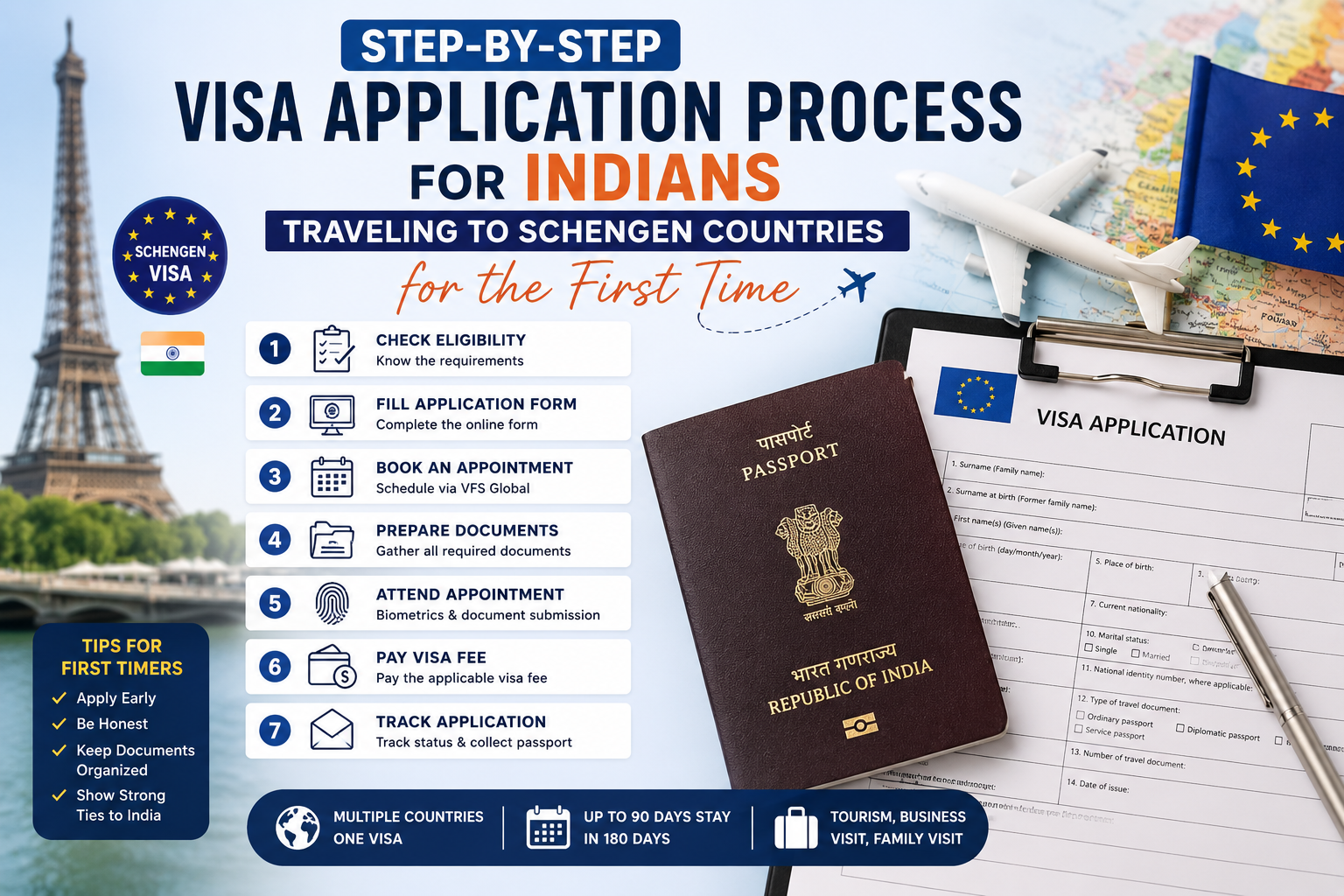
Step-by-Step Visa Application Process for Indians Traveling to Schengen Countries for the First Time
To get a Schengen tourist visa from India, you pick your main destination, fill in the form, book a slot at the visa centre, pay the fee, give your documents and fingerprints, and wait for a decision. The official fee for an adult is 90 euros, and a decision normally comes within 15 days, but it can take up to 45 days. The step most first-timers get wrong is not the form. It is applying late, or sending documents that do not match each other.
This guide walks through the whole process for Indian passport holders in plain language. It covers the order of steps, the documents consulates ask for, how to think about bank balance, travel insurance, fees, timing, and the mistakes that lead to refusals. Rules differ a little from one country to another, so treat this as a map and always confirm the final checklist on the official page of the country you apply to.
Key takeaways
- Apply to the country where you will spend the most nights. If the nights are equal, apply to the country you enter first.
- Apply at least 15 days before travel, and not earlier than 6 months before.
- The adult fee is 90 euros. The visa centre can add its own service charge on top.
- Travel medical insurance is compulsory, with cover of at least 30,000 euros.
- Normal processing is 15 days, and it can stretch to 45 days. Do not book non-refundable tickets before you have the visa.
- Real, consistent documents beat a thick file. Fake bookings and borrowed bank balances are the fastest way to a refusal.
What is a Schengen visa?
A Schengen visa lets you travel to the countries in the Schengen Area on one short-stay visa. You can stay up to 90 days in any 180-day period. Countries in the area include France, Germany, Italy, Spain, the Netherlands, Switzerland, Greece and Austria. If you hold a visa issued by France and your trip also includes Italy and Switzerland, you do not need separate visas for them.
The common tourist visa is the short-stay Type C visa. Study, work and long stays fall under national visas, which have different rules. This guide is only about tourist trips.
Which country should you apply to?
The European Commission gives a clear rule. If you visit several Schengen countries, apply at the consulate of the country where you will spend the most time. If the stays are of equal length, apply to the country you will enter first.
| Trip plan | Where to apply | Why |
|---|---|---|
| France 5 nights, Italy 3 nights, Switzerland 4 nights | France | Longest stay |
| Italy 4 nights, Spain 4 nights, flying into Spain first | Spain | Equal stay, first entry |
| One country only | That country | Only destination |
People sometimes try to apply to a country they think is easier, even though the trip is mostly elsewhere. That is risky. Your tickets, hotel bookings and cover letter will show where you really spend your time, and a mismatch raises questions.
Step-by-step Schengen visa process from India
Step 1: Fix your main destination and dates
Finalise the route before you start. Changing dates in the middle of an application causes mismatched documents. Keep the trip realistic. Five countries in six days looks like a tour you could not really do, and it can weaken your case. If you need ideas for a route, our guide to the best countries to visit in Europe for first-time travelers can help you pick one or two bases.
Step 2: Check your passport
The Commission lists a passport valid for at least 3 months after you leave the Schengen Area. Many consulates also want a passport issued within the last 10 years and with blank pages. For the wider picture on validity rules, read our explainer on the passport six-month rule. Check the rule of your chosen country as well.
Step 3: Fill in the application form
Most countries use an online form or a form you download. You will enter passport details, travel dates, accommodation, job details and who pays for the trip. Your flight plan, hotel stays, leave letter and bank statements should all tell the same story with the same dates. Small inconsistencies are a common cause of delay.
Step 4: Book your appointment
In India, many countries take applications through an external service provider such as VFS Global, while some use their own embassy or another provider. Check the website of the country you chose to see which one applies and to find the real booking link. The visa centre cities differ by country, but major cities like New Delhi, Mumbai, Bengaluru, Chennai, Kolkata and Hyderabad are commonly listed.
The visa code says an appointment should normally be offered within two weeks of your request, but in busy months slots can run out sooner than that. If you plan to travel in May, June or December, start watching for slots early. You can apply up to 6 months before your trip, so there is no need to wait.
Step 5: Gather your documents
The European Commission lists the basics: a completed form, a photo that meets ICAO standards, your passport, medical insurance, and proof of the purpose of your trip, your finances, your accommodation and your intent to return home. Each country then adds its own checklist. For Indian applicants this usually means:
- Passport and copies of the old passport, if any
- Cover letter explaining the trip purpose, dates and who funds it
- Return flight reservation and a day-by-day plan
- Hotel bookings or an invitation letter if staying with family or friends
- Bank statements, usually the last 3 to 6 months (check the exact period on your country checklist)
- Income tax returns or Form 16 for salaried applicants, or business proof for the self-employed
- Employment letter and approved leave letter, or student proof
- Travel insurance policy
The consulate can ask for extra papers, so keep scanned copies ready.
Step 6: Buy travel medical insurance
Insurance is compulsory for a Schengen visa. The rule in the Visa Code is cover of at least 30,000 euros, and it must include emergency medical care, hospital treatment and repatriation, including in case of death. It must be valid in all Schengen countries for the entire stay. Many Indian insurers sell Schengen-compliant plans. Whichever you pick, read the policy wording and make sure it states Schengen cover, the 30,000 euro limit and your exact travel dates. Do not choose only on price.
Step 7: Pay the fee
The official visa fee is 90 euros for adults and 45 euros for children aged 6 to 12. The visa centre may charge an extra service fee, and optional services like courier or SMS cost more. Rupee amounts move with the exchange rate and the centre’s own charges, so check the official website of the country or its provider on the day you pay.
Step 8: Attend the appointment and give biometrics
You submit your file and your fingerprints and photo are taken. Fingerprints are collected at the time of application for most applicants. For a tourist visa this visit is often only about documents and biometrics, but a consulate can call you for an interview or ask for more papers later.
Step 9: Wait for the decision
The Commission says a decision normally takes 15 days, and up to 45 days if your case needs a closer look or extra documents. Treat the 45 days as a real possibility in peak months, and do not buy non-refundable flights until you have the visa in your passport.
Step 10: Check the visa sticker
When the passport comes back, check your name spelling, passport number, validity dates, number of entries and the allowed days. If anything is wrong, tell the visa centre straight away.
How much bank balance do you need?
There is no single amount for every country. Each consulate looks at whether your money can cover the trip: travel, stay, food and local costs, for the number of days you plan. Some countries publish a daily amount in their checklist, so look for that first.
What matters more than a number is a believable history. Regular salary credits and steady savings look natural. A large, sudden deposit just before applying, or money parked in your account for a few weeks, can raise questions about where it came from. If someone else, such as a parent or spouse, is paying for the trip, include a sponsorship letter and their own bank proof with a clear relationship document. If you plan your finances early, you have time to build a clean statement instead of fixing it later.
What helps an application, and what hurts it
| Usually helps | Usually hurts |
|---|---|
| Stable income and regular bank activity | Sudden unexplained deposits |
| Realistic itinerary matching your leave days | Too many countries in too few days |
| Consistent dates across all documents | Documents that contradict each other |
| Clear cover letter | Fake or unverifiable bookings and letters |
| Proof of ties to India: job, family, property | Unclear reason to return home |
The EU publishes refusal statistics, but there is no secret formula. Consulates assess each file on its own, so honest and clear paperwork is the safest approach. On hotel bookings, use real reservations that you can cancel for free, rather than made-up confirmations. A forged document can lead to a refusal and may affect future applications.
Common reasons for refusal
Consulates refuse applications for reasons such as unclear purpose or conditions of the stay, not enough proof of funds, doubts that you will leave before the visa expires, or documents that look false. Each of these is something you can control with careful preparation. If you are refused, you get a written reason and a way to appeal. Read the reason carefully before reapplying, because sending the same file again rarely helps.
Does a visa guarantee entry?
No. A visa allows you to travel to the border, and the border officer makes the final decision on entry. The EU is also rolling out its Entry/Exit System, which records fingerprints and a photo of non-EU visitors at the border. Our guide on EES at Schengen borders for Indian travellers explains what to expect. Airport screening has its own rules too, which we cover in European airport security rules.
If you travel to Europe often
Indian citizens who have already obtained and lawfully used two Schengen visas in the previous three years can get a multiple-entry visa valid for two years, under a 2024 European Commission decision for applications from India. Member states can still decide differently in individual cases, so it is not automatic. First-time applicants follow the normal rules.
Plan the money around the visa
Once the visa is approved, the budget is the next job. Our step-by-step guide to planning a Europe trip on a budget covers flights, stays and daily costs, and if you want to see where else you can go without a visa, check visa-free countries for Indians in 2026.
FAQ
How long does Schengen visa processing take in India?
The European Commission says a decision normally takes 15 days and can take up to 45 days when more checks or documents are needed. Apply early, especially for summer and December travel.
When can I apply for a Schengen visa?
You can apply at least 15 days before your trip and no earlier than 6 months before it. Slots in India can fill up, so booking early is sensible.
How much does a Schengen visa cost for Indians?
The adult fee is 90 euros and the fee for children aged 6 to 12 is 45 euros. The visa centre may add a service fee, so check the final amount on the official site of your chosen country.
Is travel insurance mandatory for a Schengen visa?
Yes. The policy must cover at least 30,000 euros for emergency medical care, hospital treatment and repatriation, and must be valid across the Schengen Area for your whole stay.
Is VFS Global the same as the embassy?
No. A visa centre only collects documents and biometrics and handles appointments. The embassy or consulate takes the decision, and the centre cannot promise approval.
How this guide was checked
The fee, timing, insurance, document and where-to-apply points were checked on 10 October 2026 against the European Commission pages and the legal texts listed below. Country checklists, bank statement periods, service charges and appointment systems change, so confirm them on the official page of the country you apply to. This is general information, not legal or immigration advice.
Sources
- European Commission: Applying for a Schengen visa
- EU Visa Code, Regulation (EC) No 810/2009 on EUR-Lex
- Commission Implementing Decision on multiple-entry visas for Indian nationals (18 April 2024)
Already have one or two Schengen visas? Read how the Schengen cascade for Indians can lead to longer multiple-entry visas, and if a visa was refused, see the common Schengen visa rejection reasons and what to fix.
Related Guides
- Best Countries to Visit in 2026 With Easy Visa Options for Indian Travelers
- Visa-Free Countries for Indians in 2026: What Changed and the Current List
- Japan Tourist Visa Guide (2026): Requirements, Documents and Fees
- EES at Schengen Borders in 2026: What Indian Travellers Should Expect
Browse all of our Europe Travel guides.

Varinder Kaur is from Amritsar, India. She has traveled to well-known places across India, including Darjeeling, and to a few countries abroad, and shares travel experiences and practical tips for travelers through OpinionHook.






7 Comments
Comments are closed.