Secondary Cities vs Tourist Hotspots: Why Visit Smaller Cities
Secondary cities are important regional cities that get far fewer international tourists than a country’s famous hotspots. Visiting one, such as Bologna instead of only Rome, or Lyon instead of only Paris, often means smaller crowds, easier bookings, a stronger local feel and, in many cases, lower costs. You do not have to skip the famous places. Pairing one big name with one smaller city is usually the best balance.
This guide explains what secondary cities are, why travellers are choosing them, how they compare with tourist hotspots, and how Indian travellers can fit them into a Europe or Japan trip without making the visa side harder.
Key takeaways
- A secondary city is a significant regional city with far fewer international visitors than the headline destinations.
- Smaller crowds make it easier to book, to walk around and to meet local people.
- Costs are often lower for hotels and restaurants, but not always. Compare real prices for your dates.
- Visiting them spreads tourism spending more widely and eases pressure on overcrowded places.
- Many long-haul flights from India land at big hubs, so plan a train or short flight onward.
- On a Schengen visa, check the main destination rule before adding cities in other countries.
- A balanced plan: one famous city plus one or two lesser-known ones.
What are secondary cities?
A secondary city is a destination that matters within its country or region but attracts significantly fewer international tourists than the major tourism centres. These are not remote villages. They are real cities with history, strong local culture, good food and plenty to see.
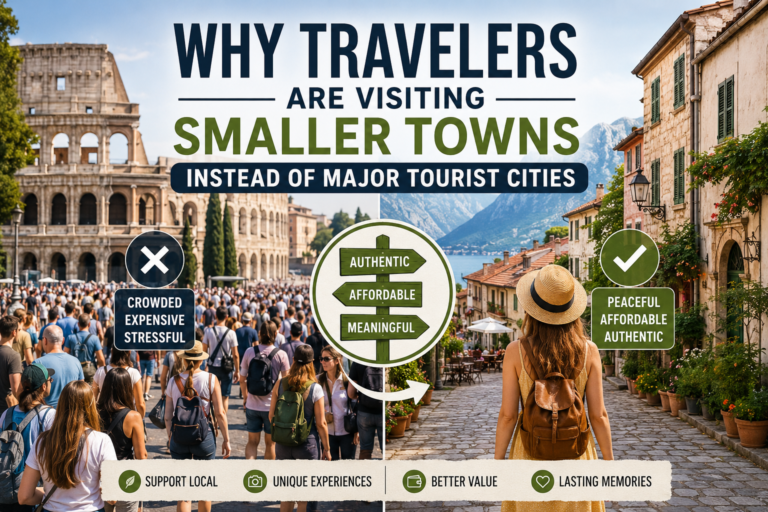
Examples include Bologna, Valencia, Lyon, Fukuoka, Porto and Ghent. They get fewer international visitors than their more famous counterparts, but many travellers find them equally rewarding. If you are looking for even smaller places, see our article on why visit smaller towns instead of major tourist cities.
Why visit secondary cities instead of popular destinations?
The main reason is that the experience often feels more natural. Major tourist cities can become victims of their own success. When millions of visitors arrive, businesses adapt to tourism demand. Restaurants start catering to visitors rather than residents, souvenir shops replace neighbourhood stores and historic districts stay crowded all day.
Secondary cities usually keep a stronger link to everyday life. You can enjoy the place without feeling that you are moving through a tourism machine.
Why are travellers looking beyond the famous hotspots?
Many travellers are frustrated by overtourism. Popular destinations often come with:
- Long queues at attractions
- Crowded streets
- Higher hotel prices
- Long waits at restaurants
- Higher transport costs at peak times
Cities such as Venice, Barcelona, Amsterdam and Dubrovnik are often mentioned in discussions about overtourism. Venice, for example, has introduced an access fee for day visitors on selected peak days, according to reports about its 2026 calendar. The fee is a sign of how seriously some places now treat crowd pressure. These cities are still wonderful to visit. The goal is not to avoid them. It is to find a better balance between popular sights and authentic experiences.
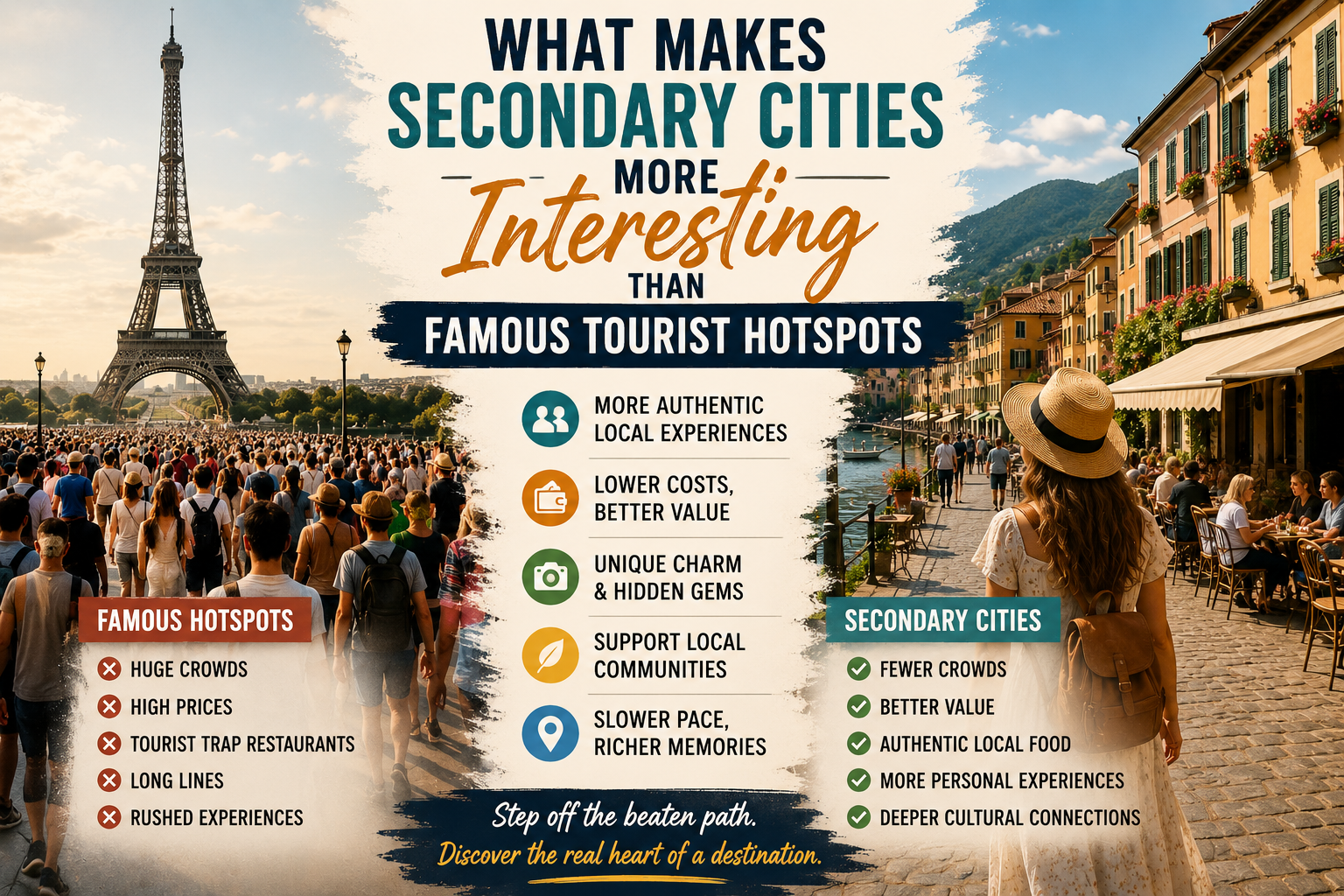
Secondary cities vs famous tourist hotspots
| Secondary cities | Famous tourist hotspots |
|---|---|
| Smaller crowds | Large crowds |
| More local atmosphere | Heavy tourism presence |
| Often lower costs | Often higher costs |
| Easier reservations | High demand at peak times |
| Slower pace | Faster pace |
| More resident-focused businesses | More tourist-focused businesses |
| Easier to meet local people | Less local interaction |
| Often underrated attractions | World-famous attractions |
Both types have value. The table shows common tendencies, not rules, and every city is different.
What makes secondary cities more interesting?
The answer is access. In a secondary city you often get easier access to local culture, people, food and traditions. Instead of competing with thousands of other visitors for the same experience, you can engage with the place more naturally. That usually leads to stronger memories. Our article on what makes a trip memorable explains why connection often beats fame.
A better trip does not always come from seeing the most famous landmark. It often depends on how a place makes you feel. Secondary cities often offer less stress, more flexibility, better value and more genuine interactions. Without constant crowds, it is easier to notice architecture, local life and everyday details.
Three city pairs to compare
These are examples to help you think, not rankings. Every traveller likes different things.
Bologna and Rome
Rome is one of the world’s most visited cities and has landmarks like the Colosseum and the Trevi Fountain. Bologna has fewer international visitors, but offers historic architecture, lively public squares, a strong food culture and walkable streets. It is closely associated with dishes such as ragu alla Bolognese and handmade pasta. If you are visiting Italy for the first time, consider seeing Rome and then adding Bologna.
Valencia and Barcelona
Barcelona is famous for its architecture, beaches and culture. Valencia offers Mediterranean beaches, historic districts, modern architecture and a strong food scene, with a different, calmer feel. The paella dish is closely associated with the Valencia region. Many travellers choose Valencia as an alternative or an addition when they want Spanish culture without the heaviest crowds.
Lyon and Paris
Paris deserves its reputation. But some travellers find Lyon more relaxed. Lyon is often described as a food capital of France, and combines historic neighbourhoods, river scenery and cultural attractions. Queues at major sights are often shorter than in the busiest parts of Paris, though this depends on the season.
Why do secondary cities often feel more authentic?
“Authentic” is an overused word in travel, but many people notice a real difference. In places with lower tourism volumes, local businesses often serve residents first, neighbourhoods keep more of their original character, restaurants focus on local customers and community traditions stay visible.
This does not mean famous places are fake. It means that in secondary cities, local life is often easier to observe and join. There are fewer layers of tourist infrastructure between you and daily culture. If this idea appeals to you, our guide on experiencing a country like a local goes further.
The rise of underrated destinations
Many travellers now ask “Where can I have the best experience?” instead of “Where is everyone going?” That shift has given secondary cities more attention. Places once treated as side trips are increasingly becoming main destinations. If you enjoy discovering lesser-known places, our list of hidden travel destinations has more ideas.
If you have ever visited a famous landmark and spent more time in the queue than at the attraction, you already understand why this is happening. Sometimes the best part of a trip is the place nobody told you about.
How to find a good secondary city
A simple way is to look beyond a country’s most famous destination. Here are some pairings you can use as a starting point:
| Famous destination | Secondary city alternative |
|---|---|
| Paris | Lyon |
| Barcelona | Valencia |
| Rome | Bologna |
| Amsterdam | Utrecht |
| Prague | Brno |
| Tokyo | Fukuoka |
| Lisbon | Porto |
| Brussels | Ghent |
To choose one, try these steps:
- Check a map for regional cities within two or three hours by train of the famous city.
- Look for a university, a food market or a historic centre, which usually means a lively local scene.
- Read recent reviews from visitors, and look for local-language sources too.
- Compare train or bus times, and check the schedule on the day you plan to travel.
- Book at least the first night, and keep the rest flexible.
This does not mean skipping famous destinations. Combine one major city with one or two lesser-known ones.
How do secondary cities change the way you travel?
In famous hotspots, travellers often feel pressure to visit every major attraction, follow strict schedules and tick off landmarks. Secondary cities naturally encourage a slower pace. Without dozens of must-see attractions competing for attention, you can spend more time exploring neighbourhoods, visiting local cafes, talking with residents, enjoying public spaces and learning about traditions. That tends to build a more personal connection with the place. For more on this style, read our guide on slow travel and how to plan it.
Why can food be better in secondary cities?
Food is one of the strongest reasons people choose secondary cities. In busy tourist centres, restaurants near major sights often cater mainly to visitors. In secondary cities, local residents make up a larger share of customers, so restaurants may focus more on local traditions than on tourism trends.
- Lyon is known for traditional French cuisine.
- Bologna is known for handmade pasta and regional specialities.
- Valencia is closely tied to paella.
- Porto is known for its food markets and local Portuguese dishes.
If you eat vegetarian, check menus in advance, since traditional regional dishes in some cities are meat-based. Local markets and bakeries are good fallback options, and many cities now have vegetarian restaurants.
Do secondary cities usually cost less?
Often, but not always. Hotels, restaurants and sometimes attraction tickets can cost less in smaller cities than in the world’s busiest tourist spots. Local transport costs can be similar. The table shows what tends to differ, not a price list.
| Expense | Major tourist hotspot | Secondary city |
|---|---|---|
| Hotels | Often higher | Often lower |
| Restaurants | Often higher near sights | Often lower in local areas |
| Attraction tickets | Often higher | Sometimes lower |
| Local transport | Similar | Similar |
| Overall daily budget | Often higher | Often more affordable |
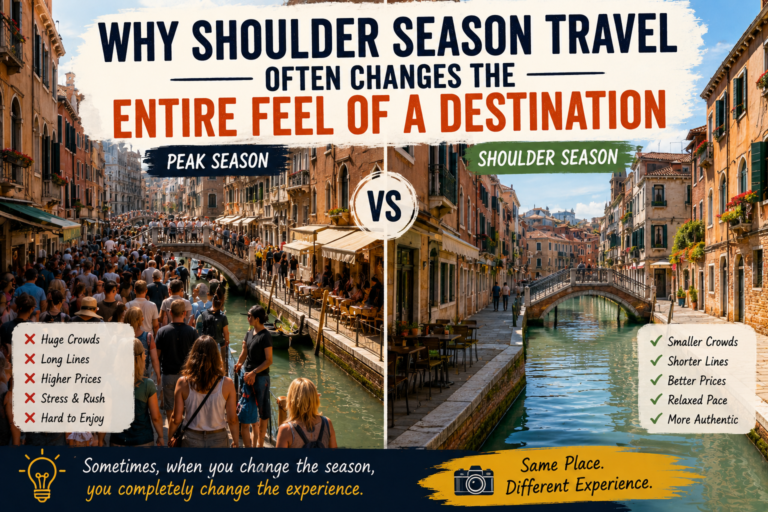
Prices depend on season, events and exchange rates. Before you decide, compare real prices for your dates. Our Europe budget guide shows how to build a budget in rupees, and the article on shoulder season vs peak season explains how timing changes costs.
How do secondary cities help reduce overtourism?
Overtourism has become a challenge for some destinations. When travellers choose secondary cities, spending spreads across a wider region. This can benefit local businesses, regional economies, community infrastructure and cultural preservation. It also helps reduce congestion in cities already under heavy pressure. The effect of any one trip is small, but travel choices add up.
Are the attractions as good?
People sometimes assume lesser-known cities lack attractions. In reality, many offer historic architecture, museums, food markets, festivals, scenic neighbourhoods and local traditions. The difference is that the experiences often feel more accessible. You can enjoy sights at a more relaxed pace instead of competing with crowds.
Practical tips for Indian travellers
Check the Schengen main destination rule
If you travel to several Schengen countries, you generally apply to the country that is your main destination. According to the EU’s guidance on applying for a Schengen visa, if you spend the longest period in one country, that is your main destination, and if you spend equal time in each, it is the country of entry. Adding a secondary city inside the same country usually does not change this, but adding a city in a different country might. Check the official rules and the consulate’s checklist before booking. Our Schengen visa step-by-step guide explains the process.
Plan how you will get there
You will often arrive at a big hub airport and continue by train, bus or a short flight. Check timetables, luggage rules and ticket prices in advance. For multi-city logistics, see multi-country trip planning.
Consider Japan too
The same idea applies in Japan, where cities such as Fukuoka can be an alternative or addition to Tokyo. See our Japan itineraries for 3 to 14 days for planning a route.
Look closer to home
The idea works in India too. Instead of the most famous tourist city in a state, consider a nearby regional city and compare crowds, food and costs. Treat this as a starting point for your own research, not a rating.
A simple rule for your next trip
On your next international trip, spend at least a third of your time in a secondary city. If you are visiting Italy, add Bologna to Rome and Florence. If you are going to Spain, add Valencia to Madrid or Barcelona. In France, consider Lyon along with Paris. This keeps the big sights on your list while making space for the unexpected.
Common mistakes
Assuming famous means better
Popularity and quality are not always the same. Many lesser-known places offer experiences that rival the big names.
Spending the whole trip in one major city
Big cities deserve time, but spending all your days in one hotspot narrows your view of a country.
Ignoring local recommendations
Locals often know places that get far less international attention but are great to visit.
Following social media trends blindly
Social media tends to highlight the same destinations again and again. Some of the best experiences happen in places that rarely go viral.
Not checking transport before booking
Some smaller cities have fewer direct connections or less frequent trains. Check schedules, especially for the last train of the day.
How this guide was checked
The Schengen main destination rule was checked against the EU’s guidance document on applying for a Schengen visa. The Venice access fee reference comes from a report on the 2026 calendar published in December 2025, and the 2026 peak days have largely passed, so check Venice’s official site if you plan to visit. City comparisons and cost tendencies are general travel observations rather than statistics, and prices vary by season. Always compare current prices for your own dates.
Frequently asked questions
Why visit secondary cities instead of popular tourist destinations?
They often have fewer crowds, easier bookings, a stronger local feel and sometimes lower costs. You can enjoy the destination more comfortably and see more of everyday life.
What are secondary cities in travel?
They are important regional cities that attract fewer international tourists than major hotspots. They usually have culture, food and history without the same crowds.
Are secondary cities cheaper than famous hotspots?
Often, but not always. Hotels and restaurants can cost less, but prices depend on season and events. Compare prices for your dates.
Do I need a separate visa for a secondary city in Europe?
Not if it is in the Schengen area and your visa covers the countries and dates. You need to apply to the correct country based on your main destination. Check the consulate’s rules.
How do I find underrated destinations?
Look at regional cities near major hubs, read local publications and recent reviews, and check train connections. Often the best options are only a few hours from a famous city.
Final thoughts
Famous destinations earn their reputations. Paris, Rome, Barcelona and Tokyo offer unforgettable experiences. But great travel is not always about the most famous place. Many travellers find that secondary cities give them what they were looking for: connection, value and a clearer view of local life.
The next time you plan a trip, do not only ask where everyone else is going. Ask where you will have the best experience. Pair one famous destination with one secondary city, give yourself time in both and compare.
Sources
- EEAS: How to apply for a Schengen visa (PDF)
- The Local Italy: When will you need to pay a fee to visit Venice in 2026
Related Guides
- Why Visit Smaller Towns Instead of Major Tourist Cities
- Beyond the Tourist Trail: How to Experience a Country Like a Local
- Itinerary vs Spontaneity: How Much Should You Plan a Trip?
- First-Time International Travel Tips: What to Know Before You Go
Browse all of our Trip Planning guides.

Varinder Kaur is from Amritsar, India. She has traveled to well-known places across India, including Darjeeling, and to a few countries abroad, and shares travel experiences and practical tips for travelers through OpinionHook.