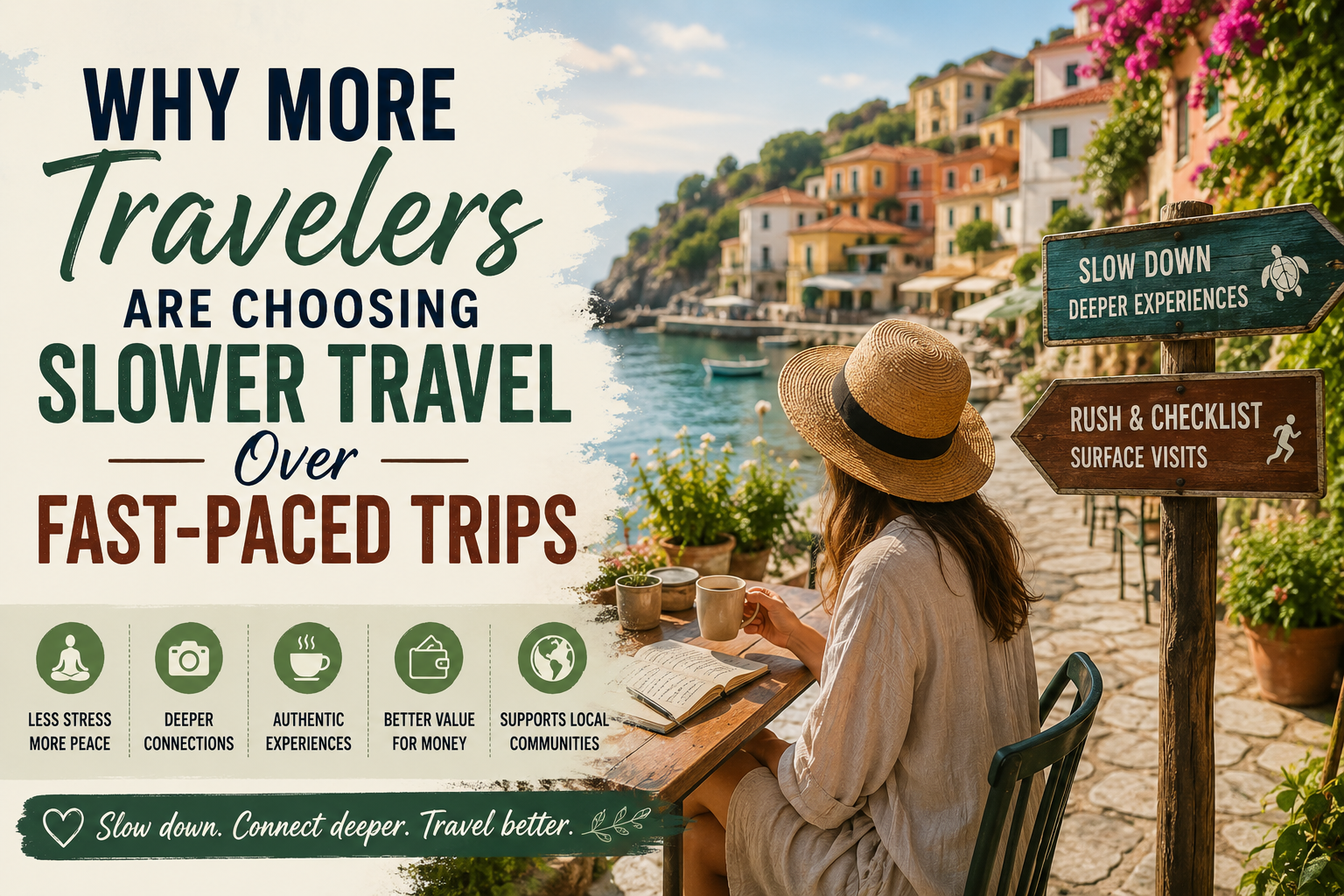
Why More Travelers Are Choosing Slower Travel Over Fast-Paced Trips
Summary
For years, many travelers followed the same formula: visit as many places as possible in the shortest amount of time. A typical itinerary might include five cities, three countries, dozens of attractions, and a packed schedule squeezed into one or two weeks.
Today, that approach is changing.
More travelers are spending longer periods in fewer destinations. Instead of rushing from one landmark to another, they are choosing to slow down, spend time in local neighborhoods, eat at family-owned restaurants, and experience destinations beyond the usual tourist checklist.
This shift is often called slow travel.
Slow travel is not about traveling less. It is about traveling differently. People are increasingly realizing that meaningful experiences often come from staying longer, moving slower, and connecting more deeply with the places they visit.
This guide explains why more travelers are choosing slow travel over fast-paced trips, how slow travel changes the way people experience the world, and how you can apply this approach to your own adventures.
Key Takeaways
- Slow travel focuses on quality experiences rather than quantity.
- More travelers are prioritizing meaningful experiences over busy itineraries.
- Slow travel often reduces stress and travel fatigue.
- Staying longer in one destination can lower travel costs.
- Slow travelers frequently experience more authentic local culture.
- The approach encourages deeper connections with people and places.
- Slow travel can improve mental well-being and create stronger memories.
- You do not need unlimited vacation time to embrace slow travel principles.
What Is Slow Travel?
Slow travel means spending more time in fewer places so you can experience a destination more deeply.
Instead of trying to see everything, slow travelers focus on understanding a place, its culture, daily life, food, traditions, and local communities.
The concept is inspired by the broader Slow Movement, which began with the Slow Food movement in Italy during the 1980s. The idea was simple: quality matters more than speed.
That same philosophy now influences how people travel.
A slow traveler may spend ten days in one city rather than visiting five cities in ten days.
The goal is not to check attractions off a list. The goal is to experience a destination in a more meaningful way.
Why More Travelers Are Choosing Slow Travel
Many travelers are choosing slow travel because traditional fast-paced tourism often leaves them exhausted rather than fulfilled.
After years of tightly packed itineraries, travelers are starting to question whether seeing more actually means experiencing more.
A common travel scenario looks like this:
- Early morning flight
- Full day of sightseeing
- Late-night train
- New city the next morning
- Repeat for several days
While this approach allows travelers to visit many places, it can also create fatigue, stress, and a constant feeling of rushing.
Slow travel offers an alternative.
Instead of moving every day, travelers stay longer, settle into local routines, and focus on quality experiences.
Many people return home feeling more refreshed and connected to their destinations.
Why Are Travelers Moving Away From Fast-Paced Trips?
The biggest reason is simple: people want better experiences, not just more experiences.
Modern travel has become heavily influenced by social media.
Many travelers feel pressure to visit famous landmarks, take photos, and move on to the next destination.
The result is often a trip filled with activity but lacking meaningful moments.
Slow travel shifts the focus back to experience.
Rather than standing in line for five attractions in one day, travelers might spend an afternoon in a local café, explore neighborhood markets, or have conversations with residents.
These experiences often become the most memorable parts of a trip.
Slow Travel vs Rushing Through Destinations
One of the easiest ways to understand slow travel is to compare it directly with traditional fast-paced tourism.
Slow Travel vs Fast Travel Comparison
| Slow Travel | Fast-Paced Travel |
|---|---|
| Fewer destinations | Multiple destinations |
| Longer stays | Short stays |
| Less stress | Frequent travel fatigue |
| Deeper local experiences | Surface-level experiences |
| More flexibility | Rigid schedules |
| Stronger cultural connection | Attraction-focused travel |
| Often lower transportation costs | Higher transportation costs |
| Focus on quality | Focus on quantity |
Neither approach is inherently wrong.
However, more travelers are discovering that slower travel often provides greater satisfaction.
What Are the Benefits of Traveling Slow Over Fast Trips?
The biggest benefit of slow travel is depth.
When you spend more time in one destination, you begin to notice details that rushed travelers often miss.
You learn local routines.
You find restaurants away from tourist areas.
You become familiar with neighborhoods.
You experience a place more like a temporary resident than a visitor.
These experiences create stronger memories because they involve genuine interaction rather than constant movement.
You Get to Experience Local Culture More Naturally
One of the main reasons travelers embrace slow travel is the opportunity to experience local culture in a more authentic way.
When visiting a city for only one day, most people stay within major tourist zones.
When staying for a week or longer, behavior changes.
Travelers often:
- Shop at local markets
- Use public transportation
- Visit neighborhood cafés
- Attend community events
- Explore lesser-known areas
This creates a more complete understanding of the destination.
For example, travelers spending extended time in cities such as Rome, Kyoto, Lisbon, or Seville often report that their favorite memories come from everyday experiences rather than famous landmarks.
Slow Travel Often Reduces Travel Stress
Traveling constantly can be exhausting.
Every destination change requires:
- Packing
- Transportation
- Check-in procedures
- Route planning
- Schedule management
Repeating this process every few days consumes time and energy.
Slow travel removes much of that pressure.
Staying longer in one place means fewer logistics and more time enjoying the destination itself.
Many travelers find that this slower pace improves overall trip satisfaction.
Why Slow Travel Creates Better Memories
Memory research suggests that meaningful experiences are often connected to emotion, interaction, and personal involvement.
Slow travel naturally encourages these elements.
Think about two different scenarios:
Scenario one:
You spend twenty minutes at a famous attraction, take photos, and leave.
Scenario two:
You spend an evening talking with locals at a neighborhood restaurant, learning about regional traditions and daily life.
Both experiences are valuable, but the second often leaves a deeper impression.
Slow travel increases opportunities for those memorable moments.
Real-World Examples of Slow Travel
The popularity of slow travel is visible across many destinations.
Tuscany, Italy
Many visitors now choose week-long stays in small Tuscan towns rather than rushing between multiple Italian cities.
Instead of trying to see all of Italy in one trip, they spend time enjoying local food, vineyards, markets, and countryside experiences.
Lisbon, Portugal
Portugal has become a favorite destination for long-stay travelers.
Many visitors remain in Lisbon for several weeks, using it as a base while exploring surrounding towns at a relaxed pace.
Kyoto, Japan
Travelers increasingly choose longer stays in Kyoto to experience temples, traditional neighborhoods, tea culture, and seasonal events without rushing.
Andalusia, Spain
Rather than spending one day in each city, many travelers now stay longer in Seville, Granada, or Córdoba to better understand regional culture and history.
These examples highlight a growing shift toward quality-focused travel.
Why Is Slow Travel Better Than Fast Tourism?
Slow travel is often considered better than fast tourism because it allows travelers to spend more time in fewer destinations, experience local culture more deeply, reduce travel stress, and create more meaningful memories. Instead of focusing on seeing as much as possible, slow travel prioritizes connection, quality experiences, and a more relaxed pace.
How Slow Travel Supports More Sustainable Tourism
Another reason slow travel is growing in popularity is its connection to sustainable tourism.
When travelers stay longer in one place, they often contribute more directly to local communities.
Instead of spending money only at major tourist attractions, they are more likely to support:
- Local restaurants
- Independent cafés
- Family-owned accommodations
- Local guides
- Neighborhood businesses
Organizations such as the United Nations World Tourism Organization have repeatedly emphasized the importance of sustainable tourism practices that benefit local communities and reduce the negative effects of overtourism.
Slow travel naturally aligns with many of these goals.
A Different Way to Measure a Successful Trip
For decades, many travelers measured success by how much they saw.
Today, more people are measuring success by how deeply they experienced a place.
The question is shifting from:
“How many destinations did I visit?”
to:
“How well did I experience the destination?”
That change is one of the biggest reasons why more travelers are choosing slow travel over fast-paced trips.
Mid-Article Insight
If you’ve ever returned from vacation feeling like you need another vacation just to recover, you may have experienced the downside of fast-paced travel.
A slower approach does not mean doing less.
It means giving yourself enough time to enjoy what you’re already doing.
How Slow Travel Changes Your Perspective
One of the biggest benefits of slow travel is that it changes how you see both the destination and yourself.
When you’re constantly moving, your attention naturally stays focused on logistics. You’re thinking about train schedules, hotel check-ins, attraction tickets, and transportation routes.
Slow travel removes much of that mental clutter.
Instead of focusing on what’s next, you focus on what’s happening right now.
You notice how people live.
You observe daily routines.
You pay attention to small details that are often overlooked during rushed trips.
This shift often leads to a deeper appreciation of local culture and a more meaningful travel experience.
Many travelers say they remember ordinary moments from slow trips more clearly than famous landmarks from fast-paced vacations.
Why Slow Travel Is Better Than Fast Tourism for Many People
Slow travel is not necessarily better for everyone, but it solves many common travel frustrations.
Fast tourism often creates a checklist mentality. Travelers feel pressure to maximize every hour and see everything possible before moving on.
The result can be:
- Decision fatigue
- Physical exhaustion
- Reduced enjoyment
- Constant schedule pressure
Slow travel takes the opposite approach.
Instead of asking, “What else can I fit into today?”
You start asking, “What do I actually want to experience?”
This simple mindset shift often improves the entire trip.
Why Slow Travel Helps You Connect With Destinations
The longer you stay somewhere, the more familiar it becomes.
After several days in the same area, you start recognizing local businesses, neighborhoods, and routines.
You may find yourself returning to the same bakery each morning or chatting with the owner of a small café.
These repeated interactions create a sense of connection.
That connection is difficult to achieve when you’re only spending a few hours in a destination.
Many travelers describe this as the difference between seeing a place and understanding a place.
Slow Travel vs Tourist Traps
One reason many travelers are moving toward slow travel is frustration with overcrowded tourist attractions.
Popular landmarks are often worth seeing, but they can also become overwhelming during peak travel periods.
Fast-paced itineraries frequently revolve around:
- Famous photo locations
- Attraction checklists
- Crowded tour routes
- High-volume tourist zones
Slow travelers often spend time beyond these areas.
They explore neighborhoods that don’t appear on every travel blog.
They visit local markets instead of souvenir shops.
They eat where residents eat rather than choosing restaurants designed primarily for tourists.
This often leads to more memorable experiences and a better understanding of local culture.
Why Slower Travel Can Save Money
Many people assume that staying longer automatically costs more.
In reality, slow travel can often reduce overall travel expenses.
Transportation is frequently one of the biggest costs during a trip.
Every flight, train ride, bus ticket, or transfer adds expense.
When travelers reduce the number of destinations, they often reduce transportation costs as well.
Example Comparison
| Fast-Paced Trip | Slow Travel Trip |
|---|---|
| 5 cities in 10 days | 2 cities in 10 days |
| Multiple train tickets | Fewer transfers |
| More transportation expenses | Lower transportation expenses |
| Frequent hotel changes | Longer accommodation stays |
| Higher daily logistics costs | Better budget control |
Longer accommodation stays can also lead to discounts through vacation rental platforms and extended-stay properties.
How Slow Travel Supports Better Budget Management
When travelers stay longer in one destination, spending habits often become more practical.
Instead of relying on:
- Airport meals
- Tourist restaurants
- Last-minute transportation
they begin using:
- Local grocery stores
- Neighborhood cafés
- Public transportation systems
This often reduces daily expenses while creating a more authentic experience.
Many long-term travelers report spending less per day than travelers following aggressive multi-city itineraries.
The Mental Health Benefits of Slow Travel
One of the most discussed advantages of slow travel is its impact on mental well-being.
Modern life already moves quickly.
Many people spend their days managing:
- Work responsibilities
- Family commitments
- Notifications
- Deadlines
- Constant information
Fast-paced vacations sometimes recreate that same pressure.
Instead of relaxing, travelers find themselves rushing between activities.
Slow travel introduces space into the experience.
You have time to sit in a park.
You can spend an hour watching local life unfold from a café terrace.
You can enjoy a meal without checking the time.
These moments often create the feeling of relaxation people hoped to achieve when booking the trip.
Why Travelers Are Prioritizing Experiences Over Attractions
A noticeable trend in recent years is the growing focus on experiences rather than landmarks.
Travelers increasingly value activities such as:
- Cooking classes
- Local food tours
- Community events
- Cultural workshops
- Walking neighborhoods
These activities often require time.
You cannot fully experience local culture if your schedule is packed from morning until night.
Slow travel creates room for these opportunities.
As a result, many travelers return home with stories about people and experiences rather than simply lists of attractions visited.
How Remote Work Helped Popularize Slow Travel
The rise of remote work has played a significant role in the growth of slow travel.
Many professionals can now work from different locations for part of the year.
This flexibility allows them to stay longer in destinations rather than rushing through them.
Cities such as:
- Lisbon
- Valencia
- Chiang Mai
- Bali
- Mexico City
have become popular among remote workers partly because they support longer stays.
Even travelers who do not work remotely have started adopting some of the same principles by choosing fewer destinations and longer visits.
How Social Media Changed Travel Behavior
Social media has influenced travel in two different ways.
First, it encouraged fast tourism.
Many travelers felt pressure to visit every famous landmark and capture as many photos as possible.
This contributed to packed itineraries and destination checklists.
However, social media also helped popularize slow travel.
Many creators now share content about:
- Living like a local
- Long-term stays
- Cultural immersion
- Sustainable tourism
- Mindful travel
As travelers see these experiences online, they begin questioning whether constant movement is really the best way to travel.
This shift has helped fuel the growing interest in slower, more intentional travel.
Why Slow Travel Often Leads to More Authentic Food Experiences
Food is one of the easiest ways to connect with a destination.
Yet rushed itineraries often limit food experiences to quick meals between attractions.
Slow travelers usually have more opportunities to:
- Visit local markets
- Try family-owned restaurants
- Learn regional traditions
- Explore neighborhood food scenes
For example, spending a week in Naples provides a very different food experience than visiting for a few hours during a day trip.
The same applies to destinations such as Kyoto, Seville, Bangkok, or Istanbul.
Time allows food experiences to become part of the journey rather than a break between activities.
Soft Travel Tip: Try One Destination Longer Than Usual
If you’re unsure whether slow travel is right for you, start small.
Instead of planning four destinations on your next trip, choose two.
Instead of staying two nights, stay five.
Pay attention to how the experience feels.
Many travelers find that reducing movement actually increases enjoyment.
You do not need to completely change your travel style overnight.
Small adjustments often reveal the benefits of slower travel very quickly.
The Growing Shift Toward Quality Over Quantity
Travel habits are evolving.
More people are realizing that collecting destinations is not the same as experiencing them.
A slower pace often creates stronger memories, lower stress, better cultural understanding, and more meaningful experiences.
That realization is one of the main reasons why slow travel continues to grow in popularity around the world.
For many travelers, the goal is no longer to see everything.
The goal is to experience something worth remembering.
How to Embrace a Slow Travel Lifestyle
Slow travel does not require a complete lifestyle change. It starts with making different decisions when planning a trip.
The simplest way to embrace slow travel is to reduce the number of destinations and increase the amount of time spent in each location.
Instead of trying to visit four cities in ten days, consider spending five days in two cities. You’ll spend less time in transit and more time actually experiencing the places you’ve traveled to see.
A slow travel mindset focuses on presence rather than productivity. The goal is not to maximize every hour. The goal is to enjoy the destination without constantly thinking about the next stop.
Slow Travel Tips for Mindful Explorers
If you’re new to slow travel, a few simple habits can make a big difference.
Choose Fewer Destinations
One of the most effective slow travel strategies is reducing your itinerary. Fewer destinations often lead to deeper experiences and less travel fatigue.
Stay in Local Neighborhoods
Instead of booking accommodations near major tourist attractions, consider staying in residential areas where locals live, shop, and spend their time.
Use Public Transportation
Buses, trains, trams, and metro systems provide a better sense of daily life than taxis or organized tours.
Leave Space in Your Schedule
Not every hour needs a planned activity. Some of the best travel memories happen unexpectedly.
Return to Places You Enjoy
Many travelers feel pressure to constantly see something new. Slow travelers often revisit favorite cafés, parks, or neighborhoods because familiarity can enhance the experience.
Common Mistakes People Make When Trying Slow Travel
Many first-time slow travelers unintentionally turn their trip into a fast-paced itinerary.
Trying to Do Too Much
The most common mistake is scheduling too many activities. Slow travel works best when there is room for flexibility.
Measuring Success by Attractions Visited
A successful trip is not determined by the number of landmarks you see. It is often measured by the quality of your experiences.
Staying Too Busy
Many travelers leave home seeking relaxation but create a schedule that feels more stressful than everyday life.
Ignoring Local Culture
Slow travel is not simply staying longer. It involves engaging with the destination, local customs, food, and community.
People Also Ask
Why are more travelers choosing slow travel?
More travelers are choosing slow travel because it reduces stress, creates deeper cultural experiences, and allows more meaningful connections with destinations. Many people find that spending longer in fewer places is more enjoyable than rushing through multiple cities.
What is the main purpose of slow travel?
The main purpose of slow travel is to experience a destination more deeply. Rather than focusing on quantity, slow travel prioritizes quality experiences, local culture, personal connection, and a relaxed pace.
Is slow travel cheaper than fast travel?
In many cases, yes. Slow travel often reduces transportation expenses, encourages longer accommodation stays, and allows travelers to use local services rather than relying on costly tourist-focused options.
How does slow travel change your perspective?
Slow travel encourages travelers to pay attention to everyday life, local customs, and meaningful interactions. This often leads to a deeper understanding of different cultures and a more memorable travel experience.
What are the benefits of traveling slow over fast trips?
Benefits include reduced stress, stronger cultural connections, lower transportation costs, improved work-life balance during travel, and more authentic experiences. Many travelers also report feeling less exhausted after their trips.
Can slow travel work for short vacations?
Yes. Even a one-week vacation can follow slow travel principles. Instead of visiting several destinations, focus on one location and spend more time exploring it in depth.
Final Thoughts
The growing popularity of slow travel reflects a larger change in how people think about travel itself.
For years, success was measured by how many destinations you could fit into a limited amount of time. Today, many travelers are realizing that meaningful experiences rarely happen when you’re constantly rushing.
Slow travel offers something different.
It creates space to appreciate local culture, build genuine connections, enjoy regional food, and experience destinations beyond their most famous landmarks. It reduces the pressure to do everything and replaces it with the freedom to enjoy what matters most.
Whether you’re planning a weekend getaway, a two-week vacation, or a longer international journey, adopting even a few slow travel principles can completely change how you experience a destination.
The next time you plan a trip, challenge yourself to remove one destination from your itinerary and spend that extra time where you already are.
You may end up seeing less.
But there’s a good chance you’ll experience much more.
Ravinder Kaur is the founder of OpinionHook, an independent travel publication established in 2023. She oversees editorial standards, destination research, travel planning resources, and content quality across the website. OpinionHook focuses on publishing practical travel guides, itineraries, budgeting advice, and destination resources designed to help travelers make informed travel decisions.