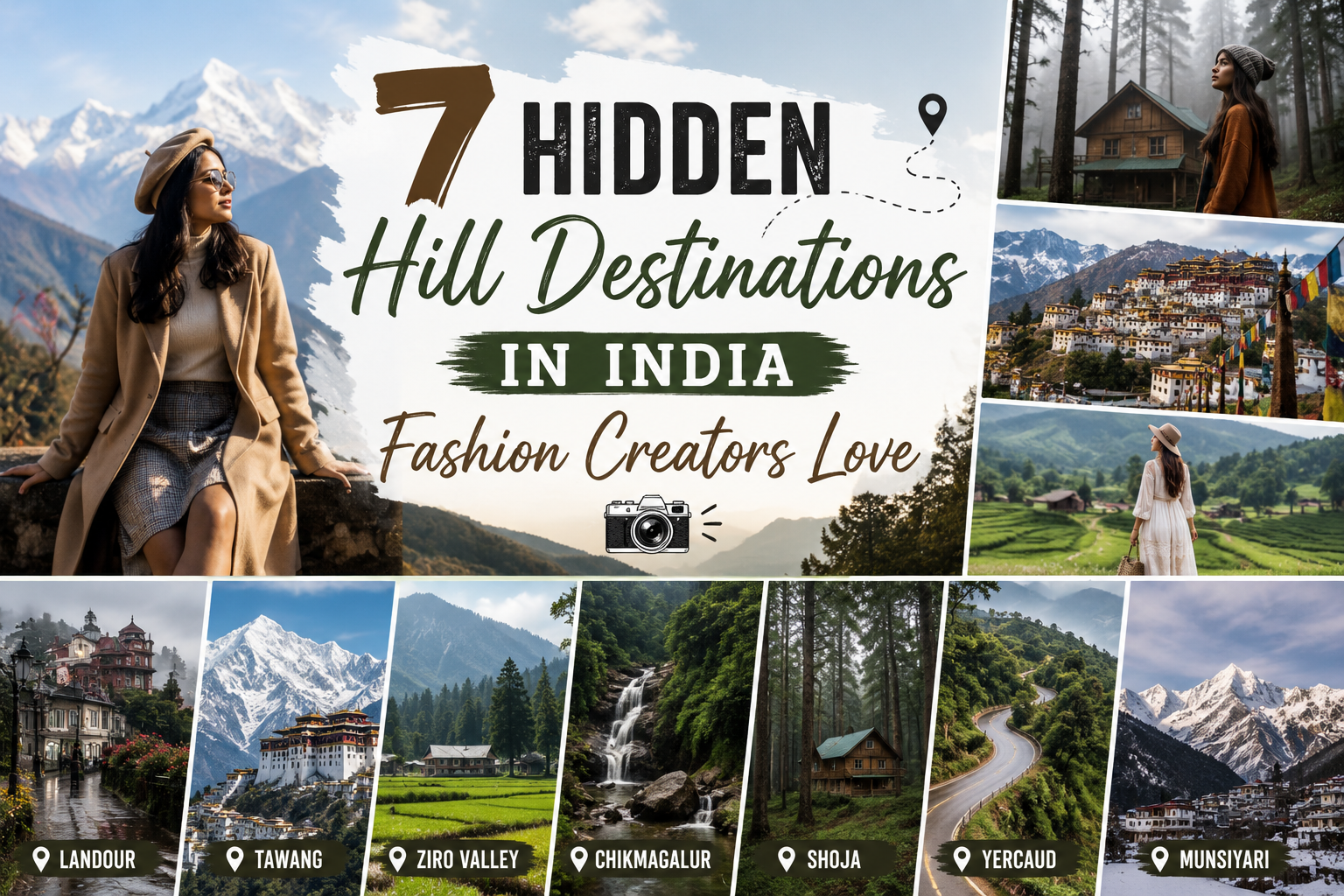
7 Hidden Hill Destinations in India Fashion Creators Love
The seven hidden hill destinations in India that fashion creators like most are Landour, Tawang, Ziro Valley, Chikmagalur, Shoja, Yercaud and Munsiyari. They share the same qualities that make a good shoot: soft light, quiet backdrops, plenty of texture (forests, old buildings, tea and coffee estates, mountains) and fewer crowds than Manali or Shimla.
This guide is for anyone who shoots outfits, lookbooks or travel reels, and also for ordinary travellers who simply want a quieter hill trip. For each place you get what it looks like, the kind of content it suits, the practical points that can trip you up (permits, altitude, weather and drones) and links to official or reputable sources.
Key takeaways
- Offbeat hill stations usually give cleaner frames than crowded tourist hubs, because you spend less time waiting for people to move.
- Misty weather, pine forests, tea and coffee estates and old colonial streets give natural, soft backdrops without heavy editing.
- Early morning gives the softest light and the fewest people.
- Tawang and Ziro are in Arunachal Pradesh, where Indian citizens need an Inner Line Permit. Apply before you travel.
- Tawang sits around 3,000 m, so read about altitude sickness and allow time to adjust.
- Season changes the mood. Monsoon and winter give very different looks, and each has risks for gear and travel.
- Check drone rules and any local permission for commercial shoots before you fly or set up.
Why creators prefer hidden hill towns
Fashion content needs more than a nice view. It needs consistent light, a quiet frame and a backdrop that does not look like everyone else’s. In a famous tourist spot you can spend more time waiting for crowds to clear than shooting. A small hill town with a forest road, a cafe and a viewpoint within walking distance lets you build several looks in one day without long transfers.
Mountain weather also helps. Cloud and mist soften harsh sunlight, which reduces strong shadows and gives smoother skin tones. That is a big reason foggy hill stations photograph so well. Our article on why planning trips from Instagram and TikTok can backfire is worth a read if you want to avoid chasing the same viral spot as everyone else.
Quick comparison
| Destination | State | Approximate elevation | Best for | Practical note |
|---|---|---|---|---|
| Landour | Uttarakhand | About 300 m above Mussoorie | Vintage, cafe and layered looks | Cantonment area; follow local rules |
| Tawang | Arunachal Pradesh | About 3,000 m | Winter and editorial looks | Inner Line Permit; altitude; winter snow |
| Ziro Valley | Arunachal Pradesh | About 1,688 m | Earthy, boho, sustainable fashion | Inner Line Permit |
| Chikmagalur | Karnataka | About 1,000 m (town) | Coffee estate lifestyle looks | Heavy rain in monsoon |
| Shoja | Himachal Pradesh | Check locally | Cosy, forest looks | Verify road and stay options |
| Yercaud | Tamil Nadu | About 1,515 m | Minimal, soft-palette reels | Rain mainly July to October |
| Munsiyari | Uttarakhand | About 2,200 m | Himalayan editorials | Cold and changeable weather |
Elevations come from Wikipedia entries and are approximate.
1. Landour, Uttarakhand: best for a vintage, layered look
Landour sits just above Mussoorie, about 300 m higher, and feels quieter. It has old British-era buildings, ridge roads, pine and deodar forest, bookshops and cafes, and a soft colour palette that suits neutral and layered outfits. Trench coats, knitwear, long skirts and boots tend to look at home here.
The viewpoints and cafes near Char Dukan are popular for cafe-style shots. Early morning is the best time, because tourists arrive later and mist often hangs over the road.
Practical points.
- Landour is reachable from Dehradun, which has the nearest railhead. Jolly Grant Airport is about 90 minutes away by road.
- Much of Landour is a cantonment area run by a cantonment board under the Ministry of Defence. Be respectful and check local rules if you plan a larger shoot.
- Winters are cold, with snowfall possible between December and February. April and May are warmer, and the monsoon runs roughly from May to September.
Thinking of a bigger Himalayan trip later? See our best trekking destinations in the world.
2. Tawang, Arunachal Pradesh: best for dramatic winter content
Tawang has snowy peaks, a large Buddhist monastery, prayer flags and winding mountain roads. Wikipedia describes Tawang Monastery as the largest Buddhist monastery in India, founded in 1681. Layered coats, knitwear, boots, scarves and monochrome outfits work well against these landscapes, and the scale of the mountains adds depth to editorial shots.
Practical points.
- Permit. Indian citizens need an Inner Line Permit to enter Arunachal Pradesh. A travel article reports that Indian nationals can apply online at arunachalilp.com, with IDs and a local address, and that permits are valid for a limited period. Confirm the current process, fee and validity on the official portal.
- Altitude. The town is around 3,000 m, and the road passes the Sela Pass at about 4,170 m. Altitude sickness can affect anyone. Read our guide to avoiding altitude sickness, which explains symptoms, gradual ascent and when to descend.
- Weather. Wikipedia says Tawang receives snowfall every year in December and January, and that the Sela road usually gets disconnected in winter. The Sela Tunnel, inaugurated in March 2024, now gives all-weather access. Even so, leave buffer days.
- Respect. Monasteries are active places of worship. Ask before photographing inside and follow local guidance.
3. Ziro Valley, Arunachal Pradesh: best for earthy and boho looks
Ziro is a green valley with rice fields, pine-covered hills and bamboo houses, at around 1,688 m. It is home to the Apatani tribe, whose permanent wet-rice cultivation is unusual in the state, and the area is on India’s tentative list for UNESCO World Heritage under the Apatani cultural landscape. The calm, organic feel suits linen, handmade jewellery, sustainable fashion and cottagecore or bohemian looks.
Practical points.
- Indian citizens need an Inner Line Permit, as for Tawang.
- Ziro is a living cultural landscape. Ask permission before photographing people, homes or fields, and avoid trampling crops for a shot.
- Music festival dates change from year to year. Check the organiser’s official page rather than relying on an old date.
4. Chikmagalur, Karnataka: best for coffee estate content
Chikmagalur is known as the land of coffee. Estates give you rows of plants, wooden homestays, misty mornings and waterfalls within one property, which saves travel time on short shoots. The greenery is dense after the rains, which gives a rich look with little editing.
Practical points.
- Wikipedia lists the town at roughly 1,040 to 1,090 m. It is around 240 km from Bengaluru and 183 km from Mysuru, with Mangaluru the nearest international airport.
- Rainfall rises from May and stays high through the monsoon months. Protect your gear and carry rain covers.
- Many creators stay at estate homestays. Ask the host in advance if you plan to shoot a brand campaign on the property.
5. Shoja, Himachal Pradesh: best for a cosy forest look
Shoja is a small, quiet spot in Himachal Pradesh with forest roads, wooden cottages and quiet viewpoints, and it is often described as a calmer alternative to Manali for cosy sweater content and autumn-style shoots. Pine forests add layered depth that makes outfit details stand out.
We could not find a reliable source for Shoja’s elevation, road conditions or visitor numbers, so check recent reviews and your homestay before you go. Weather in the hills can change quickly, so fog can help a shoot or cancel one.
6. Yercaud, Tamil Nadu: best for minimal reels
Yercaud sits at about 1,515 m in the Shevaroy Hills of the Eastern Ghats, in Salem district. It gets less social media attention than Ooty or Kodaikanal. Viewpoints and roads are quieter, and tree cover keeps the light soft. It suits clean reels, minimal outfits, soft colour palettes and casual styling. Roads that curve through the greenery also work well for drone footage, where drones are permitted.
Practical points.
- Salem Junction railway station is about 35 km away, and Coimbatore is the nearest major airport.
- Wikipedia notes the heaviest rain from July to October and the driest months from January to March.
- Attractions listed include Yercaud Lake, a rose garden, viewpoints and Kiliyur Falls.
7. Munsiyari, Uttarakhand: best for Himalayan editorials
Munsiyari, in Pithoragarh district at about 2,200 m, is a starting point for treks into the interior of the range and is known for wide Himalayan views. That scale suits editorial-style shoots, winter campaigns and monochrome styling. It is quieter than the major Uttarakhand hill stations.
Practical points.
- Weather can turn cold and change fast. Layer up, and carry spare batteries and power banks.
- Roads in the hills can be affected by rain and landslides, so check road status before you go.
- If you plan to trek from here, hire a local guide and check permits with the district authorities.
What makes a hill town good for fashion photography?
- Soft natural light. Fog or cloud reduces harsh shadows.
- Visual texture. Forests, stone roads, wooden buildings and cafes add depth.
- Few crowds. You shoot faster and more naturally.
- Several backdrops nearby. Forest, road, cafe and viewpoint within short distances.
- Predictable weather windows. This matters when you are shooting for a brand.
Best time to visit
There is no single best month. Winter, roughly October to February in the north, gives crisp, clear visuals and winter fashion. The monsoon months give moody mist and rich greens, but they add risk for gear, roads and landslides. Eastern and southern hills have different patterns, so check each place individually. In Yercaud, for example, the driest months are January to March, while in Landour the monsoon runs from about May to September.
Drones, permits and permissions
- Drones. India’s Drone Rules, 2021 say drones must be registered on the Digital Sky platform unless exempt, and airspace is split into green, yellow and red zones. Red zones are no-drone areas without government permission, and yellow zones need permission. Always check the latest Digital Sky airspace map before every flight. Border areas and military zones are especially sensitive.
- Commercial shoots. If you are shooting a paid brand campaign with a crew, ask local authorities, the property owner or a local guide whether permission is needed. Rules vary by place.
- Local people. Ask before photographing residents, and never block roads or religious spaces for a shot.
Common mistakes
- Shooting at midday, when light is harsh. Morning and late afternoon are better.
- Packing too many outfits. Mountain travel is tiring. Plan three or four strong looks.
- Ignoring cold, which drains camera and phone batteries faster.
- Not carrying rain protection for gear.
- Skipping the permit check for Arunachal Pradesh.
For packing ideas, see our travel backpack guide. If you are heading out alone, read our Ultimate Solo Travel Guide. For more quiet places, see 10 hidden travel destinations for 2026 and beyond the tourist trail.
Frequently asked questions
Which hill station in India is best for fashion photography?
Landour, Tawang and Munsiyari are strong choices because of their scenery, low crowds and natural textures. The best option depends on the season and style you want.
Which hidden hill stations suit Instagram reels?
Yercaud, Ziro Valley and Chikmagalur suit reels because of their misty roads, estates and greenery. Keep in mind monsoon rain and permits.
What is the best season for shooting in Indian hills?
Winter (roughly October to February in the north) is good for clean visuals and winter outfits, while the monsoon gives mist and moody tones. Check the weather pattern for each destination.
Do I need a permit for Tawang or Ziro?
Yes. Indian citizens need an Inner Line Permit to enter Arunachal Pradesh. Check the official state process before you go.
Are offbeat hill stations cheaper than famous ones?
Often, but not always. Smaller places may have lower accommodation costs, but getting there can take longer and cost more. Compare real prices for your dates.
How we checked this guide
Elevations, climate notes and access details were cross-checked against Wikipedia entries for each place in October 2026. Permit information for Arunachal Pradesh comes from a travel guide and should be confirmed on the official portal. Drone information comes from the Government of India’s published Drone Rules summary. We could not verify details for Shoja. This guide does not claim first-hand visits to each place. Conditions change, so check locally before you travel.
Sources
- Wikipedia: Tawang
- Wikipedia: Ziro
- Wikipedia: Landour
- Wikipedia: Munsiyari
- Wikipedia: Yercaud
- Wikipedia: Chikmagalur
- Curly Tales: Guide to the Inner Line Permit for Arunachal Pradesh
- Arunachal Pradesh ILP portal
- Government of India: Drone Rules, 2021 (PIB document)
Related Guides
- 10 Hidden Travel Destinations That Won’t Stay Secret for Long
- Best Trekking Destinations in the World for Adventure Lovers 2026
- Top 8 Travel Destinations You Must Visit in 2026
- Hidden Costs in Budget Destinations: Why Cheap Trips Get Expensive
Browse all of our Adventure and Trekking guides.
Varinder Kaur is from Amritsar, India. She has traveled to well-known places across India, including Darjeeling, and to a few countries abroad, and shares travel experiences and practical tips for travelers through OpinionHook.