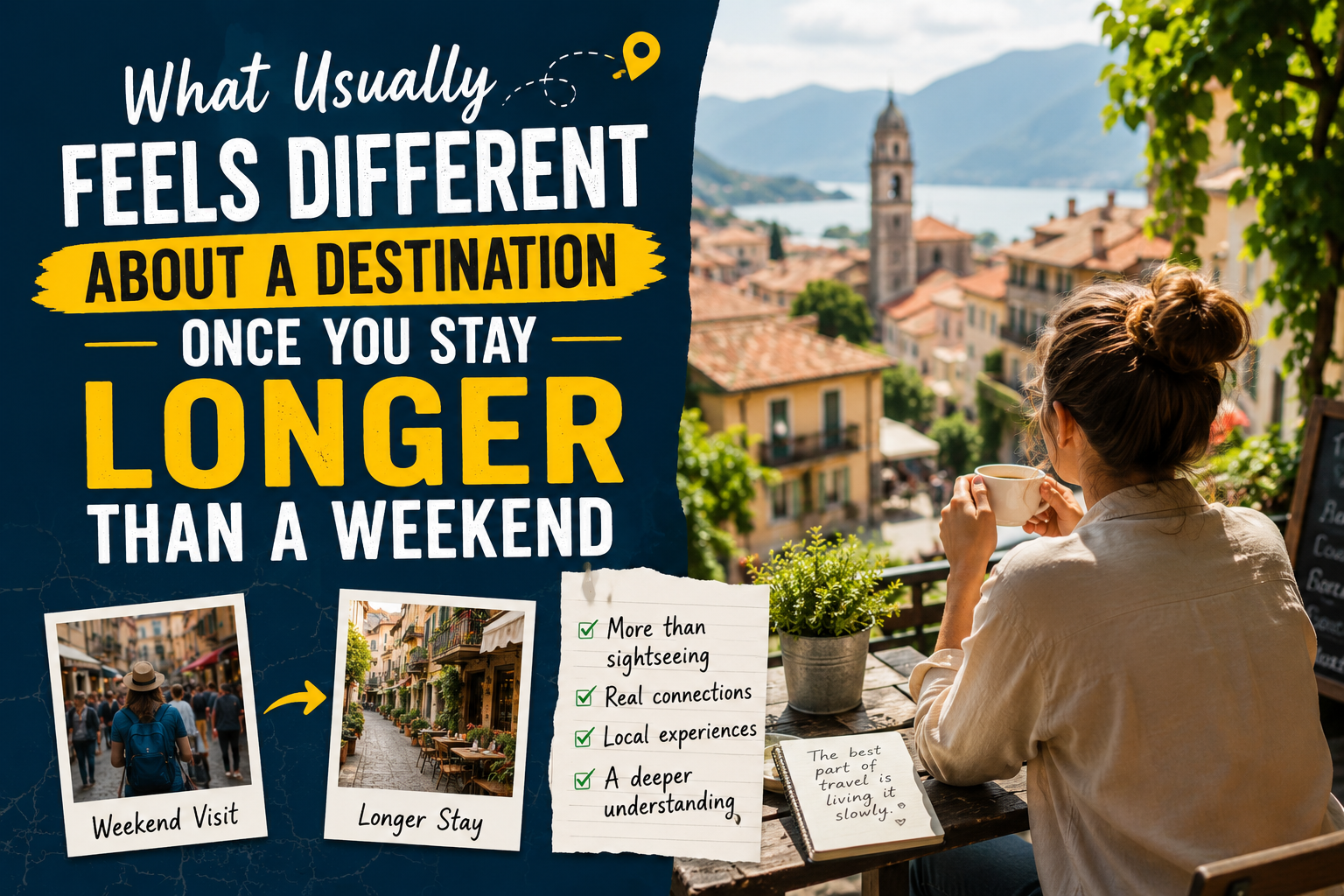
Staying Longer in One Destination: What Changes After the First Week
A place often feels different once you stay past the first few days. In the first two or three days you chase the sights. After a week, you start to notice how ordinary life works: where people shop, when they eat, how they get to work. That shift is the main thing that changes when you stay longer in one destination, and it is why a slower trip often feels richer than a quick one.
This guide explains what changes after the first week, why it happens, and how you can get the same benefit even if you only have a few extra days. It is written for ordinary travellers, including those of us who count leave days and rupees carefully, so it also covers the cost side of staying longer.
Key takeaways
- The place does not change. Your attention does. After a few days you stop ticking off sights and start noticing daily life.
- Around the end of the first week, maps, transport and food choices feel familiar, which frees up energy for the things you came for.
- Repeated visits to the same cafe, shop or park build small connections with local people.
- Longer stays can be kinder to your budget per day, but only if you plan transport, stay and visa limits properly.
- You do not need months. Adding three or four extra days in one base can change the whole feel of a trip.
Why does a place feel different after a few days?
On a weekend trip, most people plan every hour. The trip is a list: the landmark, the famous restaurant, the viewpoint, the photo. That is a perfectly fine way to travel, but it keeps your attention on the list.
When you have more time, the pressure drops. You stop asking what to see next, and you start asking how life works here. You see which side of the street fills up at breakfast time. You notice which shops stay open late and which close in the afternoon. The place moves from being an attraction to being a neighbourhood you are temporarily part of.
This is hard to get in 48 hours, simply because there is not enough time to repeat anything.
What actually changes after the first week
The list below is what many travellers describe once the first-week adjustment is over. It is not a scientific rule, and everyone moves at a different pace.
| Stage | What it usually feels like | What you tend to do |
|---|---|---|
| Days 1 to 2 | High excitement, lots of decisions | Visit the famous sights, take photos |
| Days 3 to 5 | Routines start to form | Find a regular cafe, learn the transport |
| Days 6 to 7 and beyond | Less decision fatigue, more curiosity | Explore local markets, parks and everyday places |
| Second week and beyond | Comfortable and slightly bored in a good way | Slow down, repeat favourite places, plan day trips |
You notice daily rhythms
Every city has a rhythm. Offices, schools, markets and trains create busy and quiet times. If you stay in one area for a week, you can watch this rhythm repeat. Weekday mornings look different from Sunday mornings, and the same street can feel calm at noon and lively at night. A short visit shows you a single snapshot. A longer visit shows you the pattern.
Tourist zones matter less
On a short trip, most people stay near the main attractions because there is no time to go elsewhere. With more days, you naturally walk further. You pass residential streets, neighbourhood markets, small parks and local bakeries. Many travellers find these places stick in memory longer than the famous landmark that first drew them.
Small details become meaningful
A shopkeeper who remembers your order, a park where people gather every evening, a cafe full of students with laptops. None of these appear in a top ten list, yet they are often the part of a longer stay that people talk about later.
Why locals can feel more approachable
Tourists meet people once. Long-stay travellers meet the same people again and again. A cashier recognises you. The person at the juice stall nods. A neighbour says good morning.
Psychologists have studied this for decades. The mere-exposure effect, first described by Robert Zajonc in 1968, is the idea that repeated contact with something tends to make us like it more and feel more comfortable with it. It is not a magic rule, and later research has shown limits to it, but it explains why small repeated interactions can turn a stranger’s city into somewhere familiar.
For Indian travellers, there is a practical side too. A few friendly repeat visits can help you find out where to eat vegetarian food, which shops sell what you need, or which area feels comfortable at night. That information is hard to get on a two-day trip.
What tourists often miss
Famous destinations are known for a handful of landmarks, but residents spend little time there. Everyday life happens elsewhere. Things short-trip visitors commonly miss include:
- Neighbourhood markets and street food stalls
- Community festivals and seasonal events
- Public libraries, parks and sports grounds
- Morning routines and commuter habits
- Regional dishes that do not appear on tourist menus
- Residential districts and local shopping streets
The longer you stay, the more of these you are likely to see. If you like this idea, our guide to experiencing a country like a local has more practical ways to step off the main trail.
The difference between visiting and living somewhere
A visitor mostly consumes a place: see this, eat that, tick it off. A temporary resident takes part in it. Neither approach is wrong, and they lead to different trips.
| Visitor questions | Longer-stay questions |
|---|---|
| What should I see? | Where do locals buy vegetables? |
| What should I eat? | Which neighbourhood feels right for me? |
| Which attractions are worth the ticket? | How do residents spend their weekends? |
| How do I fit it all in? | What is happening outside the tourist zones? |
The second set of questions usually leads to a deeper experience because it is about understanding, not collecting.
How to live like a local without pretending to be one
You are still a guest, and that is fine. Living like a local while travelling simply means joining ordinary life in small ways:
- Use public transport instead of cabs where it is safe and practical
- Shop at a local grocery store and learn a few food words
- Return to the same neighbourhood cafe a few times
- Cook a meal now and then if your accommodation has a kitchen
- Spend an afternoon in a park or community space
These may sound less exciting than a famous attraction, but they teach you a lot. A supermarket visit shows food habits and prices. An afternoon in a park shows how people use public space. Both give you a better feel for the culture than another guided tour.
Why slower trips tend to leave stronger memories
Memory is closely linked with emotion and personal involvement. On a fast trip you take in a lot of information in a short time, and the attractions can blur together. A longer stay gives you repeated, personal moments that act as anchors: the route you walked each evening, the stall where you bought breakfast, the festival you ran into by chance. These feel personal, so they are easy to recall.
There is one more benefit. Slower trips reduce the tiredness that comes from constant packing and moving. If you often feel worn out after a holiday, read our piece on travel burnout and how frequent travellers avoid it.
Is staying longer more expensive?
Not necessarily. It depends on where you stay, how you move and what rules apply to your visa. Some points to check:
- Accommodation: Many hotels, apartments and guesthouses offer weekly or monthly rates. Look at the listing or ask the host directly. The discount differs from place to place, so compare the total price, not just the nightly rate.
- Transport: Fewer long journeys mean fewer tickets, and local passes or monthly cards may be cheaper than single fares.
- Food: Cooking a few meals and eating where locals eat usually costs less than restaurant meals near landmarks.
- Visa and entry rules: Check how many days your passport allows before you plan a long stay. Rules for Indian passport holders vary by country and change over time. Our guide to visa-free countries for Indians in 2026 is a good starting point, but always confirm the stay limit on the official government site.
- Insurance: Make sure your travel insurance covers the full length of the trip.
If you are planning a longer stay, our tips on saving money on accommodation can help you compare options.
A simple way to try it without months abroad
You do not need a sabbatical. Even a few extra days can change a trip. Try this:
- Choose one base for the whole trip, or for most of it.
- See the big attractions early so they do not hang over you.
- Leave one or two blocks of free time each day.
- Use local transport and walk without a fixed destination.
- Return to the same cafe or shop at least a few times.
- Take one day trip rather than changing hotels every night.
Before you book, compare the total cost of four nights and seven nights. In some places a weekly rate makes the longer stay surprisingly close in price. Check the real numbers instead of guessing.
Are you experiencing the place or ticking boxes?
Many of us turn holidays into productivity projects. We chase lists, rush between sights and worry about missing something. Halfway through a trip, ask yourself: am I experiencing this place, or just completing a checklist? If it is the second, drop one planned activity tomorrow and walk through a neighbourhood instead. Our article on slow travel, its benefits and how to plan it goes into the planning side in more detail.
Why remote work made longer stays more common
Remote and flexible work has made longer stays practical for more people, and many travellers now prefer fewer places with deeper time in each. If this appeals to you, see our list of lesser-known destinations for remote workers. Remember that working while on a tourist visa may not be allowed in some countries, so check the rules before you plan to work from abroad.
FAQ
What is slow travel?
Slow travel means spending more time in fewer places. Instead of rushing between attractions, you stay longer, use local transport, eat locally and get to know a neighbourhood.
How long should you stay in one place to experience it properly?
There is no perfect number. Many travellers say the feel of a place changes after about five to seven days, once routines form. Even three or four extra days can help.
Is slow travel cheaper than many short trips?
Often it can be, because you spend less on transport and may get weekly accommodation rates. It is not guaranteed, so compare the full cost before you book.
What do tourists usually miss about a destination?
They often miss local markets, neighbourhood life, community events, regional food and everyday routines, because short trips stay close to famous sights.
Can you live like a local while travelling?
You can take part in everyday life by using local transport, shopping at local stores and spending time in neighbourhoods. You remain a visitor, but these habits give you a deeper understanding of a place.
How this guide was checked
This is a practical guide based on general travel patterns, not a study of any one city, and it does not claim figures for prices or stay lengths. The one research reference, the mere-exposure effect, was checked against an academic citation listed below. Visa and entry rules change, so always confirm them on the official site of the country you plan to visit.
Sources
Related Guides
- How to Choose the Right Travel Backpack for Every Trip
- How to Travel More While Working Full Time: Practical Tips
- Travel Burnout: Causes, Signs and How Frequent Travelers Avoid It
- Itinerary vs Spontaneity: How Much Should You Plan a Trip?
Browse all of our Trip Planning guides.
Varinder Kaur is from Amritsar, India. She has traveled to well-known places across India, including Darjeeling, and to a few countries abroad, and shares travel experiences and practical tips for travelers through OpinionHook.




3 Comments
Comments are closed.