
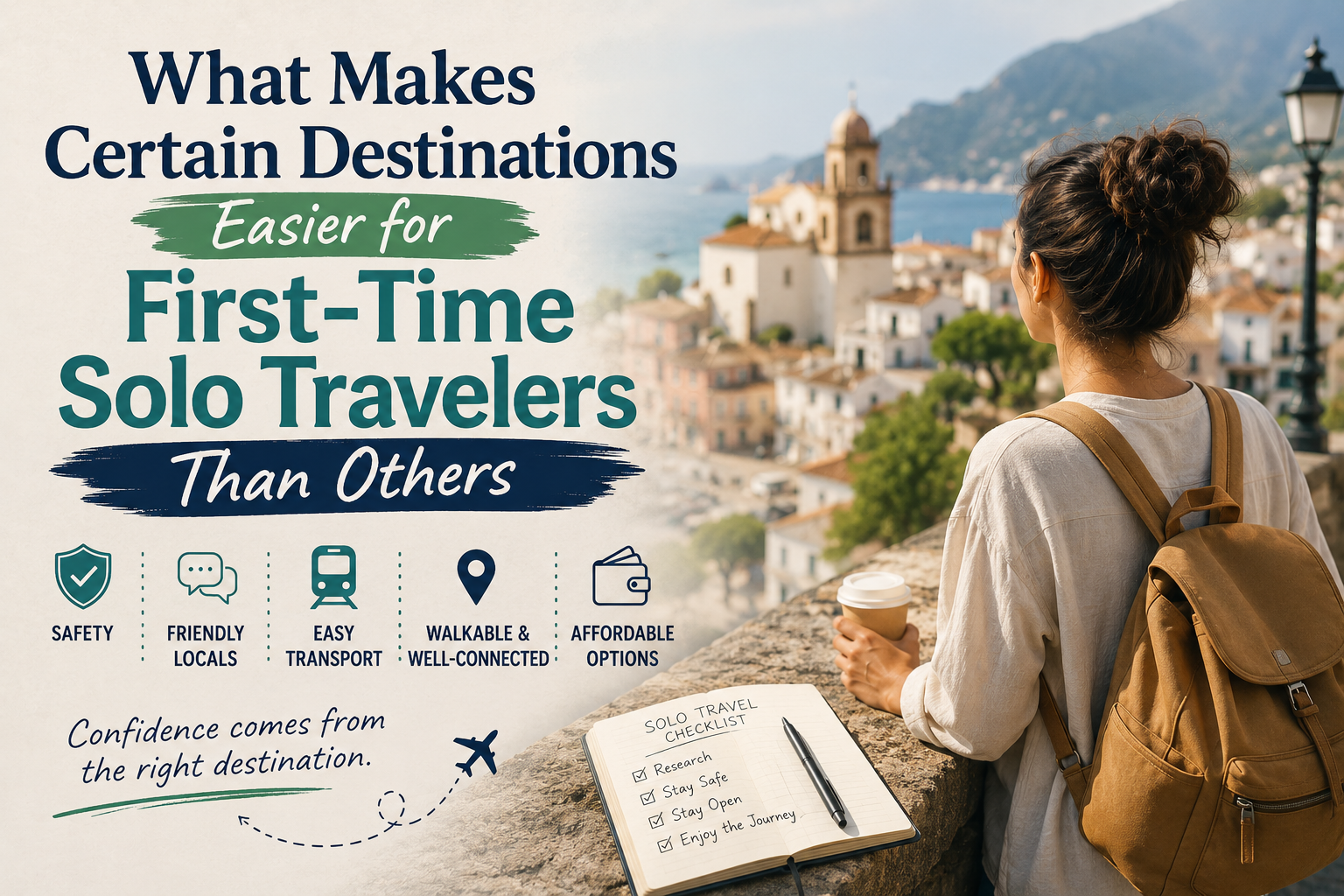
What Makes Certain Destinations Easier for First-Time Solo Travelers Than Others
Quick Summary
A lot of people think solo travel is mainly about courage.
I don’t completely agree.
Confidence matters, of course. But after talking with solo travelers and spending time traveling alone myself, I’ve become convinced that destination choice matters even more.
In fact, I think the wrong destination can make a confident traveler feel stressed, while the right destination can make a nervous beginner feel surprisingly comfortable.
That’s something many people don’t realize when planning their first solo trip.
They spend weeks choosing attractions, hotels, and restaurants. But they don’t spend enough time thinking about whether the destination itself is beginner-friendly.
And honestly, that’s often the difference between a first solo trip that feels exciting and one that feels overwhelming.
If you’re wondering what makes certain destinations easier for first-time solo travelers, the answer has very little to do with famous landmarks.
It usually comes down to things like transportation, safety, language barriers, local culture, and how easy it is to solve small problems when something goes wrong.
Those details may not look exciting on Instagram.
But they’re the things that matter when you’re standing alone in a train station trying to figure out where to go next.
Key Takeaways
| Beginner-Friendly Destinations Usually Have | More Challenging Destinations Often Have |
|---|---|
| Reliable public transportation | Complicated transportation systems |
| Strong tourism infrastructure | Limited visitor support |
| Good safety reputation | Higher travel risks |
| Clear signage | Difficult navigation |
| Easy accommodation options | Limited lodging choices |
| Helpful local attitudes | Less tourist-friendly systems |
| Manageable language barriers | Significant communication challenges |
Why Some Countries Are Better for Beginner Solo Travelers Than Others
The biggest difference is predictability.
That might sound boring, but it’s true.
When you’re traveling alone for the first time, you’re already handling a lot of new experiences.
You’re navigating airports.
You’re managing your own schedule.
You’re solving unexpected problems without anyone helping you.
Because of that, destinations that reduce uncertainty tend to feel much easier.
Take countries like Japan, Singapore, New Zealand, or Portugal.
These places consistently appear on lists of beginner-friendly destinations because many parts of the travel experience are straightforward.
Transportation generally works.
Tourist information is easy to find.
Visitors can move around independently without constant stress.
Compare that to destinations where transportation systems are less organized, language barriers are stronger, or tourism infrastructure is still developing.
Those places can still be amazing.
But they often demand more experience and flexibility.
Personally, I don’t think a first solo trip should be about proving how adventurous you are.
I think it should be about building confidence.
There’s a difference.
What First-Time Solo Travelers Should Look for in a Destination
The first thing I tell people is simple:
Stop focusing only on attractions.
Start focusing on logistics.
A destination can have incredible beaches, famous landmarks, and amazing food.
But if every basic task feels difficult, your trip becomes more stressful than enjoyable.
When I evaluate a destination for solo travel, I usually ask myself a few practical questions.
Can I move around easily?
Can I find accommodation without problems?
Can I get help if something goes wrong?
Can I communicate well enough to handle daily situations?
Can I safely explore without constantly feeling on edge?
Those questions matter much more than many first-time travelers expect.
What usually works is choosing a destination where everyday tasks feel manageable.
What often fails is choosing a destination solely because it looks exciting on social media.
Social media rarely shows the complicated parts of travel.
It rarely shows missed trains.
It rarely shows confusing bus stations.
It rarely shows the frustration of spending an hour trying to solve a simple problem in a language you don’t understand.
Real travel includes those moments too.
Why Transportation Often Determines Whether Solo Travel Feels Easy
If I had to pick one factor that makes the biggest difference for beginners, it would probably be transportation.
Good transportation creates confidence.
Bad transportation creates stress.
It’s really that simple.
Countries with reliable train networks, clear metro systems, and organized public transportation give solo travelers freedom.
You spend less time worrying.
You spend more time exploring.
One reason so many first-time solo travelers enjoy Japan is because the transportation system is incredibly efficient.
The same is true in parts of Europe where trains connect major cities smoothly and predictably.
Meanwhile, destinations with confusing transportation systems can feel exhausting, even when the attractions themselves are wonderful.
I’ve seen travelers spend more energy figuring out transportation than actually enjoying the destination.
That’s never a good sign.
Why Safety Feels Different When You’re Traveling Alone
Safety matters on every trip.
But it feels different when you’re by yourself.
When you’re traveling with friends or family, you naturally share responsibility.
Someone else notices directions.
Someone else keeps track of plans.
Someone else helps solve problems.
Solo travelers don’t have that luxury.
That’s why safest and easiest countries for first solo international travel often become popular recommendations.
The goal isn’t to eliminate all risk.
That’s impossible anywhere.
The goal is to choose environments where common travel problems remain manageable.
Countries with strong tourism infrastructure, reliable emergency services, and good reputations for visitor safety tend to help beginners feel more comfortable.
And honestly, there’s nothing wrong with prioritizing that on your first solo trip.
Some people act like difficult destinations make you a “real traveler.”
I’ve never agreed with that idea.
Travel isn’t a competition.
The goal is to have a good experience.
The Language Barrier Isn’t Always the Problem People Expect
Many new travelers worry about language.
I did too.
In reality, language barriers are often less important than people think.
What matters more is whether a destination is set up to help visitors navigate daily life.
Countries that provide multilingual signs, transportation information, maps, and tourist resources can feel surprisingly easy even when you don’t speak the local language.
Japan is a great example.
Many visitors arrive worried about communication.
Then they discover that transportation systems, tourism services, and navigation tools make daily travel much easier than expected.
What usually works is learning a few basic phrases and approaching situations politely.
What often fails is assuming everyone will automatically speak English everywhere.
A little effort goes a long way.
Why Experienced Solo Travelers Choose Destinations Differently
One thing I’ve noticed is that experienced solo travelers evaluate destinations differently than beginners.
Beginners often ask:
“What is the most exciting place I can visit?”
Experienced travelers often ask:
“How enjoyable will daily life be once I get there?”
That’s a huge difference.
Daily life determines the quality of a trip.
Can you easily find food?
Can you get around?
Can you feel comfortable exploring?
Can you solve problems without major stress?
The older I get, the more important those questions become.
A destination doesn’t have to be famous to provide an incredible experience.
Sometimes the easiest destinations end up being the most enjoyable because they allow you to focus on the experience instead of the logistics.
My Personal Opinion on First Solo Trips
If I could give only one piece of advice to someone planning their first solo adventure, it would be this:
Choose easy first.
Choose challenging later.
I know that advice isn’t particularly exciting.
But I think it’s practical.
Your first solo trip should build confidence, not test your limits.
Once you’ve successfully traveled alone, navigating airports, transportation systems, accommodations, and unexpected situations becomes much easier.
Then you can gradually take on more complex destinations.
That’s usually what works.
What often fails is trying to make your very first solo trip the most ambitious trip of your life.
The destination will still be there next year.
Confidence grows faster when early experiences go well.
And in my opinion, that’s one of the smartest lessons any new solo traveler can learn.

Ravinder Kaur is the founder of OpinionHook, an independent travel publication established in 2023. She oversees editorial standards, destination research, travel planning resources, and content quality across the website. OpinionHook focuses on publishing practical travel guides, itineraries, budgeting advice, and destination resources designed to help travelers make informed travel decisions.
4 Comments
Comments are closed.