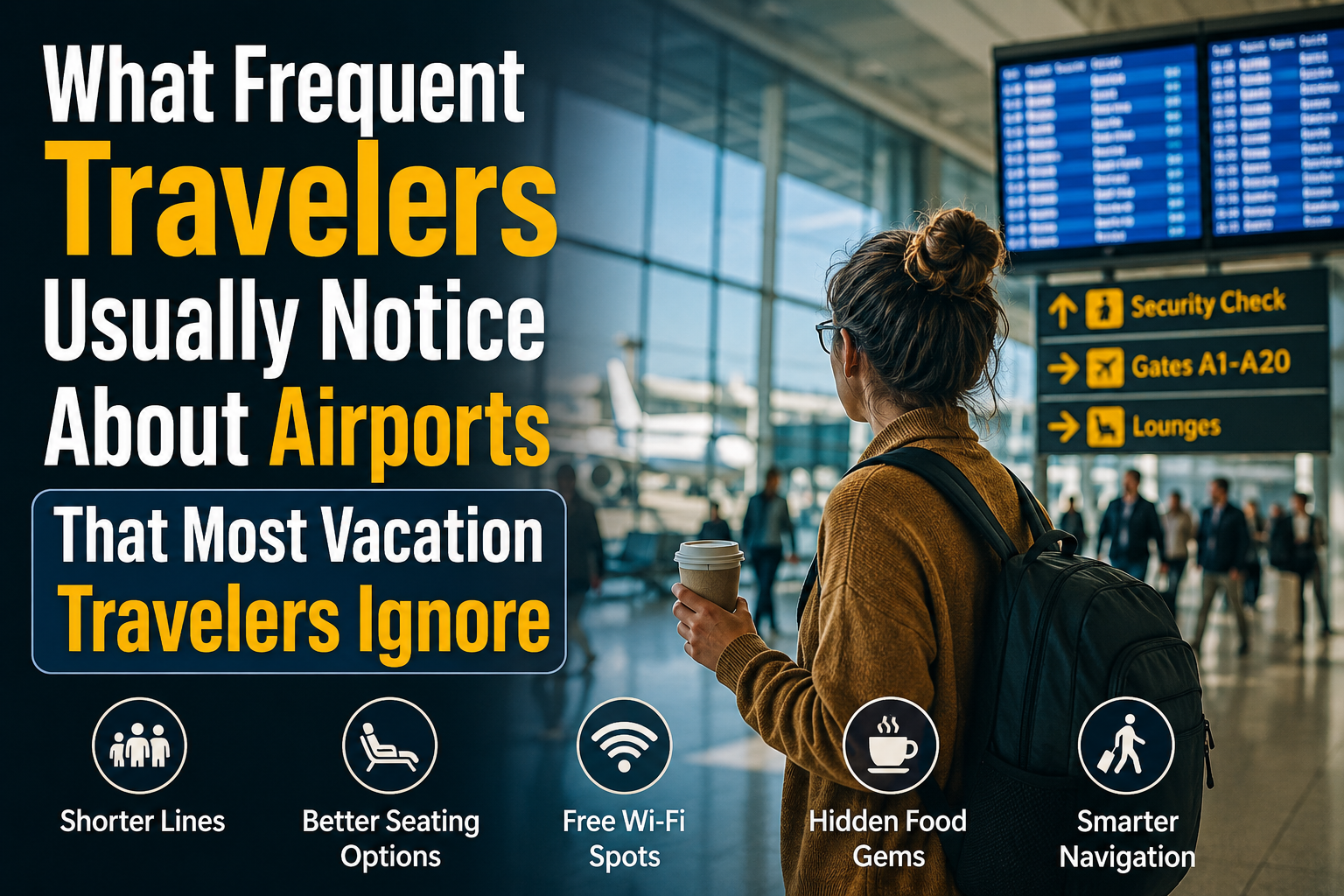
What Frequent Travelers Usually Notice About Airports That Most Vacation Travelers Ignore
Most people walk into an airport thinking about their destination. Frequent travelers walk into an airport thinking about the airport itself.
That sounds strange until you’ve spent enough time flying.
After a while, you stop looking at airports as giant waiting rooms. You start noticing patterns. You see why one security line moves twice as fast as another. You learn which gates almost always get crowded. You recognize the small habits that make travel easier and the mistakes that create unnecessary stress.
The interesting part is that none of this knowledge is hidden. Airports aren’t keeping secrets from vacation travelers. Most people simply don’t spend enough time flying to notice the details.
If you’ve ever watched someone move through a busy airport with complete confidence while everyone else seemed stressed, this article will explain what they’re paying attention to.
Key Takeaways
- Frequent travelers pay attention to airport processes, not just flights.
- Security line strategy matters more than many people realize.
- Experienced travelers constantly monitor gate and flight updates.
- Business travelers often prioritize efficiency over comfort.
- Airport crowd patterns can reveal useful information before official announcements.
- Small habits can save significant time and reduce travel stress.
- Understanding how airports operate makes every trip easier.
Ever Wonder Why Some People Look Completely Relaxed at Airports?
A few years ago, I found myself standing in a security line that barely moved for twenty minutes.
Naturally, I assumed airport security was backed up.
Then I looked to my left.
Another line with nearly the same number of people was moving twice as fast.
At the time, I thought it was bad luck.
Now I know it wasn’t.
Frequent travelers notice things like that almost immediately.
They don’t just see a line. They see families unpacking strollers, travelers reorganizing bags at the last second, and passengers trying to figure out airport procedures for the first time.
The people who fly regularly aren’t necessarily smarter than everyone else. They’ve simply seen the same situations hundreds of times before.
That’s probably the biggest difference between frequent and occasional travelers at airports.
One group sees a crowded terminal.
The other sees a system with predictable patterns.
What Frequent Travelers Notice Before They Even Reach the Airport
One thing that surprised me after talking to several business travelers was how much planning happens before they leave home or their hotel.
Vacation travelers often think arriving early solves every problem.
Experienced travelers usually think differently.
Instead of adding extra hours to their schedule, they gather information.
They check which terminal they’re using.
They look at airport traffic conditions.
They verify whether their airline has changed gates recently.
Some even check where their incoming aircraft is currently located.
That last one sounds excessive until you’ve been delayed enough times.
If your plane is supposed to arrive from another city and that aircraft hasn’t even left its previous airport, there’s a good chance your flight schedule might change.
This isn’t about obsessing over every detail.
It’s about removing surprises.
Frequent flyers know airports become much easier when you know what you’re walking into.
Security Lines Tell a Bigger Story Than Most Travelers Realize
One of the biggest airport secrets frequent flyers know is that the shortest line isn’t always the fastest line.
I learned this lesson the hard way.
Like most travelers, I used to automatically choose whichever line looked shortest.
Sometimes that worked.
Other times it didn’t.
Over time, I noticed experienced travelers doing something different.
They pause.
They watch.
They evaluate.
A line with twenty people carrying laptops, backpacks, and small carry-ons often moves much faster than a line with ten travelers unpacking large bags, managing children, or sorting documents.
That’s not criticism.
It’s simply reality.
The speed of a security line depends more on traveler behavior than line length.
Frequent travelers understand this because they’ve watched it happen over and over again.
When they choose a line, they’re not counting people.
They’re reading the situation.
Experienced Travelers Rarely Stop Looking at Flight Information
Many vacation travelers check their flight details once and assume everything will stay the same.
Airports don’t always work that way.
Gate changes happen.
Departure times shift.
Aircraft assignments change.
Weather delays ripple across entire airport networks.
People who fly regularly understand this.
I’ve watched experienced travelers glance at airport screens almost casually every time they walk past one.
They’re not anxious.
They’re staying informed.
One gate change at a large international airport can mean an extra fifteen-minute walk.
Miss that announcement and your relaxing coffee break suddenly becomes a sprint through the terminal.
Frequent travelers know that airport information is constantly evolving.
That’s why they treat flight details as something to monitor, not something to check once and forget.
The Strange Reason Frequent Travelers Don’t Always Sit Near Their Gate
This habit confused me for years.
I would reach my gate and immediately find a seat nearby.
It seemed logical.
After all, boarding would happen there.
Why go anywhere else?
Then I noticed experienced travelers doing the exact opposite.
Many of them would check their gate and then disappear.
Some headed toward quieter seating areas.
Others found better restaurants.
Some worked from airport lounges.
A few simply walked around.
At first it looked risky.
Later it made perfect sense.
Most flights don’t start boarding immediately after passengers arrive.
In fact, people often spend forty-five minutes or more waiting near gates that won’t be used for quite some time.
Frequent travelers understand this.
As long as they’re monitoring notifications and keeping an eye on flight information, they know they can use that time more effectively.
The Real Difference Between Vacation Travelers and Business Travelers
People often assume business travelers are naturally more confident.
I don’t think that’s true.
I think they’re more familiar.
There’s a difference.
When you’ve gone through the same airport twenty times, fewer things surprise you.
You know roughly how long security takes.
You know where to grab coffee.
You know which terminals require extra walking.
You know what usually causes delays.
That familiarity creates calm.
One approach isn’t necessarily better than the other.
They’re simply different.
Vacation travelers are focused on the trip ahead.
Business travelers are focused on moving through the airport as efficiently as possible.
What Business Travelers Notice That Most People Ignore
One of the most interesting things about frequent travelers is what they pay attention to.
It usually isn’t what you’d expect.
They’re not necessarily looking at airport shops.
They’re not spending much time browsing souvenir stores.
Instead, they notice practical details.
Power outlets.
Available seating.
Reliable Wi-Fi.
Quiet corners.
Workspaces.
Restrooms that aren’t overcrowded.
The funny thing is that these details seem insignificant until you’re delayed for three hours.
Then they suddenly become extremely important.
I’ve seen travelers wander around desperately looking for a charging outlet while experienced flyers were already working comfortably because they chose their seat carefully from the beginning.
That difference comes down to observation.
Frequent travelers think several steps ahead.
Airport Crowds Reveal More Than You Think
Here’s something I didn’t realize until I started traveling more often.
Crowds can provide information.
Not official information.
Useful information.
For example, when food courts suddenly become packed during what should be a quiet period, it often means people are waiting longer than expected.
When gate areas remain unusually empty, boarding may still be a while away.
When large groups begin gathering near service desks, something operational may be happening nearby.
Again, none of these observations are guaranteed.
But frequent travelers pay attention because patterns often repeat.
Airports are surprisingly predictable once you’ve spent enough time in them.
And the people who travel often learn to read those signals without even thinking about it.
A Mid-Trip Tip That Can Change Your Airport Experience
If you only take one idea from this article, make it this one.
Don’t assume the space directly beside your gate is the best place to wait.
In many airports, it’s the worst place.
It’s usually louder.
It’s usually more crowded.
And it’s often harder to find seating or charging outlets.
Try walking one or two gates away.
You’ll often find quieter spaces with fewer people and more room to relax.
It’s a simple adjustment, but it can make a surprising difference during long waits.
And it’s something experienced travelers do all the time without even thinking about it.
Frequent Travelers Pay Close Attention to Carry-On Bags
If you’ve ever been on a completely full flight, you’ve probably heard the announcement.
“Due to limited overhead bin space, some carry-on bags may need to be checked at the gate.”
Most occasional travelers hear that and hope for the best.
Frequent travelers usually saw it coming thirty minutes earlier.
One thing experienced flyers quickly learn is that overhead bin space is limited, no matter how large the aircraft looks from the outside.
When boarding starts, they quietly watch what’s happening around them.
Are people carrying oversized bags?
Is the flight completely full?
Are passengers struggling to fit luggage into overhead compartments?
Those details matter.
I’ve seen flights delayed simply because passengers spent ten minutes rearranging bags in overhead bins. It’s one of those small airport realities that doesn’t seem important until you’re sitting there waiting for the aircraft door to close.
This is one reason many frequent travelers pack differently than vacation travelers.
Their bags are usually smaller.
They’re organized the same way every trip.
And they’re designed to fit easily without creating problems during boarding.
It’s not about minimalism. It’s about efficiency.
Walking Distance Matters More Than Most People Think
One of the biggest mistakes new travelers make is assuming that once they’ve cleared security, they’re basically at their gate.
Sometimes that’s true.
Sometimes it’s very far from true.
Large international airports can feel like small cities.
I’ve landed at airports where reaching the next gate required a train ride, multiple escalators, and what felt like a short workout.
Frequent travelers understand this.
That’s why they often check terminal maps before they travel.
They want to know:
- How far is the gate?
- Is a terminal transfer required?
- Is another security checkpoint involved?
- How much walking should I expect?
People often underestimate how much stress comes from simply not knowing what’s ahead.
When experienced travelers arrive at an airport, they already have a mental picture of where they’re going.
That confidence makes the entire process smoother.
Delays Don’t Affect Frequent Travelers the Same Way
Nobody likes delays.
Not frequent travelers.
Not vacation travelers.
Not airline employees.
But frequent travelers usually react differently.
The first few times I experienced major delays, I spent most of my energy being frustrated.
That reaction is understandable.
You’ve planned a trip, followed the schedule, arrived on time, and suddenly everything changes.
Experienced travelers know that frustration rarely fixes anything.
Instead, they switch into problem-solving mode.
The moment a delay appears, they’re checking alternatives.
They’re looking at connecting flights.
They’re reviewing airline notifications.
They’re figuring out whether the delay is likely to grow longer.
Years of travel teach an important lesson.
Air travel is unpredictable.
Weather changes.
Aircraft need maintenance.
Air traffic congestion happens.
Frequent travelers don’t expect perfection.
They expect occasional disruption and prepare accordingly.
Ironically, that mindset often makes travel less stressful.
Airport Staff Often Reveal What’s Happening Before Announcements Do
This isn’t an exact science.
But it’s something I’ve noticed repeatedly.
Experienced travelers pay attention to airport staff.
Not because staff members are secretly sharing information.
But because behavior often reveals clues.
Imagine you’re sitting near a gate.
Suddenly several gate agents begin making phone calls.
A maintenance team arrives near the aircraft.
Airline employees start having unusually long discussions.
Something may be happening behind the scenes.
It doesn’t always mean a delay.
It doesn’t always mean a gate change.
But experienced travelers notice these shifts because they’ve seen similar situations before.
By the time an official announcement arrives, they already expected something might be changing.
Again, this isn’t insider knowledge.
It’s simply observation.
And observation is one of the biggest skills frequent travelers develop over time.
Airport Design Says a Lot About the Travel Experience
Most people notice airport design only when it’s unusually beautiful.
Frequent travelers notice it all the time.
After visiting enough airports, certain differences become obvious.
Some airports feel calm.
Others feel exhausting.
Some are easy to navigate.
Others seem designed to confuse people.
The best airports usually share a few things in common.
Clear signs.
Logical layouts.
Good lighting.
Comfortable seating.
Enough space for passengers to move freely.
Airports like Singapore Changi and Amsterdam Schiphol regularly receive praise from travelers because moving through them feels intuitive.
You rarely feel lost.
You rarely feel rushed.
Everything simply works.
And when you’re spending dozens of hours every year in airports, those details matter more than fancy architecture.
Frequent Flyers Notice How Other Travelers Move
This may sound strange, but people-watching becomes surprisingly useful when you travel often.
Experienced travelers notice movement patterns.
They notice where crowds form.
They notice which escalators become congested.
They notice which security checkpoints suddenly become busy.
Most importantly, they notice where people are slowing themselves down.
For example, many travelers stop immediately after clearing security to reorganize bags, check documents, or put on jackets.
Frequent travelers usually move away from busy areas before doing those things.
It’s a small habit.
But small habits often create smoother experiences.
After enough flights, efficiency becomes second nature.
What Frequent Travelers Know About Airport Food
Airport food has a reputation.
Some of it is deserved.
Some of it isn’t.
One thing frequent travelers learn quickly is that airport dining quality varies dramatically.
The first restaurant you see may not be the best option.
In many large airports, the busiest locations are simply the most visible.
Experienced travelers often walk a little farther.
They know better options may be hidden deeper inside the terminal.
They also pay attention to timing.
Waiting until everyone else gets hungry usually means standing in longer lines.
It’s another example of a recurring theme throughout this article.
Frequent travelers aren’t necessarily doing different things.
They’re often doing the same things at different times.
Airport Travel Hacks Frequent Flyers Use Without Thinking
Many so-called travel hacks online are either obvious or unrealistic.
The useful ones tend to be simple.
Here are a few habits experienced travelers use regularly:
They Keep Essential Items Easy to Reach
Passports, boarding passes, chargers, and headphones don’t get buried inside luggage.
They’re accessible within seconds.
They Download Airline Apps
Airline notifications often arrive faster than public announcements.
They Charge Devices Whenever Possible
Even if a battery is already at 70%, experienced travelers often top it up.
They’ve learned that unexpected delays happen.
They Stick to Consistent Packing Systems
The same items go into the same locations every trip.
This reduces mistakes and speeds up security screening.
None of these habits are exciting.
That’s probably why they work.
People Also Ask
What do frequent travelers notice at airports?
Frequent travelers notice patterns that occasional travelers often miss. They pay attention to security line efficiency, gate changes, crowd behavior, walking distances, boarding procedures, and airport layouts. These observations help them move through airports more smoothly and avoid unnecessary stress.
What airport secrets do frequent flyers know?
Most airport “secrets” aren’t actually secrets. Frequent flyers understand how crowd patterns work, how to choose better security lines, when to expect delays, and how airport operations affect passengers. Their advantage comes from experience rather than insider information.
What is the biggest difference between frequent and occasional travelers?
The biggest difference is mindset. Vacation travelers focus on reaching their destination. Frequent travelers focus on managing the journey efficiently. They pay closer attention to airport operations, timing, and potential disruptions.
Why do business travelers seem more confident at airports?
Business travelers often visit the same airports repeatedly. Familiarity reduces uncertainty. They know airport layouts, airline procedures, and common travel challenges, which makes them appear more relaxed and confident.
Are airport lounges worth it for frequent travelers?
For many frequent travelers, yes. Lounges provide quieter environments, reliable internet, charging stations, food, and comfortable seating. The value increases for people who spend significant time in airports each year.
The Biggest Lesson Frequent Travelers Learn
After enough flights, something interesting happens.
You stop thinking of airports as obstacles.
You start seeing them as systems.
Once you understand how those systems work, travel becomes easier.
Not perfect.
Not stress-free.
Just easier.
You begin noticing small details that help you make better decisions.
You choose better security lines.
You anticipate delays more effectively.
You avoid crowded waiting areas.
You move through terminals with less uncertainty.
None of these habits require elite status, special memberships, or years of business travel.
Most of them simply require paying closer attention.
And that’s really the biggest difference between frequent travelers and everyone else.
They notice things.
Then they learn from them.
Conclusion
The next time you’re at an airport, try an experiment.
Instead of focusing only on your flight, pay attention to what’s happening around you.
Watch how different security lines move.
Notice where crowds gather.
Observe how experienced travelers navigate the terminal.
Look at how boarding actually works.
You may be surprised by how much information is hiding in plain sight.
What frequent travelers know about airports isn’t secret knowledge. It’s the result of repetition, observation, and experience.
The good news is that you don’t need hundreds of flights to start benefiting from those lessons.
You can begin on your very next trip.
And once you start noticing the same details frequent flyers notice, airports tend to feel a little less chaotic and a lot more manageable.

Ravinder Kaur is the founder of OpinionHook, an independent travel publication established in 2023. She oversees editorial standards, destination research, travel planning resources, and content quality across the website. OpinionHook focuses on publishing practical travel guides, itineraries, budgeting advice, and destination resources designed to help travelers make informed travel decisions.