AEST to IST: India–Australia Time Difference Explained
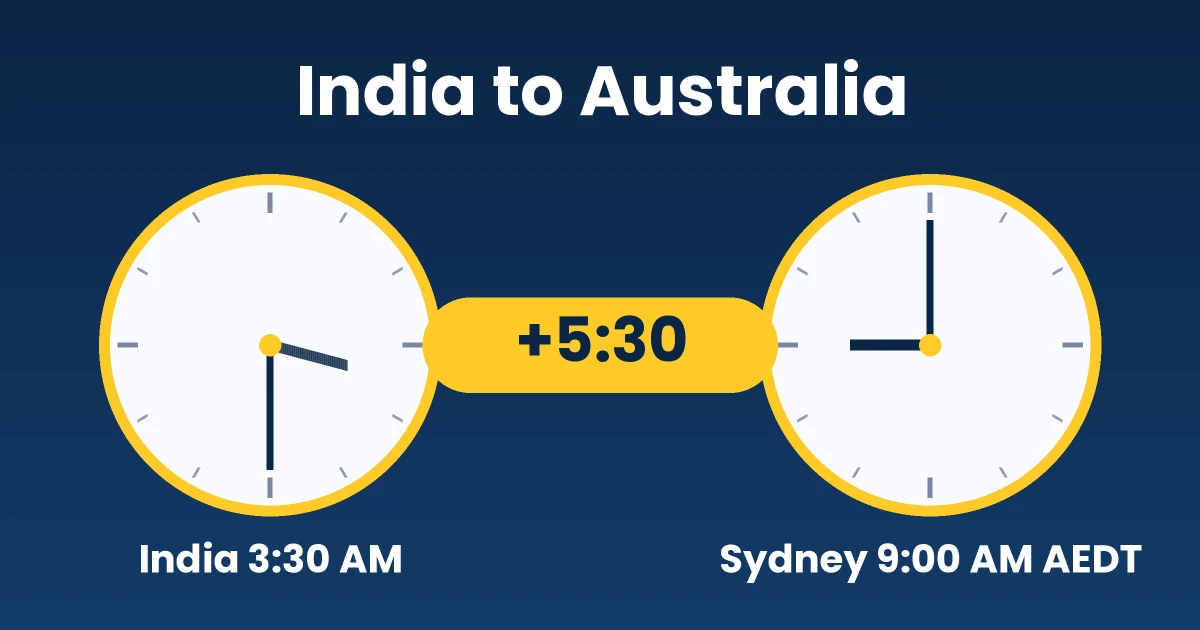
Quick answer: Australia is ahead of India. Eastern Australia is 4 hours 30 minutes ahead on AEST (UTC+10) and 5 hours 30 minutes ahead on AEDT (UTC+11). Right now Sydney, Melbourne, Canberra and Hobart are on AEDT, because daylight saving started on 4 October 2026 and runs until 4 April 2027. Brisbane stays on AEST all year. So to change AEST to IST, subtract 4 hours 30 minutes. To change Sydney time to IST between 4 October 2026 and 4 April 2027, subtract 5 hours 30 minutes. For example, 9:00 AM in Sydney now is 3:30 AM in India.
Most people search for AEST to IST, but AEST is only half the answer. AEST is a fixed label for UTC+10, and Sydney and Melbourne are on AEST only in the cooler half of the year. In the warmer half they use AEDT, which is one hour ahead. Queensland, Western Australia and the Northern Territory never change their clocks. This guide shows the gap for every Australian city, a simple method to convert in both directions, cheat-sheets for the most searched times, when the gap changes, the best hours to call, and the mistakes that cause missed meetings. The gaps are calculated from the IANA time zone database that phones and computers use, and the daylight saving dates are checked against NSW government and national news sources. Last updated 11 October 2026.
Key takeaways
- India uses IST (UTC+5:30) all year and never changes its clocks.
- Australia is ahead of India everywhere. The gap is between 2 hours 30 minutes (Perth) and 5 hours 30 minutes (Sydney in summer).
- AEST is UTC+10 and AEDT is UTC+11. Sydney, Melbourne, Canberra and Hobart use AEDT from 4 October 2026 to 4 April 2027.
- Queensland (Brisbane), Western Australia (Perth) and the Northern Territory (Darwin) do not change clocks, so their gap from India stays the same all year.
- To convert Australia time to India time, subtract the gap. To convert India time to Australia time, add it.
- Australian clocks change in October and April, which is the opposite season from the UK and USA.
AEST, AEDT, ACST, AWST: what the letters mean
Australia has three main time zones, and two of them have a summer version.
| Time zone | Short name | UTC offset | Where it applies |
|---|---|---|---|
| Australian Eastern Standard Time | AEST | UTC+10 | NSW, Victoria, Tasmania and ACT in winter, and Queensland all year |
| Australian Eastern Daylight Time | AEDT | UTC+11 | NSW, Victoria, Tasmania and ACT in summer |
| Australian Central Standard Time | ACST | UTC+9:30 | South Australia in winter, and Northern Territory all year |
| Australian Central Daylight Time | ACDT | UTC+10:30 | South Australia in summer |
| Australian Western Standard Time | AWST | UTC+8 | Western Australia all year |
The letters matter because many websites show AEST all year, even when Sydney is on AEDT. If a Sydney meeting invite says AEST in December, check which clock it really means. Using the city name is safer than using the letters.
India to Australia time difference by city
The table shows how far each Australian city is ahead of India. It covers the current summer period and the cooler months that follow.
| City | Gap from India until 3 Apr 2027 (Australia is ahead by) | Gap from 4 Apr 2027 to 2 Oct 2027 |
|---|---|---|
| Sydney, Melbourne, Canberra, Hobart | 5 h 30 min | 4 h 30 min |
| Brisbane (Queensland) | 4 h 30 min | 4 h 30 min |
| Adelaide (South Australia) | 5 h | 4 h |
| Darwin (Northern Territory) | 4 h | 4 h |
| Perth (Western Australia) | 2 h 30 min | 2 h 30 min |
Adelaide is on a half-hour zone, so its gap ends in 00 instead of 30. Darwin is on a half-hour zone all year and is 4 hours ahead of India.
How to convert AEST to IST (and IST to AEST)
There are three steps.
- Pick the Australian city. Time depends on the state, not the whole country.
- Check whether that city is on daylight time. Sydney, Melbourne, Canberra, Hobart and Adelaide are on daylight time from the first Sunday in October to the first Sunday in April. Brisbane, Perth and Darwin never are.
- Subtract or add the gap. Indian time equals Australian time minus the gap. Australian time equals Indian time plus the gap. If the answer passes midnight, move the date by one day.
There is a second way. Convert the Australian time to UTC, then add 5 hours 30 minutes for India. For example, Sydney in summer is UTC+11, so 9:00 AM in Sydney is 10:00 PM UTC the previous day, which is 3:30 AM IST.
Worked examples
AEDT is Sydney and Melbourne in summer (now to 4 April 2027). AEST is Sydney and Melbourne in winter, and Brisbane all year.
- 9:00 AM Sydney to India: in AEDT, 9:00 AM minus 5 hours 30 minutes is 3:30 AM IST. In AEST, it is 4:30 AM IST.
- 5:00 PM Sydney to India: in AEDT, 11:30 AM IST. In AEST, 12:30 PM IST.
- 10:00 AM in India to Sydney: in AEDT, 10:00 AM plus 5 hours 30 minutes is 3:30 PM. In AEST, it is 2:30 PM.
- 8:00 PM in India to Sydney: in AEDT, 1:30 AM the next day. In AEST, 12:30 AM the next day.
- Date change, Australia to India: 1:00 AM Tuesday in Sydney (AEDT) is 7:30 PM Monday in India.
- Date change, India to Australia: 11:00 PM Monday in India is 4:30 AM Tuesday in Sydney (AEDT).
Cheat-sheets you can save
The first table uses Sydney and Melbourne time on AEDT, which applies until 4 April 2027. In winter (AEST, and Brisbane all year), the gap is one hour smaller, so add one hour to every Indian time in the first table. The second table shows both AEDT and AEST.
Sydney time (AEDT) to Indian time
| Sydney or Melbourne time (AEDT) | Indian time |
|---|---|
| 5:00 AM | 11:30 PM (previous day) |
| 8:00 AM | 2:30 AM |
| 9:00 AM | 3:30 AM |
| 10:30 AM | 5:00 AM |
| 12:00 PM | 6:30 AM |
| 3:30 PM | 10:00 AM |
| 5:00 PM | 11:30 AM |
| 9:00 PM | 3:30 PM |
| 11:00 PM | 5:30 PM |
Indian time to Australian time
| Indian time | Sydney, Melbourne (AEDT, now) | Brisbane or Sydney in winter (AEST) | Perth (AWST) |
|---|---|---|---|
| 6:00 AM | 11:30 AM | 10:30 AM | 8:30 AM |
| 8:00 AM | 1:30 PM | 12:30 PM | 10:30 AM |
| 10:00 AM | 3:30 PM | 2:30 PM | 12:30 PM |
| 12:30 PM | 6:00 PM | 5:00 PM | 3:00 PM |
| 3:30 PM | 9:00 PM | 8:00 PM | 6:00 PM |
| 6:00 PM | 11:30 PM | 10:30 PM | 8:30 PM |
| 8:00 PM | 1:30 AM (next day) | 12:30 AM (next day) | 10:30 PM |
| 10:00 PM | 3:30 AM (next day) | 2:30 AM (next day) | 12:30 AM (next day) |
When Australia changes its clocks
| Date | What happens | Gap from India |
|---|---|---|
| Now to 3 Apr 2027 | NSW, Victoria, Tasmania, ACT and South Australia are on daylight time | Sydney, Melbourne, Canberra, Hobart 5 h 30 min. Adelaide 5 h. Brisbane 4 h 30 min. Darwin 4 h. Perth 2 h 30 min |
| 4 Apr 2027, 3:00 AM | Daylight time ends and clocks go back one hour | Sydney, Melbourne, Canberra, Hobart 4 h 30 min. Adelaide 4 h. The others do not change |
| 3 Oct 2027 (first Sunday in October) | Clocks go forward one hour | Sydney, Melbourne, Canberra, Hobart back to 5 h 30 min. Adelaide 5 h |
Australia’s daylight saving runs from the first Sunday in October to the first Sunday in April, which is the opposite season from the UK and USA. One effect is that the India–Australia gap grows by an hour in October when Australia moves forward, and the India–UK gap also grows by an hour in October when the UK moves back, but in the opposite direction. If you work with both countries, check every meeting in October and April.
Best times to call or meet between India and Australia
The table shows the hours when it is between 8:00 AM and 9:30 PM on both sides. These are polite hours for most people.
| Place | Australian time | India time |
|---|---|---|
| Sydney, Melbourne (AEDT, now to 3 Apr 2027) | 1:30 PM to 9:30 PM | 8:00 AM to 4:00 PM |
| Sydney, Melbourne (AEST, 4 Apr to 2 Oct 2027) | 12:30 PM to 9:30 PM | 8:00 AM to 5:00 PM |
| Brisbane (all year) | 12:30 PM to 9:30 PM | 8:00 AM to 5:00 PM |
| Perth (all year) | 10:30 AM to 9:30 PM | 8:00 AM to 7:00 PM |
The overlap sits in the Indian morning and the Australian afternoon and evening. For example, 8:00 AM in India is 1:30 PM in Sydney in summer, and 12:30 PM IST is 6:00 PM in Sydney. After about 4:00 PM in India it is already 9:30 PM in Sydney, so late Indian evenings do not work for most calls. For a full plan for relatives, see our guide on the best time to call family abroad from India.
Real-life situations where the gap matters
Students and university deadlines
Australian universities publish deadlines in local time. A deadline of 11:59 PM in Sydney in summer (AEDT) is 6:29 PM the same day in India. In winter (AEST) it is 7:29 PM. Always confirm the deadline on the official website, and set your reminder in the Australian city’s time zone.
Job interviews and remote work
Write the time in both zones, for example 10:00 AM Sydney / 4:30 AM IST. In your calendar app, pick the city (Sydney, Brisbane or Perth) instead of AEST or AEDT, so the invite converts correctly on both sides. Recheck recurring meetings around 4 April 2027 and in early October 2027.
Flights between India and Australia
Tickets show local time at each airport. As an example, a flight that leaves Delhi at 11:00 PM IST and takes 12 hours lands at 11:00 AM IST, which is 4:30 PM in Sydney in summer. Flight times differ by route, so check the airline for the exact duration.
Cricket and live events
Australian events are listed in local time. A match that starts at 2:30 PM in Sydney in summer starts at 9:00 AM in India. A 7:00 PM start in Sydney is 1:30 PM in India.
Common mistakes to avoid
- Using AEST for Sydney in summer. Sydney is on AEDT from 4 October 2026 to 4 April 2027.
- Treating Australia as one time. Perth, Darwin, Adelaide and Brisbane each have different gaps.
- Assuming Queensland changes its clocks. It does not, so Brisbane’s gap stays at 4 hours 30 minutes all year.
- Saying India is ahead of Australia. Australia is ahead of India, so you subtract the gap when you go from Australia to India.
- Forgetting the date change. Early morning in Sydney is usually the previous evening in India.
Check the live gap
Want the answer for a specific day and city? Use our free India–Australia time difference tool, which uses the same time zone data as this guide. If you work with other countries too, see our guides on the UK to India time difference, how to calculate the time difference between India and the USA and the India–Canada time gap in 2026. All our calculators are on the tools page. Planning your first trip abroad? See our first-time international travel tips.
Frequently asked questions
What is AEST to IST?
AEST is UTC+10 and IST is UTC+5:30, so AEST is 4 hours 30 minutes ahead of IST. To convert AEST to IST, subtract 4 hours 30 minutes. For example, 9:00 AM AEST is 4:30 AM IST. In summer, Sydney uses AEDT, which is 5 hours 30 minutes ahead.
What is the time difference between India and Sydney?
Sydney is 5 hours 30 minutes ahead of India from 4 October 2026 to 4 April 2027, while it is on AEDT. From 4 April 2027 to the first Sunday of October 2027 it is 4 hours 30 minutes ahead, on AEST.
Is Australia ahead of or behind India?
Australia is ahead of India everywhere. The gap is between 2 hours 30 minutes (Perth) and 5 hours 30 minutes (Sydney and Melbourne in summer).
Why do I see different answers for AEST and AEDT?
AEST is the standard time (UTC+10) and AEDT is the daylight time (UTC+11). Sydney, Melbourne, Canberra and Hobart use AEDT in summer and AEST in winter. Brisbane uses AEST all year.
When does Australia change its clocks?
Clocks moved forward on Sunday 4 October 2026 in New South Wales, Victoria, South Australia, Tasmania and the ACT. They go back on Sunday 4 April 2027. Queensland, Western Australia and the Northern Territory do not change.
What is 10 AM in India in Australia?
10:00 AM in India is 3:30 PM in Sydney and Melbourne in summer (AEDT), and 2:30 PM in Sydney in winter (AEST). In Perth it is 12:30 PM, all year.
What is 8 AM in India in Australia?
8:00 AM in India is 1:30 PM in Sydney in summer (AEDT) and 12:30 PM in winter (AEST). In Brisbane it is 12:30 PM all year.
What is the time difference between India and Perth?
Perth is 2 hours 30 minutes ahead of India all year. Western Australia does not change its clocks.
How many hours difference is there between India and Australia?
Between 2 hours 30 minutes and 5 hours 30 minutes, depending on the city and the season. Sydney and Melbourne are 5 hours 30 minutes ahead until 4 April 2027. Brisbane is 4 hours 30 minutes ahead all year.
Sources and how we checked
- NSW Government: Daylight saving
- SBS News: Daylight saving in Australia explained
- Wikipedia: Time in Australia
- Wikipedia: Indian Standard Time
The gaps in this guide are calculated from the 2026 release of the IANA time zone database. Daylight saving dates for 2026 and 2027 are from the NSW Government and SBS News. The October 2027 start follows the first-Sunday-in-October rule. This guide is general information. For visa, flight or legal deadlines, always use the official source. Last updated 11 October 2026.

Varinder Kaur is from Amritsar, India. She has traveled to well-known places across India, including Darjeeling, and to a few countries abroad, and shares travel experiences and practical tips for travelers through OpinionHook.