Schengen Cascade Visa for Indians: Who Qualifies and How to Apply
Quick answer: The Schengen cascade is an EU rule that lets travellers with a good visa history move up to multiple-entry Schengen visas valid for one, two or up to five years. For Indians living in India, a European Commission decision dated 18 April 2024 says a two-year multiple-entry visa should be issued if you have obtained and lawfully used two Schengen visas in the previous three years and meet the normal entry conditions.
That sounds simple, but the details trip people up. This guide explains who qualifies, what your visa history must show, how to ask for a longer visa, and what to check before you pay for an appointment.
Key takeaways
- The India-specific rule (Commission Implementing Decision C(2024) 2434, 18 April 2024) covers Indian nationals who live in India and apply at a Member State consulate in India.
- To get the two-year visa under that decision, you need two Schengen visas obtained and lawfully used within the previous three years.
- First-time applicants do not qualify. The decision itself treats first-time applicants as a higher-risk group.
- Longer visas of up to five years exist under Article 24 of the Visa Code, but they stay at the consulate’s discretion.
- A multiple-entry visa does not extend your stay. The 90 days in any 180 days limit still applies.
- The visa will end at least three months before your passport expires, so a short-validity passport shortens the visa.
- Always check the visa sticker. Asking for a longer visa does not mean you will get one.
What the Schengen cascade means
A normal Schengen visa is often issued for one trip, or for a short window with one or two entries. A multiple-entry visa lets you enter the Schengen Area many times while it is valid, as long as you stay within 90 days in any 180-day period. The cascade is the ladder of rules that lets frequent, trustworthy travellers climb from short visas to longer ones without applying for a new type each time.
The general rules sit in Article 24 of the EU Visa Code (Regulation (EC) 810/2009). The text we read says multiple-entry visas can be issued with a validity between six months and five years. It also says the applicant must show a need to travel frequently or regularly, and must prove integrity and reliability, including lawful use of earlier visas and a real intention to leave before the visa expires.
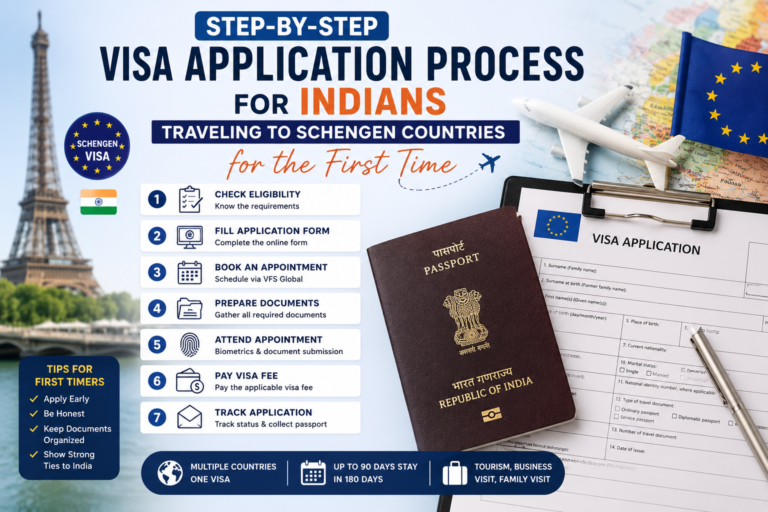
If you have not yet read how a first application works, start with our step-by-step Schengen visa process for Indians, then come back here once you have a visa or two behind you.
What the 2024 decision says for Indian applicants
India has its own cascade rule. The Commission adopted it on 18 April 2024. Here is what the text of the decision contains, in plain terms.
| Point | What the decision says |
|---|---|
| Who it covers | Indian nationals residing in India who apply for a short-stay visa at a Member State consulate in India |
| The rule | A multiple-entry visa valid for two years is issued if you have obtained and lawfully used two visas within the previous three years |
| Entry conditions | You must still meet the normal conditions in Article 6(1)(a), (c), (d) and (e) of the Schengen Borders Code |
| Passport validity | If the visa would outlast your passport, it ends three months before the passport expires |
| Longer visas | The decision does not stop Member States from issuing visas of up to five years in justified cases under Article 24(2c) of the Visa Code |
| First-time applicants | The two-year rule needs two earlier visas, so first-time applicants cannot use it |
Two things stand out. First, the India rule skips the one-year step that sits in the general ladder. Second, the decision talks about a two-year visa only. It does not say that a five-year visa follows automatically. Some news reports describe a five-year visa as the next step, but the decision text we read does not contain a five-year rule, so treat that claim with care and check with the consulate.
The general ladder: one, two and five years
Outside the India decision, Article 24 of the Visa Code sets a step-by-step ladder. We could not open the full amended article on the official site, so the steps below come from a travel-industry summary (Wego) of Article 24. Check the current article before you rely on the exact periods.
| Visa you ask for | What the summary says you need |
|---|---|
| 1-year multiple-entry | Three visas obtained and lawfully used in the previous two years |
| 2-year multiple-entry | A one-year multiple-entry visa lawfully used, looking back two years |
| 5-year multiple-entry | A two-year multiple-entry visa lawfully used, looking back three years |
In practice, an Indian applicant living in India may reach the two-year visa through the 2024 decision without holding a one-year visa. After that, the five-year visa depends on the general ladder and on the consulate’s view of your file.
Who is likely to qualify
Think of the cascade as a reward for a clean record. You are in a better position if all of these are true:
- You live in India and apply at a consulate in India.
- You have held at least two Schengen visas in the last three years and actually used them.
- You travelled on each visa, left the Schengen Area before it expired and did not overstay.
- You stayed within 90 days in any 180 days on each trip.
- Your passport has enough validity left to carry the longer visa.
- You can show a reason to travel often, such as regular business trips, family in Europe or repeated study or work visits.
- Your finances and purpose of travel are clear on the new application.
If you are applying for the first time, this path is closed for now. Your first visa builds the record that makes the second and third easier. Our guide on the passport validity rule also explains why passport dates matter more than most people expect.
What counts as lawful use
The word that matters most in the cascade is lawful. According to the Wego summary, lawful use means you actually travelled on the visa, returned home before it expired, stayed within the 90 in 180 limit and met the other entry conditions. A visa you never used usually does not help your case.
One news report says transit visas and country-specific visas do not count towards the cascade, and that overstaying or working illegally can hurt your eligibility for years. We could not confirm that wording in the official decision, so ask the consulate which of your past visas it will count.
Keep proof of each trip. Passport stamps, boarding passes and hotel bookings help if the officer asks. With the EU’s new border system, entries and exits are now recorded digitally as well. Our guide to the EES at Schengen borders explains what that means for your travel history.
How to apply for a cascade visa
There is no separate cascade form. You apply the usual way and let your history do the work.
Step 1: Pick the right consulate
Apply to the country where you will spend the most nights. If that is not clear, apply to the country of first entry. Use the same country where you can, because that country can see your earlier visa clearly.
Step 2: Check your passport
Your passport needs enough validity for the stay. Because the longer visa ends three months before the passport does, a passport close to expiry will cut your visa short. If your passport has less than two years left, consider renewing it first.
Step 3: Fill in the form and book the appointment
Complete the standard Schengen form, then book through the consulate or its official visa application centre. Our process guide walks through forms, fees, biometrics and travel insurance in order.
Step 4: Show your visa history
Take your previous visas and the passports that hold them. Add proof that you used them lawfully. If you want a multiple-entry visa, say why. A short cover letter that names the reason you travel often is enough. Do not invent trips you do not plan to take.
Step 5: Support the trip itself
Even with a perfect record, each application is checked again. Bring the purpose of travel, accommodation, funds and valid travel medical insurance as the consulate requires. The Visa Code lets consulates ask for an interview or extra documents in justified cases.
Step 6: Check the sticker on arrival
When your passport comes back, read the visa type, the dates and the number of entries. Mistakes are easier to fix before you fly.
What the validity actually means
A two-year multiple-entry visa does not mean you can live in Europe for two years. It means you can enter several times during those two years. Each stay must still fit inside the 90 days in any 180-day window.
Validity runs from the date shown on the sticker, not from your first entry. So if you collect a visa in January but travel in June, you have already used part of its life. Plan your trips so you use the visa well.
If you plan several short trips, count your days before you book. A table or a simple calendar note works well. For a wider plan on how to build a Europe route that fits the limit, see our guide to planning a Europe trip on a budget.
Common mistakes to avoid
- Assuming you qualify because you have travelled often. Past visas must have been obtained and lawfully used in the right time window.
- Counting visas that were never used.
- Applying with a passport that expires soon, then being surprised by a short visa.
- Asking for a long visa without a reason to travel often.
- Applying outside India and expecting India-specific rules to apply. The decision covers Indian nationals residing in India.
- Mixing up the visa length with the length of stay.
- Forgetting to read the sticker.
- Treating a news article or an agent’s claim as the rule. Use the decision text or the consulate.
Is a longer visa guaranteed?
No. The decision gives a rule for the two-year visa, but the consulate still checks every application against the entry conditions. A weak file can receive a shorter visa, or a refusal. Article 32 of the Visa Code lists the grounds for refusal. If that happens, read our guide on Schengen visa rejection reasons for Indians to understand the refusal form and what to fix.
Frequently asked questions
Can a first-time applicant get a two-year Schengen visa from India?
Not under the 2024 decision. It needs two visas obtained and lawfully used in the previous three years. A first-time applicant has none, so the usual single or short multiple-entry visa is the normal result.
Do I need to apply for the cascade visa separately?
No separate form exists. You apply for a Schengen visa in the normal way and show your travel history. The consulate decides the validity and number of entries it will give.
Does a five-year Schengen visa exist for Indians?
The Visa Code allows multiple-entry visas of up to five years in justified cases, and the decision does not block that. But the 2024 decision text we read contains no five-year rule. Treat a five-year visa as possible, not promised, and check with the consulate.
Can I stay in Europe for the whole validity of a multiple-entry visa?
No. You can stay up to 90 days in any 180-day period. Entering and leaving does not reset the count. Check your days before each trip.
Does the cascade apply if I live outside India?
The decision covers Indian nationals residing in India who apply at consulates in India. If you live in another country, the standard rules apply, and you should ask the local consulate.
How we checked this guide
We checked this guide on 10 October 2026. We read the text of Commission Implementing Decision C(2024) 2434 of 18 April 2024 and the Visa Code on EUR-Lex. The general one, two and five-year ladder comes from a secondary summary, because we could not open the amended article on the official site. We did not invent figures. If a point is not in these sources, we say so and send you to the consulate. Rules and consulate practice change, so confirm the current rule with the consulate or its official application centre before you pay any fee.
Sources
- Commission Implementing Decision C(2024) 2434 on multiple-entry visas for Indian nationals residing in India
- EU Visa Code, Regulation (EC) No 810/2009, on EUR-Lex
- Wego: Schengen Cascade Regime 2026
- Business Today: Indians and the 5-year Schengen cascade (30 July 2025)
- European Commission: Visa policy
Related Guides
- Step-by-Step Visa Application Process for Indians Traveling to Schengen Countries for the First Time
- EES at Schengen Borders in 2026: What Indian Travellers Should Expect
- Passport Validity Rules: The Six-Month Rule Explained
- Schengen Visa Rejection Reasons for Indians: What to Fix Before You Reapply
Browse all of our Flights, Visas and Airports guides.

Varinder Kaur is from Amritsar, India. She has traveled to well-known places across India, including Darjeeling, and to a few countries abroad, and shares travel experiences and practical tips for travelers through OpinionHook.