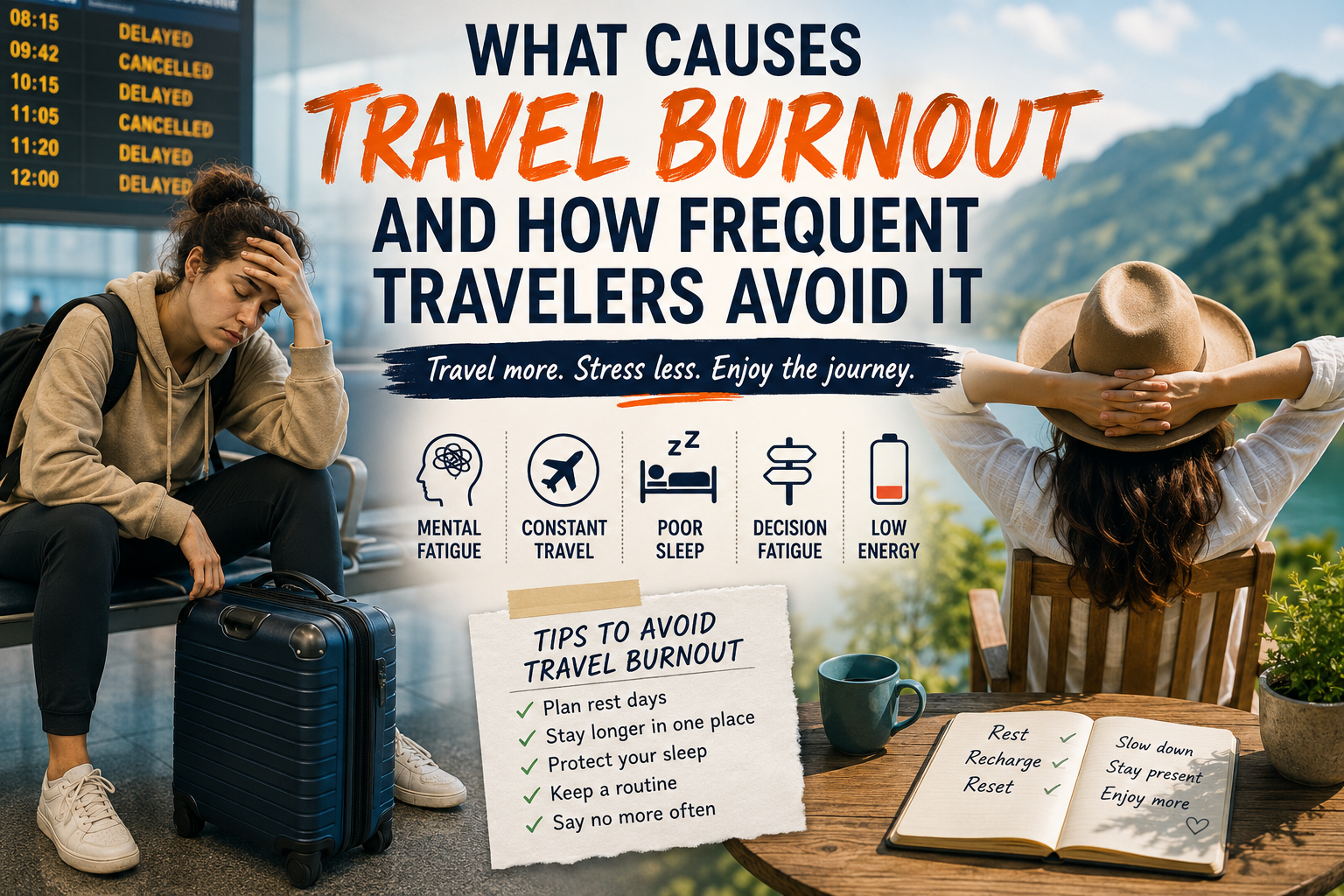
Travel Burnout: Causes, Signs and How Frequent Travelers Avoid It
Travel burnout is the deep tiredness and loss of interest that can build up when you travel too much, too fast, or with too little rest. It is not an official medical diagnosis, but many frequent travellers will recognise it. The good news is that it is usually preventable. Sleep, slower plans and regular rest days do most of the work.
This guide explains what causes travel burnout, how to tell it apart from normal travel tiredness, the early warning signs, and the habits that help frequent travellers stay energised. It also covers a problem many Indian travellers face: short leave, packed itineraries and long flights that push us to see everything in a few days.
Key takeaways
- Travel burnout builds up over time. Normal travel tiredness fades after a few days of rest; burnout lingers.
- Common causes are constant movement, poor sleep, too many decisions, overpacked plans and no routine.
- Early signs include irritability, trouble sleeping, low motivation and losing interest in things you normally enjoy.
- Fewer stops, longer stays and one rest day for every few busy days are the most reliable fixes.
- Adults generally need 7 or more hours of sleep, according to the US CDC. Protecting sleep on trips is the simplest habit to build.
- Travel burnout is not a medical diagnosis. If low mood or exhaustion lasts or worsens, talk to a doctor or a mental health professional.
What is travel burnout?
Travel burnout is a general term for a state of physical, emotional and mental exhaustion linked to a lot of travel or a very demanding trip. People use it for backpackers on long trips, remote workers who move often, business travellers, and holidaymakers who try to cover too much in too little time.
A quick note on the word burnout. The World Health Organization defines burn-out in its International Classification of Diseases as a syndrome linked to chronic workplace stress, and says the term should not be used for experiences in other areas of life. So when we say travel burnout in this guide, we are using an everyday phrase for travel-related exhaustion, not a medical condition.
Travel fatigue vs travel burnout
| Travel fatigue | Travel burnout | |
|---|---|---|
| How long it lasts | A few days | Weeks or longer |
| Cause | Usually one trip or one long journey | Repeated or long-running strain |
| Recovery | Improves after a few good nights of sleep | Rest helps, but the low mood or lack of interest remains |
| Feels like | Tired, sleepy, slow | Drained, flat, irritable, unmotivated |
| Best response | Sleep and an easy day | Slow down, change the plan, get support if needed |
Jet lag is a common cause of short-term fatigue. The UK’s NHS says jet lag usually improves within a few days as your body adjusts to the new time zone, and suggests ways to reduce it, such as adjusting sleep times, spending time outdoors in daylight after you arrive and avoiding daytime naps.
What causes travel burnout
Burnout rarely has one cause. It is usually several small things that add up.
1. Constant movement
Packing, checking out, finding transport and learning a new place all use energy. If you change city every two or three days, there is almost no time to recover. Many travellers find that fewer, longer stops feel much better than a fast tour.
2. Too many decisions
Where to eat, which route to take, which ticket to buy, how to pay, whether a price is fair. On a trip, you make these choices all day. This mental load is called decision fatigue, and it can leave you feeling overwhelmed by simple choices. Building simple routines and booking key things in advance reduces it.
3. Poor sleep
Jet lag, noisy rooms, early flights and shared dorms all cut sleep. The CDC recommends 7 or more hours for adults and links enough sleep with better mood, attention and memory. Even a few short nights can make everything on a trip feel harder.
4. Overpacked itineraries
Fear of missing out is a big driver. Trying to see every sight leaves no time to rest. Many Indian travellers have limited leave and book multi-country tours that cover many cities in a week or ten days. These can be good value, but the pace is demanding. If you take one, add buffer time at the start and end.
Our guide on how much to plan a trip helps you decide how full your days should be.
5. No routine
Travel breaks your usual habits: meals, exercise, sleep times, calls with family. Without a few anchors, you can feel unsettled.
6. Social strain
Hostels, group tours and constant small talk can be tiring. So can long periods away from family and friends, particularly if you are travelling solo for the first time. Our guide on solo travel planning mistakes covers how to avoid several of these.
7. Work mixed with travel
Working remotely while moving often is a classic recipe for burnout. If you are on calls in the morning and sightseeing in the afternoon, you never fully rest. See our tips on how to travel more while working full time.
Early signs to watch for
Signs are different for each person, but common ones include:
Physical
- Constant tiredness or low energy
- Poor sleep or waking too early
- Headaches
- Stomach upset
- Catching colds more often
Emotional
- Irritability over small things
- Anxiety or feeling overwhelmed
- Feeling flat or low
Mental
- Trouble concentrating
- Forgetfulness
- Not wanting to make even small decisions
- Losing interest in places or activities you looked forward to
If you notice several of these for more than a couple of weeks, take it seriously.
A quick self-check
Ask yourself:
- Am I tired most days, even after sleeping?
- Do I dread sightseeing that I planned months ago?
- Do small problems feel huge?
- Am I sleeping badly?
- Have I stopped enjoying food, walks or conversations?
If you answered yes to several, it is time to slow down. If the feeling is heavy or does not lift, speak to a doctor or counsellor. In India, Tele-MANAS is a free, 24-hour mental health helpline on 14416 or 1800-891-4416.
Symptoms and fixes at a glance
| What you notice | What may be behind it | What to try |
|---|---|---|
| Tired all the time | Short sleep, jet lag, early starts | Protect sleep; plan a recovery day |
| Irritable | Too much noise and stimulation | Cut your plan in half for a day |
| Flat, no excitement | Too many places too quickly | Stay longer in one place |
| Anxious | Over-planning or fear of missing out | Choose two must-do things per day |
| Overwhelmed by choices | Decision fatigue | Pre-book transport and the first night |
| Poor sleep | Time zone changes, noise | Fixed bedtime, eye mask, earplugs |
How experienced travellers avoid burnout
They stay longer in fewer places
A useful rule is to stay at least three nights in each place. Staying longer cuts the number of travel days, which are the most tiring. Our guides on slow travel, slow vs fast travel and staying longer in one destination explain the benefits.
They schedule recovery days
A recovery day has no sightseeing. Sleep in, walk without a plan, do laundry, read or sit in a cafe. Plan one after every two or three busy days, and one right after a long-haul flight.
They protect sleep
The NHS and the CDC both give similar basic advice: keep regular sleep times where you can, keep the room quiet and cool, avoid caffeine late in the day and limit screens before bed. On trips, avoid very early flights when you can, and do not book a packed day right after you land.
They plan the long flights well
India to Europe is a shift of about 3.5 to 4.5 hours, depending on the season, while India to the US East Coast is roughly 9.5 to 10.5 hours. The bigger the gap, the more recovery time you need. See our tips for your first long-haul flight and for airports.
They keep a few routines
One small routine can steady you: a morning walk, a coffee at the same time, stretching, calling home at the same hour, or journaling. Routine tells your body what to expect.
They say no
Skipping a museum or a viewpoint is fine. A trip is not a checklist. Pick your top two things per day and treat everything else as a bonus.
They use a simple energy log
Rate your sleep, mood and energy from 1 to 5 each evening. After a week you will see patterns, and you can adjust before you hit a wall.
Planning a trip so you do not burn out
- Cut your first draft itinerary by about a third.
- Put the hardest travel days (flights, border crossings, long transfers) next to light days.
- Book the first night and the transport from the airport in advance.
- Add a rest day to every week of travel.
- Keep one spare day before your flight home. It saves you from rushing and helps you start work refreshed.
- If you are visiting multiple countries, read our guide to city-to-city travel so transfers do not take over your trip.
Tools can help with planning, but the final plan should feel doable to you. Our guide to AI travel planning tools shows how to use them without over-filling your itinerary.
If you are already burned out
- Stop adding new stops. Cancel or move the least important ones.
- Stay in one comfortable place for several days.
- Sleep, eat regular meals, drink water and get outdoors in daylight.
- Cut back on screens and social media, which can add pressure to document everything.
- Talk to someone you trust about how you feel.
- If the exhaustion, low mood or anxiety continues or you feel unsafe, seek professional help.
This article is general information, not medical advice.
Frequently asked questions
What causes travel burnout?
It is usually a mix of constant movement, poor sleep, too many decisions, packed schedules and a lack of routine, sometimes combined with work stress or being away from family and friends for a long time.
How long does travel burnout last?
That depends on the person and the cause. Simple travel fatigue can ease in a few days. Longer-running burnout may take weeks of slower travel and rest. If it does not improve, speak to a professional.
Is travel burnout the same as jet lag?
No. Jet lag comes from a change in time zones and usually improves within a few days. Burnout comes from long-term strain and does not go away with one good night of sleep.
Can a holiday cause burnout?
Yes. A rushed holiday with many cities, early starts and no rest days can leave you more tired than when you left. Build in buffer days.
Does slow travel help?
For most people, yes. Fewer moves means better sleep, fewer decisions and more time to enjoy where you are.
Final thoughts
You do not need to travel less to avoid burnout. You need to travel in a way that lets you recover. Choose fewer places, stay longer, protect your sleep and put rest into the plan like any other booking. The best trips are not the ones with the most stops. They are the ones you still feel good about when you get home.
How we checked these facts
We checked the sleep guidance on the US CDC website, jet lag advice on the NHS website, the definition of burn-out in the WHO’s ICD-11 statement and the Tele-MANAS helpline details in October 2026. Time zone gaps use standard time differences. This article is general information and does not replace advice from a doctor.
Sources
- World Health Organization: Burn-out an occupational phenomenon (ICD-11)
- NHS: Jet lag
- CDC: About sleep
- Tele-MANAS (Government of India) helpline information
Related Guides
- Planning a Trip From Instagram and TikTok: Why It Often Backfires
- How to Choose the Right Travel Backpack for Every Trip
- Best Lesser-Known Destinations for Remote Workers
- Why Visit Smaller Towns Instead of Major Tourist Cities
Browse all of our Trip Planning guides.

Varinder Kaur is from Amritsar, India. She has traveled to well-known places across India, including Darjeeling, and to a few countries abroad, and shares travel experiences and practical tips for travelers through OpinionHook.






One Comment
Comments are closed.