
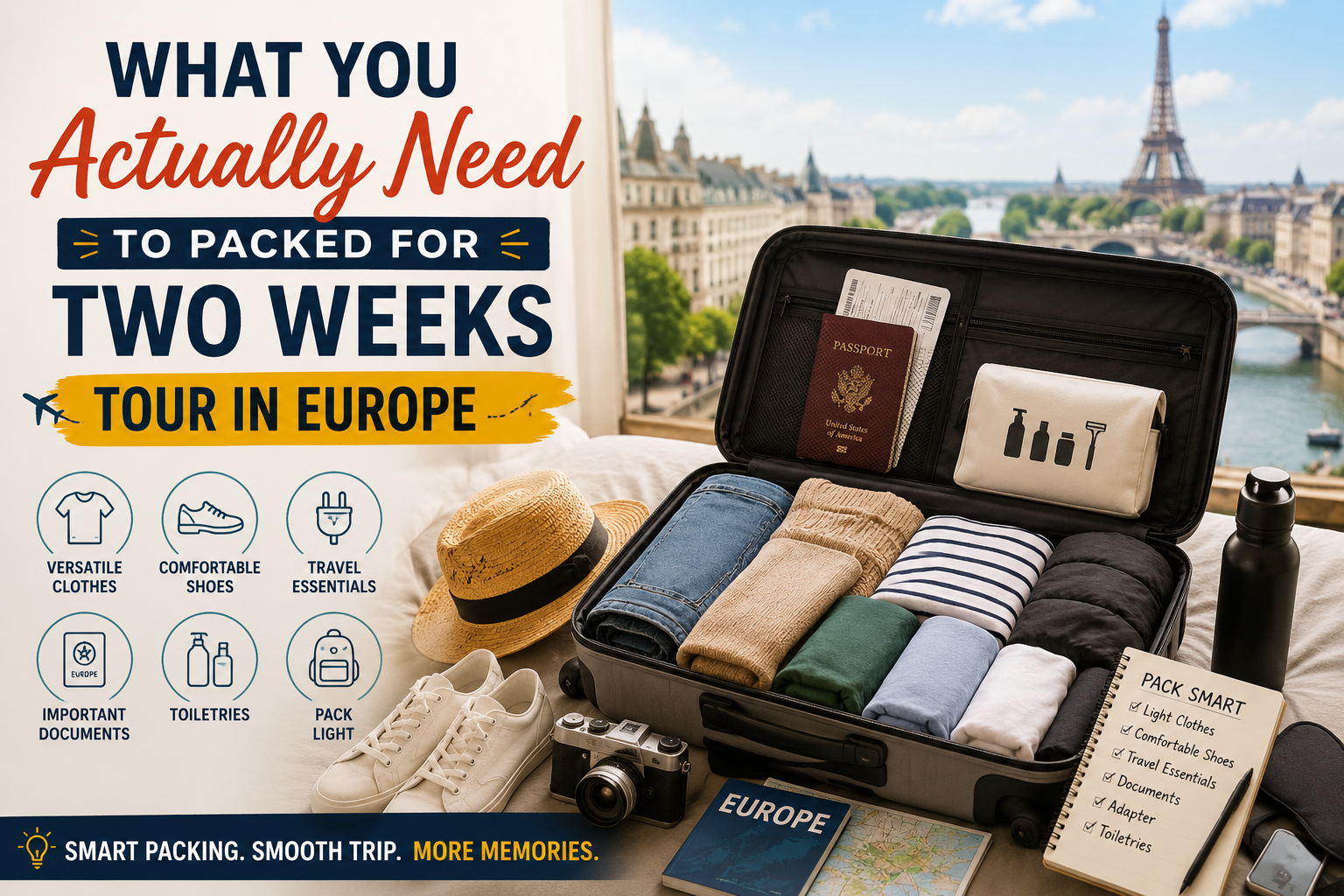
What You Actually Need to Packed for Two Weeks Tour in Europe
Summary
Packing for Europe sounds simple until you’re staring at an open suitcase wondering whether you really need five pairs of shoes, a heavy jacket, or enough clothes for fourteen different outfits.
The truth is that most travelers pack far more than they use. After a few days of carrying a heavy suitcase across train stations, cobblestone streets, airports, and hotel staircases, many realize they would have enjoyed the trip more with less luggage.
If you’re planning a two-week European adventure, you do not need to pack for fourteen separate days. You need versatile clothing, practical travel essentials, and a smart packing strategy.
This guide explains what to pack for two weeks in Europe, how to pack light without sacrificing comfort, and which items travelers consistently wish they had brought – or left at home.
Key Takeaways
- A carry-on sized suitcase is often enough for a two-week Europe trip.
- Pack clothing that can be mixed and matched.
- Choose comfortable walking shoes over fashion-focused footwear.
- Most European cities have laundromats and laundry services.
- Travel documents, payment methods, and weather preparation matter more than extra clothing.
- Pack according to the season and destinations, not the trip length.
- Leave room in your luggage for souvenirs and purchases.
Why Most Travelers Overpack for Europe
The biggest mistake travelers make is packing for every possible scenario.
They prepare for hot weather, cold weather, rain, formal dinners, beach days, hiking, and emergencies all in one suitcase.
The result is often a bag that weighs far more than necessary.
Experienced travelers know that Europe is highly developed. Whether you’re visiting Paris, Rome, Amsterdam, Barcelona, Prague, or Vienna, you’ll have access to pharmacies, grocery stores, clothing shops, and laundry facilities.
If you forget something non-essential, you can usually buy it during your trip.
That reality alone should make packing easier.
What You Actually Need to Pack for Two Weeks in Europe
For most travelers, the ideal packing list focuses on versatility rather than quantity.
You should pack enough clothing for approximately one week and plan to do laundry once during your trip.
This approach keeps luggage lighter while still providing plenty of outfit combinations.
A practical Europe travel packing checklist for two weeks includes:
Essential Categories
- Travel documents
- Clothing
- Footwear
- Toiletries
- Electronics
- Health items
- Day bag
- Weather protection
- Money and payment methods
The exact items vary depending on the season, but these categories remain consistent year-round.
How to Pack Light for Europe for Two Weeks
The simplest answer is to pack for seven days, not fourteen.
Most experienced Europe travelers follow this rule because carrying less luggage improves nearly every part of the journey.
You’ll move faster through airports.
You’ll have less stress on trains.
You’ll avoid dragging oversized suitcases through historic city centers.
You’ll also spend less time deciding what to wear.
The Three-Step Packing Method
Step 1: Choose a Base Color
Select neutral colors such as:
- Black
- Navy
- Gray
- Beige
These colors make it easier to mix clothing pieces.
Step 2: Build Multiple Outfits
Every item should work with at least two or three other pieces.
For example:
- One pair of jeans
- One pair of chinos
- Four tops
This can create several outfit combinations without adding extra weight.
Step 3: Eliminate Duplicates
You rarely need:
- Four jackets
- Six pairs of shoes
- Multiple bulky sweaters
Removing duplicates instantly reduces luggage size.
What Clothes Should You Pack for Two Weeks in Europe?
The best clothing strategy focuses on comfort, layering, and flexibility.
European weather can change quickly, especially if your itinerary includes multiple countries.
Someone traveling from Spain to Switzerland during the same trip may experience dramatically different temperatures.
Because of this, layering works better than packing heavy seasonal items.
Recommended Clothing Packing List
| Item | Quantity |
|---|---|
| T-Shirts or Casual Tops | 5-7 |
| Lightweight Shirts or Blouses | 2-3 |
| Jeans or Pants | 2 |
| Shorts or Skirts | 1-2 |
| Light Sweater | 1 |
| Jacket | 1 |
| Underwear | 7-10 |
| Socks | 7-10 |
| Sleepwear | 1 |
| Dressy Outfit | 1 |
| Rain Layer | 1 |
This list works for most spring, summer, and early fall trips.
Winter travel requires additional layers, which we’ll cover later.
The Best Shoes for a Europe Trip
If there’s one area where travelers consistently make mistakes, it’s footwear.
Europe often involves far more walking than expected.
Many first-time visitors easily walk 15,000 to 25,000 steps per day.
Historic areas such as:
- Rome
- Florence
- Lisbon
- Prague
- Edinburgh
- Budapest
feature cobblestone streets that can be challenging in uncomfortable shoes.
Ideal Shoe Setup
Most travelers only need:
- Comfortable walking shoes
- A secondary pair for evenings or backup
Athletic shoes, walking sneakers, or supportive travel shoes usually outperform fashionable options.
Many experienced travelers say their biggest packing regret was bringing too many shoes.
What Travel Documents Should You Pack for Europe?
Travel documents are the most important items in your luggage.
Without them, the trip can quickly become stressful.
Before departure, make sure you have:
Essential Documents Checklist
- Passport
- Visa (if required)
- Travel insurance information
- Flight confirmations
- Hotel reservations
- Train tickets
- Emergency contacts
- Driver’s license (if renting a car)
A practical tip is to store digital copies in:
- Google Drive
- Dropbox
- Apple iCloud
This provides backup access if physical copies are lost.
How Much Money Should You Carry in Europe?
The best approach is a combination of cards and cash.
Europe has become increasingly cashless, particularly in countries such as:
- Sweden
- Netherlands
- Denmark
- Germany’s major cities
- France
- Spain
Most purchases can be made using contactless payment methods.
However, carrying a small amount of local currency remains useful for:
- Public restrooms
- Local markets
- Small cafes
- Rural destinations
Many frequent travelers rely on cards with no foreign transaction fees because they often provide better exchange rates than currency exchange counters.
Don’t Forget Travel Insurance
Many travelers focus heavily on packing clothes while overlooking travel insurance.
This can be a costly mistake.
Unexpected situations can include:
- Flight delays
- Lost luggage
- Medical emergencies
- Trip cancellations
Providers such as World Nomads, Allianz Travel, and SafetyWing are commonly used by international travelers.
The right policy depends on your destination, age, activities, and trip value.
Weather Matters More Than Trip Length
One of the smartest packing decisions is checking destination weather instead of focusing on how many days you’ll be away.
A two-week summer trip through Italy requires a completely different packing strategy than a two-week winter trip through Germany and Austria.
Before finalizing your suitcase:
- Check weather forecasts
- Review average monthly temperatures
- Research local conditions
- Verify rainfall patterns
Reliable sources such as the national meteorological services of your destinations often provide more accurate long-term information than generic weather apps.
Mid-Article Tip: Pack for Your Actual Itinerary
A common mistake is packing for activities you probably won’t do.
If your itinerary includes museums, city sightseeing, restaurants, and train travel, pack for those activities.
Don’t bring hiking gear if you have no hiking plans.
Don’t pack formal clothing for events that aren’t scheduled.
Your itinerary should determine your packing list, not hypothetical situations.
Why Laundry Can Save Half Your Luggage Space
Many travelers underestimate how easy laundry is throughout Europe.
Most major cities have:
- Self-service laundromats
- Hotel laundry services
- Apartment washing machines
- Drop-off cleaning services
Planning one laundry session during a two-week trip can reduce your clothing load by nearly 50%.
This single strategy makes minimalist packing possible.
What Electronics Should You Pack for Two Weeks in Europe?
The right electronics can make your trip easier. Too many gadgets can become extra weight and another thing to keep track of.
For most travelers, a small electronics kit is enough.
Essential Electronics for a Europe Trip
| Item | Recommended |
|---|---|
| Smartphone | Yes |
| Phone Charger | Yes |
| Power Bank | Yes |
| Universal Travel Adapter | Yes |
| Earbuds or Headphones | Yes |
| Camera (Optional) | Depends on preference |
| Laptop (Only if needed) | Optional |
| E-Reader or Tablet | Optional |
The most important item on this list is the universal travel adapter.
Europe uses several plug types depending on the country. Travelers visiting multiple countries often find a universal adapter much more convenient than carrying multiple converters.
Why a Power Bank Is Worth Packing
Long sightseeing days can drain a phone battery quickly.
Most travelers use their phones for:
- Navigation
- Restaurant searches
- Translation
- Public transportation
- Photography
- Mobile payments
Apps such as Google Maps, Citymapper, and Google Translate can significantly increase battery usage throughout the day.
A compact power bank can prevent unnecessary stress during long travel days.
What Toiletries Should You Pack for Two Weeks in Europe?
The best approach is bringing travel-sized essentials and purchasing replacements if needed.
Europe has pharmacies, supermarkets, and convenience stores almost everywhere.
You do not need to carry oversized bottles.
Basic Toiletry Checklist
- Toothbrush
- Toothpaste
- Deodorant
- Shampoo
- Conditioner
- Face wash
- Sunscreen
- Razor
- Hairbrush
- Moisturizer
- Lip balm
A small toiletry bag is usually sufficient for a two-week trip.
Many experienced travelers place liquids in reusable travel containers to save space and comply with airline rules.
What Health and Safety Items Should You Bring?
You do not need a full medicine cabinet.
However, bringing basic health essentials can save time and money.
Recommended Health Items
- Prescription medications
- Pain reliever
- Bandages
- Motion sickness medication
- Allergy medication
- Hand sanitizer
- Blister patches
Blister patches deserve special attention.
Walking long distances in cities such as Rome, Paris, and Lisbon can create foot discomfort even with good shoes.
Many experienced travelers consider blister patches one of the most useful items in their luggage.
What to Pack for Europe in Summer
Summer is one of the easiest seasons for packing.
Most destinations experience warm weather, but temperatures can vary significantly.
Southern Europe often experiences temperatures above 85°F (29°C), while northern regions may remain much cooler.
Summer Packing Essentials
- Lightweight shirts
- Breathable clothing
- Sunglasses
- Hat
- Sunscreen
- Comfortable walking shoes
- Light sweater for evenings
Even during summer, evenings in cities such as Amsterdam, Copenhagen, or Edinburgh can feel cool.
Packing one light layer is usually a smart decision.
What to Pack for Europe in Spring
Spring weather can be unpredictable.
You may experience sunshine, rain, and cooler temperatures during the same week.
Layering becomes especially important.
Spring Packing Essentials
- Light jacket
- Waterproof layer
- Sweater
- Long pants
- Comfortable waterproof shoes
- Umbrella
Many travelers report that spring offers some of Europe’s best sightseeing conditions because crowds are often smaller than peak summer months.
What to Pack for Europe in Fall
Fall is similar to spring in many ways.
Temperatures can vary widely depending on the region.
Southern destinations often remain pleasant through October, while northern destinations become cooler much earlier.
Fall Packing Essentials
- Long-sleeve tops
- Sweater
- Jacket
- Scarf
- Comfortable shoes
- Rain protection
Layering remains the most effective strategy.
What to Pack for Europe in Winter
Winter requires a different approach.
Instead of packing numerous heavy items, focus on layering systems.
This helps maintain warmth without filling your suitcase.
Winter Packing Essentials
- Thermal base layers
- Warm sweater
- Winter coat
- Gloves
- Hat
- Warm socks
- Waterproof shoes
Many first-time travelers pack multiple bulky sweaters and discover they take up too much space.
A quality base layer often provides more warmth while using less luggage space.
Carry-On vs Checked Luggage for Europe
Many travelers wonder whether they should use carry-on luggage or check a larger suitcase.
The answer depends on the itinerary.
Carry-On Advantages
- Faster airport experience
- No baggage claim waiting
- Reduced risk of lost luggage
- Easier train travel
- Easier movement through cities
Checked Bag Advantages
- More packing space
- Better for winter travel
- More room for shopping
For most city-focused Europe trips lasting two weeks, experienced travelers often prefer carry-on luggage because mobility matters more than extra storage.
Quick Comparison Table
| Carry-On | Checked Bag |
|---|---|
| Easier mobility | More storage |
| Faster airport exit | Better for bulky clothing |
| Lower baggage fees | More souvenir space |
| Less chance of lost luggage | Suitable for family travel |
The Minimalist Packing List for a Europe Trip
Many experienced travelers now follow minimalist packing principles.
The goal is simple:
Bring only what you’ll actually use.
A minimalist packing list often includes:
Clothing
- 5 tops
- 2 bottoms
- 1 sweater
- 1 jacket
- 7 pairs underwear
- 7 pairs socks
- 2 pairs shoes
Accessories
- Phone
- Charger
- Adapter
- Power bank
- Sunglasses
Toiletries
- Small travel kit
That’s enough for many successful two-week European trips.
The key is laundry, not excess clothing.
Common Packing Mistakes Travelers Regret
After thousands of travel reviews and travel forum discussions, the same mistakes appear repeatedly.
Packing Too Many Shoes
Shoes take up more space than almost any other item.
Most travelers wear one pair most of the time.
Bringing “Just in Case” Clothing
These items usually remain untouched.
If an item doesn’t fit your planned itinerary, leave it at home.
Overpacking Toiletries
European cities provide easy access to basic personal care products.
Large bottles are rarely necessary.
Ignoring Weather Research
Packing without checking local weather often leads to carrying unnecessary items.
Forgetting a Universal Adapter
This is one of the most common travel mistakes.
Many travelers end up purchasing adapters at airports for significantly higher prices.
Soft Travel Tip
Before closing your suitcase, remove three items.
Most travelers can identify at least three things they probably won’t use.
This simple exercise often reduces luggage weight without affecting comfort.
The lighter your luggage, the easier every train ride, airport transfer, and hotel check-in becomes.
What Experienced Europe Travelers Pack Differently
People who visit Europe frequently tend to prioritize convenience over quantity.
Instead of packing more clothes, they pack:
- Better shoes
- Better layers
- Better organization
They understand that Europe is filled with stores, pharmacies, and services.
The goal is not self-sufficiency for fourteen days.
The goal is efficient travel.
A lighter suitcase gives you more flexibility, less stress, and a better overall experience.
Many seasoned travelers would rather wash clothes once than drag an oversized suitcase across Europe for two weeks.
People Also Ask
What should I pack for two weeks in Europe?
Pack versatile clothing, comfortable walking shoes, travel documents, toiletries, a universal adapter, and a lightweight weather layer. Most travelers only need enough clothing for about one week because laundry services are widely available throughout Europe.
How many outfits do I need for a 2 week Europe trip?
You do not need fourteen separate outfits. Five to seven tops and two to three bottoms are usually enough when you choose pieces that can be mixed and matched. This approach saves space and makes traveling easier.
Can I travel Europe for two weeks with only a carry-on?
Yes. Many experienced travelers complete two-week Europe trips with only a carry-on suitcase and a small backpack. Packing light and planning one laundry day makes this realistic for most seasons.
What shoes should I pack for Europe?
Comfortable walking shoes should be your priority. European cities often involve long walking days on cobblestone streets, stairs, and public transportation. A second lightweight pair of shoes is usually enough for evenings or backup.
Is it better to pack light for Europe?
Yes. Packing light makes moving between airports, train stations, hotels, and city centers much easier. It also reduces baggage fees, minimizes stress, and allows greater flexibility throughout your trip.
What should I not pack for Europe?
Avoid packing excessive clothing, multiple heavy jackets, too many shoes, oversized toiletries, and “just in case” items. Most things can be purchased locally if needed, and overpacking often creates more inconvenience than comfort.
Final Thoughts
Packing for a two-week Europe tour is less about fitting more into your suitcase and more about bringing the right things. The travelers who enjoy Europe the most are often the ones carrying the least.
Instead of packing for every possible situation, focus on versatile clothing, comfortable footwear, essential documents, and practical travel items. A lighter suitcase means easier train transfers, smoother airport experiences, and less stress throughout your journey.
Remember that Europe is one of the easiest places in the world to buy everyday necessities. If you forget something minor, chances are you’ll find it nearby. What matters most is being prepared for your actual itinerary, not every possible scenario.
Before you zip up your suitcase, do one final review. Remove anything you are unlikely to use, leave some room for souvenirs, and make sure your travel documents are easily accessible.
A well-packed bag won’t just save space. It will make your entire trip more comfortable, more flexible, and far more enjoyable.
Ready for Your Europe Adventure?
Use this packing guide as your checklist, tailor it to your destination and season, and start packing with confidence. The less time you spend worrying about what’s in your suitcase, the more time you’ll have to enjoy the cities, culture, food, and experiences that make Europe worth visiting.
Safe travels and enjoy every mile of your journey.

Ravinder Kaur is the founder of OpinionHook, an independent travel publication established in 2023. She oversees editorial standards, destination research, travel planning resources, and content quality across the website. OpinionHook focuses on publishing practical travel guides, itineraries, budgeting advice, and destination resources designed to help travelers make informed travel decisions.



One Comment
Comments are closed.