
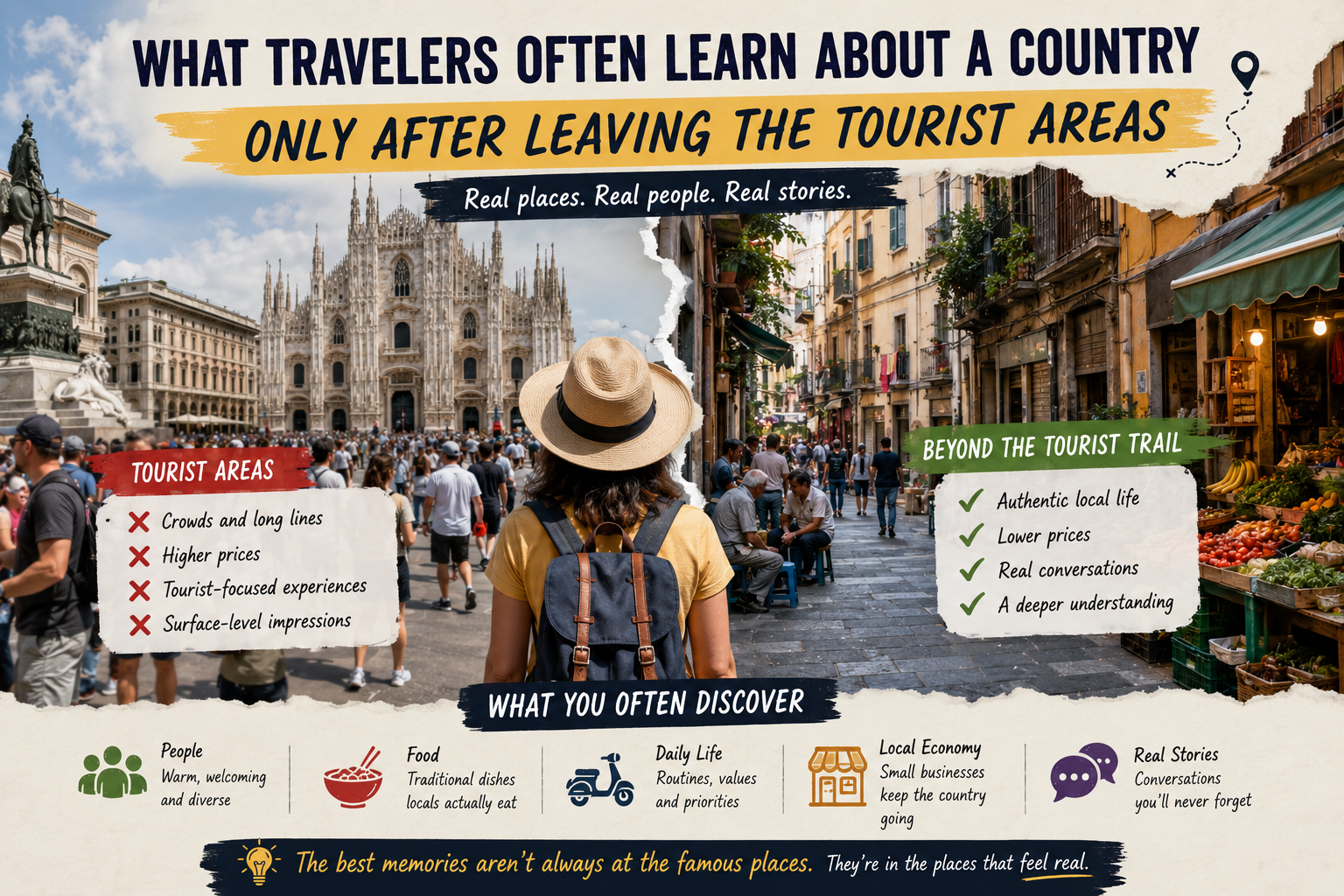
What Travelers Often Learn About a Country Only After Leaving the Tourist Areas
A lot of people think they’ve understood a country after spending a week there.
I’ve done it myself.
You visit the famous landmarks. You eat the foods everyone recommends. You take the photos people expect you to take. Then you fly home feeling like you’ve “experienced” the country.
The older I get, the less I believe that’s true.
Some of the most important things I’ve learned while traveling happened nowhere near the places listed in guidebooks. They happened on ordinary streets. In local grocery stores. On buses full of commuters. In conversations with people who weren’t trying to sell me a tour, a meal, or a souvenir.
That’s usually where a country starts feeling real.
If you’re curious about what travelers often learn about a country after leaving tourist areas, the answer isn’t usually a hidden attraction or secret viewpoint.
It’s a different understanding of how people actually live.
And in my opinion, that’s far more valuable.
Key Takeaways
| Tourist Areas Often Show | Areas Beyond Tourist Zones Often Show |
|---|---|
| Famous attractions | Everyday life |
| Visitor experiences | Local experiences |
| Curated culture | Living culture |
| Tourist menus | Daily food habits |
| Crowded highlights | Community routines |
| Global brands | Local businesses |
| Expectations | Reality |
Why Traveling Off the Tourist Trail Changes Your Perspective
The simple answer is that tourist areas are built for visitors.
The rest of the country is built for the people who actually live there.
That difference affects almost everything.
Many travelers unknowingly judge an entire country based on neighborhoods that locals rarely spend much time in themselves. It’s a bit like judging the United States entirely through Times Square or judging France entirely through the area around the Eiffel Tower.
Those places are real.
But they’re not the whole story.
That’s one reason why traveling off the tourist trail changes your perspective so dramatically.
You stop seeing what tourism markets want you to see.
You start seeing how daily life actually works.
And daily life often tells a much more interesting story.
What usually works is slowing down long enough to notice small things.
What often fails is rushing between attractions and assuming you’ve seen the country.
I’ve made that mistake more than once.
The First Hidden Truth Most Travelers Notice
One of the biggest hidden truths about a country tourists never see is that local priorities are often completely different from tourist priorities.
Visitors focus on attractions.
Locals focus on work, housing, transportation, schools, healthcare, family, and community.
That sounds obvious when you read it.
But it changes how you see a place.
When you’re inside a tourist zone, almost everything exists to serve visitors.
Hotels serve visitors.
Restaurants serve visitors.
Shops serve visitors.
Tours serve visitors.
Outside those areas, you’re seeing what people actually care about when nobody is trying to impress tourists.
I think that’s where many travel stereotypes start falling apart.
A country that seemed relaxed suddenly looks hardworking.
A country that seemed expensive suddenly feels affordable.
A country that seemed traditional suddenly feels modern.
Or the opposite.
Reality becomes more complicated.
And that’s usually a good thing.
What Happens When You Explore Beyond Popular Tourist Destinations?
The biggest thing that happens is that your assumptions get tested.
Sometimes they survive.
Sometimes they don’t.
Before visiting a place, most travelers build a mental picture based on social media, YouTube videos, travel blogs, movies, and guidebooks.
The problem is that many of those sources focus on the same locations.
As a result, millions of travelers arrive with nearly identical expectations.
Then they leave the tourist areas.
Suddenly things look different.
The architecture changes.
The food changes.
The pace changes.
The conversations change.
The atmosphere changes.
That’s often when people realize how limited their original picture was.
In my experience, the most interesting part of travel begins right there.
Not when expectations are confirmed.
When they’re challenged.
Why Local Neighborhoods Often Teach More Than Famous Landmarks
I’m not against famous landmarks.
Most famous landmarks became famous for a reason.
They’re worth seeing.
But landmarks usually tell you about history.
Neighborhoods tell you about the present.
That’s a huge difference.
A monument might teach you what happened 300 years ago.
A neighborhood shows you what life looks like today.
If you spend an hour at a famous attraction, you’ll probably learn something important.
If you spend an afternoon walking through local residential areas, using public transportation, visiting grocery stores, and sitting in parks, you’ll probably learn something completely different.
One isn’t necessarily better than the other.
But I think many travelers underestimate the second experience.
Some of my favorite travel memories involve places that never appeared in a guidebook.
Not because they were spectacular.
Because they felt real.
The Reality of Local Food Outside Tourist Areas
Food is probably one of the easiest ways to see the difference between tourist culture and local culture.
Tourist restaurants often serve what visitors expect.
Local restaurants serve what locals actually eat.
Those aren’t always the same thing.
One thing I’ve noticed repeatedly is that many travelers think they’re eating authentic food when they’re actually eating a version designed specifically for international visitors.
There’s nothing wrong with that.
But it’s worth understanding the difference.
When you leave tourist districts, menus often become simpler.
Restaurants become smaller.
Food becomes less performative.
And in many cases, meals become better.
Not always.
But often.
What usually works is looking for places filled with local customers.
What often fails is assuming the busiest tourist restaurant automatically serves the best food.
Personally, some of the best meals I’ve ever had came from places I almost walked past because they looked too ordinary.
What You Miss About a Country by Staying in Tourist Areas
This is probably the most important section of the entire article.
Because the answer isn’t attractions.
It’s people.
One of the biggest things what you miss about a country by staying in tourist areas is how ordinary life actually feels.
You miss morning routines.
You miss schoolchildren walking to class.
You miss commuters heading to work.
You miss local celebrations.
You miss neighborhood traditions.
You miss the rhythms that shape daily life.
Tourist districts often create a version of reality where every day feels like a holiday.
Real life isn’t like that.
And understanding that difference helps you understand a country much more deeply.
Why Everyday Life Reveals More Than Travel Marketing
Travel marketing has one job.
To make people want to visit.
Because of that, it naturally focuses on the most attractive parts of a destination.
Beautiful beaches.
Historic buildings.
Amazing food.
Perfect sunsets.
Those things exist.
But they’re not the whole picture.
Nobody creates tourism campaigns around grocery shopping, commuting, paying bills, or school schedules.
Yet those things make up most of people’s lives.
When you spend time outside tourist zones, you start seeing how people organize their daily lives.
That’s when a place begins feeling less like a destination and more like a society.
I think that’s one of the most rewarding parts of travel.
The Surprising Role of Public Transportation
If you want to understand a country quickly, use public transportation.
Seriously.
Buses, trains, subways, and local ferries reveal a lot.
You see how people behave in shared spaces.
You notice whether people talk loudly or quietly.
You observe how organized things are.
You notice what people wear.
You see how different generations interact.
I’ve learned more about some countries during train rides than I learned during entire days spent at tourist attractions.
That doesn’t mean attractions are unimportant.
It just means everyday experiences often provide context that attractions cannot.
Why Real Culture Is Usually Less Obvious Than Tourists Expect
Many travelers imagine culture as festivals, ceremonies, traditional clothing, or famous foods.
Those things are part of culture.
But culture is much bigger.
Culture is how people stand in line.
Culture is how neighbors interact.
Culture is how families spend weekends.
Culture is how strangers treat each other.
These details aren’t dramatic.
They’re subtle.
And that’s exactly why they’re easy to miss.
The longer I travel, the more I think real culture hides in ordinary moments.
Not extraordinary ones.
Tourists often chase the extraordinary.
Locals live the ordinary.
And the ordinary usually teaches more.
Conclusion
One of the biggest lessons I’ve learned from travel is that countries become more interesting the moment they stop performing for visitors.
That’s usually what happens when you leave the tourist areas.
You start seeing fewer attractions and more realities.
Fewer highlights and more habits.
Fewer postcards and more people.
The goal isn’t to avoid famous places.
The goal is to balance them with experiences that show how life actually works.
Because in the end, what travelers often learn about a country after leaving tourist areas isn’t a secret destination.
It’s a more complete understanding of the place itself.
And that’s something no landmark can give you.
Ravinder Kaur is the founder of OpinionHook, an independent travel publication established in 2023. She oversees editorial standards, destination research, travel planning resources, and content quality across the website. OpinionHook focuses on publishing practical travel guides, itineraries, budgeting advice, and destination resources designed to help travelers make informed travel decisions.



One Comment
Comments are closed.