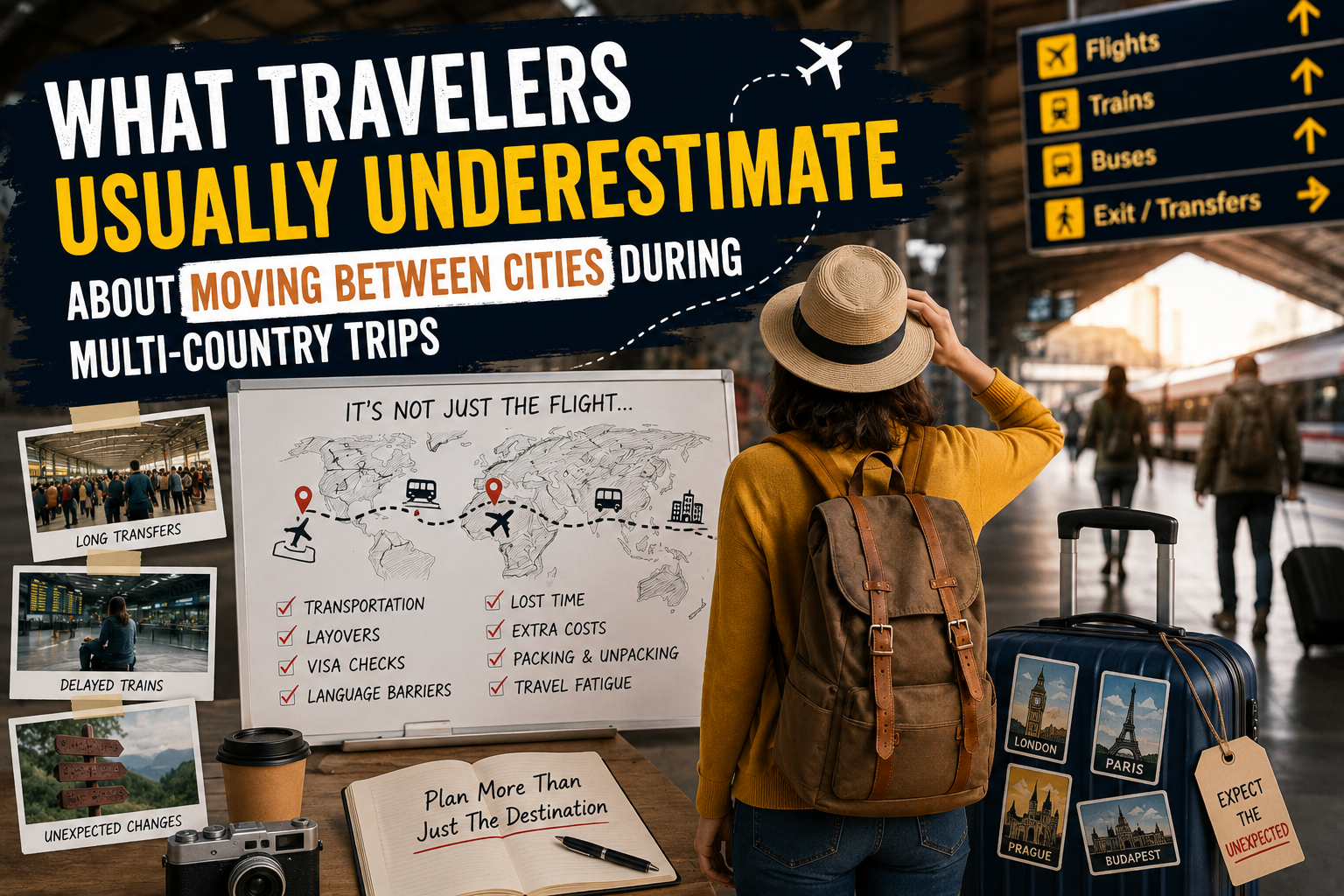
What Travelers Usually Underestimate About Moving Between Cities During Multi-Country Trips
Quick Summary
Before my first big multi-country trip, I thought the hard part would be choosing where to go.
I was wrong.
The hard part wasn’t deciding between cities. It was moving between them.
On paper, traveling from one city to another looks simple. A two-hour flight here. A train ride there. Maybe a bus connection somewhere in between.
What nobody really tells you is that travel days have a way of consuming entire days.
A one-hour flight can easily become an eight-hour process. A train journey that looks relaxing online can leave you exhausted by the time you arrive. And after repeating that process several times across multiple countries, even experienced travelers start feeling worn down.
That’s one of the biggest answers to what travelers underestimate about moving between cities on multi-country trips.
People plan destinations.
They underestimate transitions.
And in my experience, transitions are often what determine whether a trip feels exciting or exhausting.
Key Takeaways
| What Travelers Expect | What Usually Happens |
|---|---|
| Quick travel between cities | Travel days consume most of the day |
| Transportation is the main challenge | Logistics are the main challenge |
| Packing takes minutes | Packing becomes repetitive and tiring |
| Every new city feels exciting | Travel fatigue eventually appears |
| Flights save time | Airports often consume time |
| More destinations create better trips | Too many destinations create stress |
| Movement feels adventurous | Constant movement becomes work |
Why Moving Between Cities Is Harder Than Travelers Expect
The short answer is simple.
Travel isn’t just transportation.
Travel is everything surrounding transportation.
Most people look at an itinerary and see a two-hour flight.
What they don’t see is:
- Checking out of accommodation
- Getting to the airport
- Security screening
- Waiting at the gate
- Boarding
- Delays
- Collecting luggage
- Finding transportation at the destination
- Checking into the next accommodation
Suddenly that two-hour flight becomes seven or eight hours.
I’ve made this mistake more times than I’d like to admit.
I’d look at a schedule and think, “This transfer is easy.”
Then half the day disappeared.
That’s one reason why moving between cities is harder than travelers expect.
The transportation itself is usually the easy part.
Everything around it is what drains your energy.
The Biggest Mistake People Make When Planning Multi-Country Trips
The most common mistake is treating travel days like vacation days.
They’re not.
A travel day is usually a workday disguised as a vacation day.
You wake up early.
You pack.
You navigate transportation.
You solve problems.
You carry luggage.
You manage schedules.
You make decisions constantly.
By the time you arrive in your next city, you’ve already spent hours using mental and physical energy.
What usually works is treating travel days differently.
Plan less.
Expect less.
Leave room for delays.
What often fails is arriving in a new city and immediately trying to squeeze in sightseeing, museums, restaurants, and nightlife.
I’ve done it.
It rarely ends well.
Most of the time you’re simply too tired to enjoy any of it.
Why Multi-Country Trips Are More Exhausting Than Expected
Many travelers assume the excitement of seeing new places will cancel out the exhaustion.
Sometimes it does.
Eventually it doesn’t.
That’s one of the biggest reasons why multi-country trips are more exhausting than expected.
Every city requires adjustments.
New transportation systems.
New accommodation.
New neighborhoods.
New currencies in some cases.
New languages.
New routines.
Each adjustment seems small.
But they add up.
I remember a trip where I visited five countries in three weeks.
At the planning stage it felt ambitious and exciting.
By week three, I wasn’t tired of traveling.
I was tired of moving.
There’s a difference.
Most travelers don’t realize that difference until they’re living it.
The Hidden Difficulties of Moving Between Cities During Long Trips Abroad
The biggest hidden difficulty isn’t transportation.
It’s decision fatigue.
Every move requires dozens of small decisions.
Which train should I book?
Which station do I need?
How early should I leave?
Which exit should I use?
Should I take a taxi or public transport?
Where can I store my luggage?
How do I get to my accommodation?
None of those questions are difficult individually.
The problem is repetition.
When you answer questions like that every few days for weeks, your energy starts disappearing.
That’s one of the most overlooked hidden difficulties of moving between cities during long trips abroad.
People prepare for logistics.
They rarely prepare for the mental load.
What Nobody Tells You About Traveling Between Cities in Multiple Countries
Here’s something I wish someone had told me earlier.
The transportation is often easier than the recovery.
Nobody talks much about recovery days.
But they’re important.
After several consecutive travel days, many travelers start feeling less excited and more impatient.
Small problems feel bigger.
Delays become more frustrating.
Crowds become more annoying.
This doesn’t mean you’re doing anything wrong.
It means you’re human.
One thing I’ve noticed is that experienced travelers often build slower days into their schedules.
Beginners often don’t.
That’s why experienced travelers sometimes appear more relaxed.
They’re not necessarily better travelers.
They’re often just better rested.
Why Airports Are Bigger Time Drains Than Most Travelers Expect
People often focus on flight duration.
That’s usually the least important number.
A one-hour flight sounds quick.
But airports don’t operate on flight time.
They operate on process time.
Security.
Check-in.
Immigration.
Boarding.
Baggage collection.
Ground transportation.
All of that takes time.
Sometimes a four-hour train ride is actually faster door-to-door than a short flight.
This is something frequent travelers learn quickly.
And once you realize it, itinerary planning changes dramatically.
The Packing Problem Nobody Mentions
Packing seems easy during trip planning.
It becomes less fun after the tenth time.
At the beginning of a trip, packing feels exciting.
By the end, it feels repetitive.
You fold.
You organize.
You check chargers.
You check passports.
You make sure nothing is left behind.
Then you do it all again a few days later.
And again.
And again.
What usually works is traveling lighter than you think you need.
What often fails is bringing items “just in case.”
Every unnecessary item becomes another thing you’re carrying between cities.
Personally, I think overpacking causes more travel stress than people realize.
Not because of weight.
Because of friction.
Every extra item creates a tiny inconvenience.
Eventually those inconveniences add up.
How to Plan City-to-City Travel on a Multi-Country Trip
If there’s one practical lesson I’ve learned, it’s this:
Plan fewer moves than you think you need.
Most travelers underestimate how enjoyable it is to stay longer in fewer places.
More cities look impressive on an itinerary.
Fewer cities usually feel better in real life.
Instead of spending two nights in six cities, consider spending four nights in three cities.
You’ll spend less time in transit.
Less time packing.
Less time figuring things out.
And more time actually experiencing where you are.
In my opinion, that’s one of the easiest ways to improve almost any multi-country trip.
A Mid-Trip Reality Check
If you’re currently planning a trip, look at your itinerary.
Count how many travel days you have.
Now ask yourself something simple:
“Would I still enjoy this schedule if every transfer took twice as long as expected?”
Because occasionally they do.
Flights get delayed.
Trains get canceled.
Weather changes.
Connections get missed.
The travelers who handle these situations best usually aren’t the most experienced.
They’re the ones who left room in their plans for things to go wrong.
And trust me, something eventually will.
That’s normal travel.
Not bad travel.
Just travel.
Conclusion
One of the biggest lessons travelers learn during multi-country trips is that moving between destinations often requires more energy than visiting them.
The cities aren’t usually the exhausting part.
The transitions are.
That’s why what travelers underestimate about moving between cities on multi-country trips has less to do with transportation and more to do with time, energy, logistics, and expectations.
The travelers who enjoy these trips the most aren’t always the ones who visit the most places.
They’re often the ones who give themselves enough time to actually enjoy the places they visit.
And honestly, I think that’s a lesson most of us learn the hard way.

Ravinder Kaur is the founder of OpinionHook, an independent travel publication established in 2023. She oversees editorial standards, destination research, travel planning resources, and content quality across the website. OpinionHook focuses on publishing practical travel guides, itineraries, budgeting advice, and destination resources designed to help travelers make informed travel decisions.