
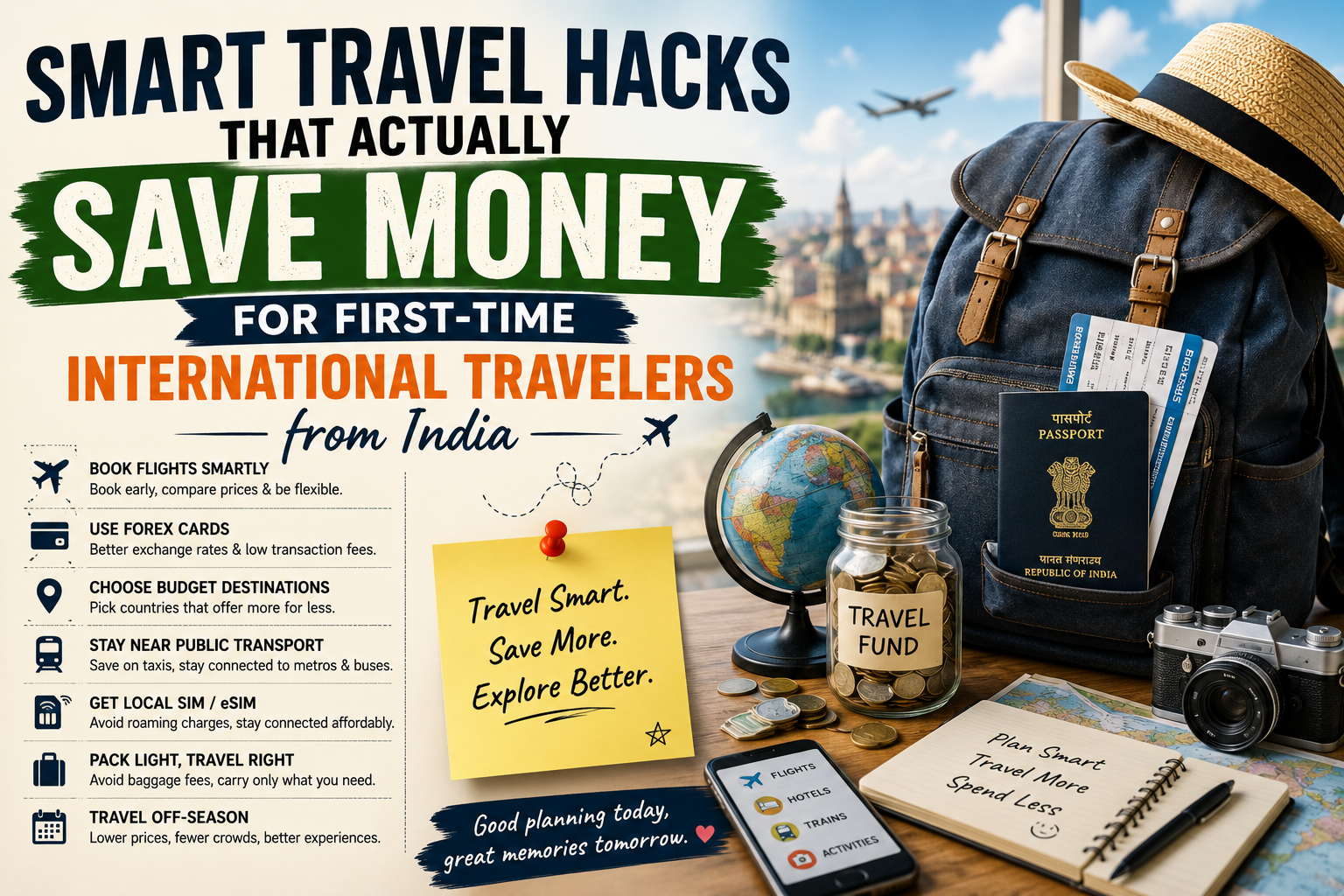
Smart Travel Hacks That Actually Save Money for First-Time International Travelers from India
Your first international trip can either feel exciting or financially painful. Sometimes both together.
A lot of first-time travelers from India spend months finding cheap flights, then casually lose money on airport food, bad currency exchange, expensive roaming packs, unnecessary luggage, and tourist trap hotels. That’s usually how the budget quietly breaks.
And honestly, social media makes it worse. People see luxury Bali villas, Santorini cafés, Swiss train rides, and assume international travel always has to look expensive. It doesn’t.
Some of the smartest travelers I’ve seen actually spend less because they plan properly and stop trying to “look rich” on vacation.
This guide is for normal travelers. People who want a good trip without returning home broke.
Quick Summary
If you only remember a few things from this article, remember these:
- Never exchange all your money at airports
- Don’t book flights at the last minute unless you enjoy overpaying
- Budget airlines are cheap only if you pack smart
- Southeast Asia usually gives Indians the best value for money
- Public transport abroad is often much better than people expect
- Shoulder season travel almost always saves money
And one more thing – expensive hotels rarely make trips better. Good location and clean rooms matter more.
Key Takeaways
- International travel from India is not as expensive as people think
- Cheap flights alone don’t mean cheap travel
- Forex mistakes quietly waste a lot of money
- Countries like Vietnam and Thailand are still some of the best beginner-friendly options
- Carrying too much luggage is one of the most common rookie mistakes
- Travel insurance feels useless until you suddenly need it
- Most travel “luxuries” online are honestly overrated
Why First-Time Travelers Usually Spend Too Much
Most people don’t overspend because they’re careless. They overspend because nobody explains where money actually disappears.
Flights are obvious. Hotels are obvious.
But then come:
- Airport taxis
- Currency exchange losses
- Extra baggage
- International roaming
- Tourist-area restaurants
- Random shopping you didn’t plan
And somehow the budget is gone by day four.
Another thing I’ve noticed – many first-time travelers panic-book everything. Fancy hotel. Expensive airport transfer. Full itinerary. Paid tours every day.
Usually that backfires.
Some of the best travel moments happen when you leave space for flexibility instead of trying to control every hour.
1. Stop Booking Flights Emotionally
This one matters a lot.
People often book flights because they’re excited, scared prices will rise, or influenced by Instagram reels saying “book NOW.”
Sometimes waiting actually helps.
What usually works
For most international routes from India, booking around 6-8 weeks early works well. Not too early. Not too late.
Websites like:
are genuinely useful for tracking prices.
Mid-week departures usually cost less too. Tuesday and Wednesday flights are often cheaper than Friday night or weekend flights.
What often fails
People search flights during peak holidays and act shocked when prices are insane.
If you’re trying to fly to Thailand during Christmas week from Delhi or Mumbai, cheap tickets probably won’t magically appear.
Another mistake is choosing ultra-cheap flights with terrible layovers. Saving ₹4,000 sounds great until you spend 17 miserable hours sleeping near Gate 42.
Personally, I think overly long layovers ruin trips before they even start.
2. Airport Currency Exchange Is Usually a Bad Deal
Honestly, airport forex counters are one of the easiest ways to lose money fast.
They know tired travelers will exchange money anyway. So rates are rarely good.
What usually works
A mix of:
- Forex card
- International debit card
- Small amount of local cash
is normally enough.
Services like:
are popular for a reason.
Forex cards especially help if currency prices suddenly change before your trip.
What often fails
Some travelers convert all their money into foreign cash before departure.
Bad idea most of the time.
Carrying huge amounts of cash feels stressful. Also, many countries barely use cash now anyway.
Another common mistake is ignoring bank charges completely. International ATM withdrawal fees can quietly add up if you keep taking out tiny amounts daily.
3. Pick Countries That Give Better Value for Indians
Your destination matters more than travel hacks sometimes.
Some places are simply easier on the wallet.
My honest opinion on Bali
Bali can still be affordable, but social media made parts of it unnecessarily expensive.
If you stay only in influencer-heavy areas, you’ll overpay for average food and crowded cafés pretending to be “hidden gems.”
The quieter parts of Bali are honestly much better.
4. Stay Near Public Transport, Not Tourist Hotspots
This saves more money than people expect.
A hotel near a metro station is often smarter than a hotel beside the most famous tourist attraction.
What usually works
Stay slightly outside expensive central zones.
In cities like:
- Bangkok
- Singapore
- Kuala Lumpur
public transport is honestly good enough for most tourists.
Sometimes staying 15 minutes away cuts hotel prices almost in half.
What often fails
Booking “luxury” hotels far away from everything.
Then spending huge money daily on taxis.
That’s not saving money. That’s shifting the expense somewhere else.
Platforms like:
help compare options properly.
Also, hostels today are not what many Indians imagine. A lot of modern hostels are cleaner and more social than cheap hotels.
5. Don’t Use Expensive International Roaming Packs
This is one of the biggest beginner mistakes.
People activate international roaming without checking local SIM or eSIM prices first.
Then they return home to a painful mobile bill.
What usually works
Buy:
- Local SIM card
- eSIM plan
Apps like:
make this much easier now.
Why this matters more than people think
Internet abroad is not optional anymore.
You need it for:
- Maps
- Cab apps
- Translation
- Banking OTPs
- Restaurant reviews
- Emergency help
Trying to “save money” by avoiding internet usually becomes frustrating very quickly.
6. Budget Airlines Are Only Cheap If You Pack Properly
This is where many travelers get tricked.
That ₹9,000 international ticket suddenly becomes ₹15,000 after:
- baggage fees
- seat selection
- airport check-in charges
- food purchases
Budget airlines know exactly how to make extra money.
What usually works
Travel lighter.
Honestly, most first-time travelers overpack badly.
You probably don’t need:
- six jackets
- four shoes
- twenty outfits
- giant skincare bottles
Simple packing usually works better.
What often fails
Packing for imaginary situations.
A lot of people pack like they’re preparing for survival reality TV instead of a vacation.
7. Travel During Shoulder Season Instead of Peak Season
This is probably the most underrated travel hack.
Peak season is expensive, crowded, and honestly exhausting sometimes.
What usually works
Travel slightly before or after peak months.
Examples:
- Europe in October instead of July
- Thailand in September instead of December
- Bali in February instead of peak summer season
Flights get cheaper.
Hotels get cheaper.
Tourist places become calmer.
You actually enjoy the trip more.
What often fails
Traveling during holidays just because everyone else is doing it.
New Year trips especially are often overpriced chaos.
Personally, I think slightly off-season travel gives a much better experience overall.
First International Trip Checklist for Indian Travelers
One Thing People Ignore – Travel Insurance
Travel insurance feels boring until something goes wrong.
Missed flights.
Lost baggage.
Medical emergency.
Cancelled booking.
Suddenly it becomes important.
Companies like:
offer plans commonly used by Indian travelers.
Honestly, skipping insurance to save a small amount rarely feels worth the risk.
Small Money-Saving Tips That Actually Help
Eat where locals eat
Tourist restaurants near famous attractions are often overpriced and average.
Smaller local places usually give:
- better food
- bigger portions
- lower prices
Withdraw cash fewer times
Frequent ATM withdrawals abroad can increase fees quickly.
Carry one backup card
Banks sometimes block international transactions randomly.
Having a second card helps a lot.
Avoid overplanning
This might sound strange, but overly packed itineraries usually increase spending.
When people rush constantly, they spend more on taxis, rushed meals, and convenience purchases.
Slow travel is often cheaper travel.
People Also Ask
What is the cheapest international destination from India?
Thailand, Vietnam, Sri Lanka, and Indonesia are among the cheapest and easiest international destinations for Indian travelers because flights, hotels, and food remain relatively affordable.
How much money should first-time travelers carry abroad?
For budget-friendly Asian countries, many Indian travelers manage comfortably with around $40-$70 per day excluding flights. Europe usually costs more because accommodation and transport are expensive.
Is forex card better than cash?
Usually yes. Forex cards are safer and often give better exchange rates than airport currency exchange counters. Still, carrying some emergency cash is smart.
Which month is cheapest for international travel from India?
February, September, and October are often cheaper because they avoid major tourist rush periods and holiday demand.
Final Thoughts
International travel does not have to be luxury travel.
That’s probably the biggest misconception beginners have.
You don’t need five-star hotels, business-class seats, or expensive cafés to enjoy another country.
Most experienced travelers actually spend smarter, not bigger.
And honestly, some “budget” trips become more memorable than expensive ones because you interact more with local life instead of staying inside luxury bubbles.
If this is your first trip abroad, focus on:
- smart planning
- realistic budgeting
- flexible travel
- avoiding obvious money traps
That usually works much better than trying to copy influencer-style travel online.
And one final thing – don’t try to visit five cities in six days just to say you did it. Slow trips are almost always better.

Ravinder Kaur is the founder of OpinionHook, an independent travel publication established in 2023. She oversees editorial standards, destination research, travel planning resources, and content quality across the website. OpinionHook focuses on publishing practical travel guides, itineraries, budgeting advice, and destination resources designed to help travelers make informed travel decisions.





2 Comments
Comments are closed.