
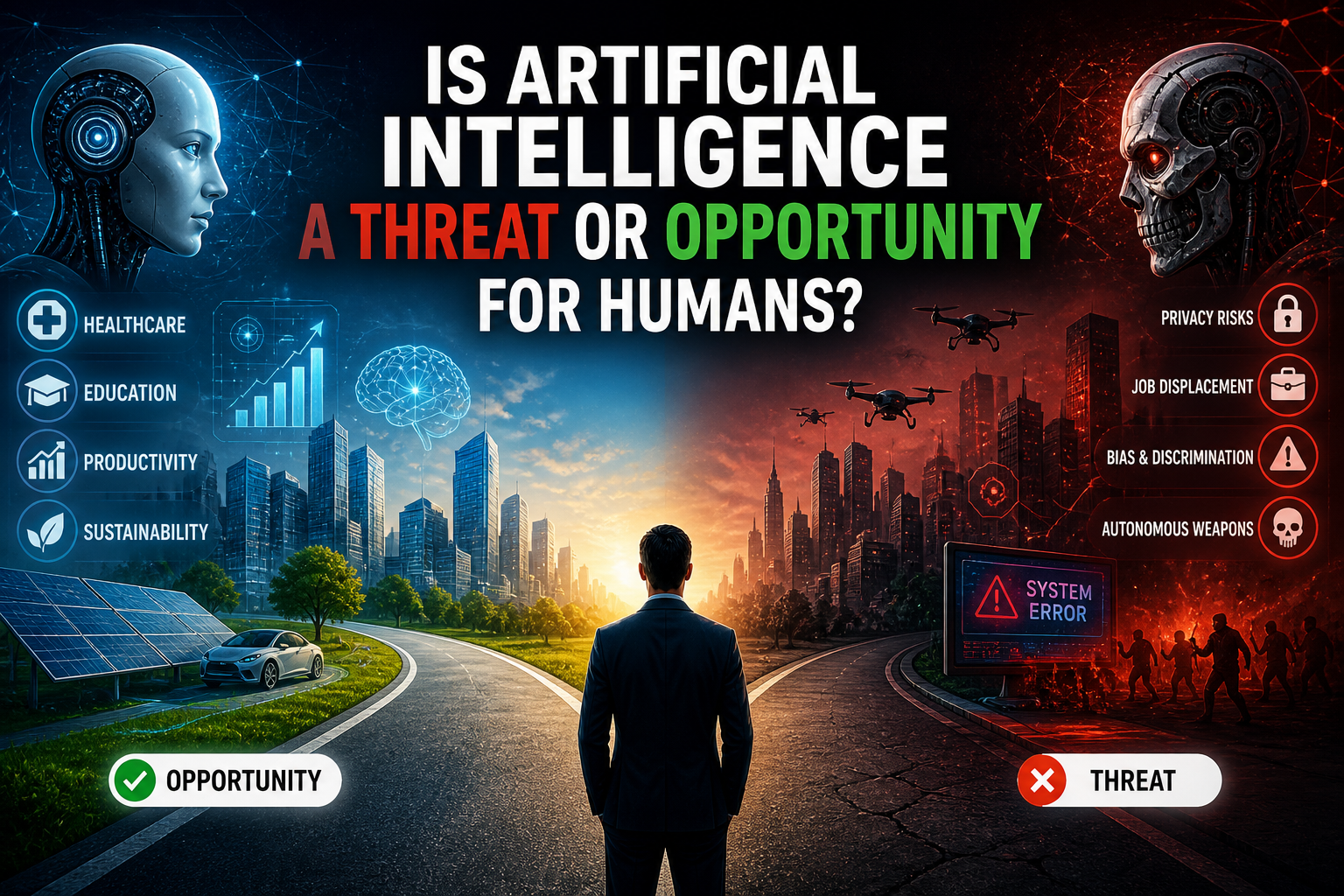
Let’s start with the good stuff—the benefits of artificial intelligence for humans.
What I’ve seen working in real life:
- AI saves time. A LOT of time.
- It handles boring, repetitive tasks better than humans
- It helps businesses scale faster
- In healthcare, it can catch problems early (this one is honestly impressive)
Example? In digital marketing, AI tools can do keyword research, content ideas, even data analysis in minutes. Earlier, this used to take hours or days.
That’s where the real opportunities of artificial intelligence are—speed and scale.
What Often Fails (Dangers of AI)
Now let’s talk about the not-so-good part—the dangers of artificial intelligence.
Here’s what usually goes wrong:
- People rely too much on AI and stop thinking
- AI gives wrong or biased outputs (yes, it happens a lot)
- Privacy issues are real—data is being used everywhere
- Some jobs are definitely getting replaced
And this is where the fear of AI threat to humanity comes in.
But honestly? The bigger problem isn’t AI—it’s how casually people use it without understanding it.
AI Replacing Humans: Let’s Be Honest
This is the most hyped topic—AI replacing humans.
Here’s my take:
AI is not replacing humans completely. But it is replacing lazy work.
Jobs That Are Getting Hit
- Data entry
- Basic support roles
- Repetitive factory jobs
No surprise here. These were predictable.
Jobs That Are Growing
- AI specialists
- Data analysts
- Digital marketers (yes, still strong if you’re smart)
- Automation experts
So yeah, jobs are shifting—not disappearing.
If you upgrade your skills, you’re safe. If you don’t… that’s where problems start.
Artificial Intelligence Impact on Society (What I See)
The artificial intelligence impact on society is mixed. Not black or white.
The Good Side
- Faster services everywhere
- Better healthcare systems
- Smarter tools in daily life
The Bad Side
- Less human interaction
- Some people getting left behind
- Confusing ethical issues
And here’s something people don’t say enough:
AI is making life easier—but also making people a bit more dependent.
That balance is important.
Future of AI and Humans (My Honest Opinion)
The future of AI and humans is not a war. It’s more like a partnership.
AI is good at:
- Speed
- Data
- Patterns
Humans are good at:
- Creativity
- Emotions
- Decision-making
Put them together, and you get better results.
Real Example
In healthcare:
- AI finds the issue
- Doctors decide what to do
That’s how it should work.
How to Actually Benefit from AI (What Works)
If you’re worried about the AI threat to humanity, don’t panic. Adapt.
Here’s what actually works:
Step 1: Learn Just Enough AI
You don’t need to become a tech expert.
Just understand:
- How tools work
- What they can and can’t do
Step 2: Build Human Skills
AI can’t replace:
- Creativity
- Communication
- Critical thinking
Focus here. This is your advantage.
Step 3: Use AI Smartly
Use it to:
- Save time
- Automate boring work
- Improve productivity
Don’t use it blindly. That’s where people mess up.
The Real Problem Nobody Talks About
The biggest dangers of artificial intelligence are not technical.
They’re human.
- Fake content (deepfakes are scary good now)
- Misinformation spreading fast
- People trusting AI without questioning
So honestly, the risk is not AI taking over.
It’s humans using AI irresponsibly.
Final Thought: Threat or Opportunity?
So again—artificial intelligence threat or opportunity?
It’s both. No sugarcoating.
- It’s a threat if you ignore it
- It’s an opportunity if you learn it
My Personal Judgment
AI won’t replace skilled, adaptable people.
But it will replace those who stay stuck.
Simple as that.
Key Takeaways (Simple Version)
- AI is changing everything—fast
- It has clear pros and real risks
- AI replacing humans is partial, not total
- The future of AI and humans is teamwork
- The real danger is misuse, not AI itself
Helpful Sources
- Stanford AI Index – https://aiindex.stanford.edu
- World Economic Forum – https://www.weforum.org
- MIT Technology Review – https://www.technologyreview.com
- McKinsey AI – https://www.mckinsey.com
- Wikipedia AI – https://en.wikipedia.org/wiki/Artificial_intelligence



Leave a Reply